
How Foam and Tape Solutions Enable Energy-Efficient Prefab Construction

Energy is fundamental to nearly every aspect of modern life, and even minor disruptions to the global energy supply can have widespread consequences. The building and construction industry is no exception. In fact, as one of the world’s largest energy consumers, from raw material production and construction to building operation and end of life, its overall energy footprint is considerable.
As a result, the way we design and build structures is evolving. Energy efficiency has become a major driving force, especially in prefabricated construction, where factory-based manufacturing, repeatability, and airtight building envelopes provide clear benefits.
New materials and technologies are gaining ground to meet stricter energy regulations. They reduce reliance on external energy sources and improve indoor comfort. They also enhance building performance.
To examine this shift, we spoke with Eef van Riet, EMEA Business Development Manager Sustainable Construction at Saint‑Gobain® Tape Solutions, about how innovative foam and tape materials contribute to more energy-efficient prefabricated construction.
Join us as we take a closer look at how small, often unseen components can play a decisive role in minimising energy losses, supporting industrialised construction, and improving the quality and longevity of modern buildings.
In this article
- Eef, Why is Prefab Construction Trending in Residential, Commercial and Industrial Construction Today?
- Why is Modern Construction Increasingly Relying on Prefabricated Assemblies?
- What Makes Panel Insulation and Sealing so Critical in Prefab Building Systems?
- How Do Innovative Foam and Tape Solutions Support Industrial Prefab Panel Manufacturing?
- What Differences Do You See Between Continuous and Discontinuous Prefab Panel Production – And How Do Sealing Solutions Adapt?
- How Do Foams and Tapes Contribute to Energy Efficiency Beyond Pure Panel Insulation Values?
- Why Should Prefab Manufacturers “Build On Foam” When Scaling Their Business?
- Where Do You See the Biggest Innovation Potential for Foam and Tape Solutions in Prefab Construction?
- Foam and Tape - The Often Unseen Enablers in Modern Sandwich Panel Constructions
Eef: There are several reasons. It is a highly efficient and cost-saving solution as the assembly time on site is reduced to a minimum and the panels are standardised in production, whilst maintaining a range of aesthetic options.
They are also very strong, lightweight, and durable. They further support sustainability. Prefab construction generates less waste and fewer nitrogen emissions. The panels are suitable for circular construction.
We have seen that prefabricated construction offers many benefits. However, the materials and technologies used depend on the needs of the project. Concrete components, timber, sandwich panels or other prefab solutions each have their specific advantages and requirements. As the prefab landscape is diverse, let us take a closer look at sandwich panel technologies. We will explain why and where they are mainly used. We will also discuss the role of innovative foam and tape solutions in sandwich panel construction.
Eef: Prefab construction benefits greatly from prefabricated elements (systems) for domestic applications (timber) and industrial applications (steel) as they combine speed, cost efficiency, and reliably high performance. Prefabricated panels enable rapid assembly, reduced on-site labour, and reliable quality due to controlled manufacturing conditions.
When installed and sealed properly, these panels offer excellent thermal insulation, high resistance to weather and environmental exposure, acoustic performance, and, depending on the panel design, strong fire resistance. Another main advantage in prefab construction is maintainability: damaged panels can often be replaced or repaired without affecting the entire structure.
Repeatability and series production are vital for manufacturers as they ensure consistent quality, both during production and when assembling on site, as well as smooth processing on the construction site and increased cost efficiency. Furthermore, there is no need for complex and costly sealant or caulk materials on site; the panels can be put together immediately upon arrival.
Eef: In prefab construction, the performance of the building envelope is determined not only by the panels themselves, but by the quality of joints, interfaces, and transitions. Even highly insulating panels can lose efficiency if joints become thermal bridges or points of air leakage.
Foam cores dramatically increase stiffness while minimising material use, and they help structures withstand compression, shear, and bending forces. The right sealing solutions ensure long-term airtightness and watertightness, improving energy efficiency, durability, and overall building value.
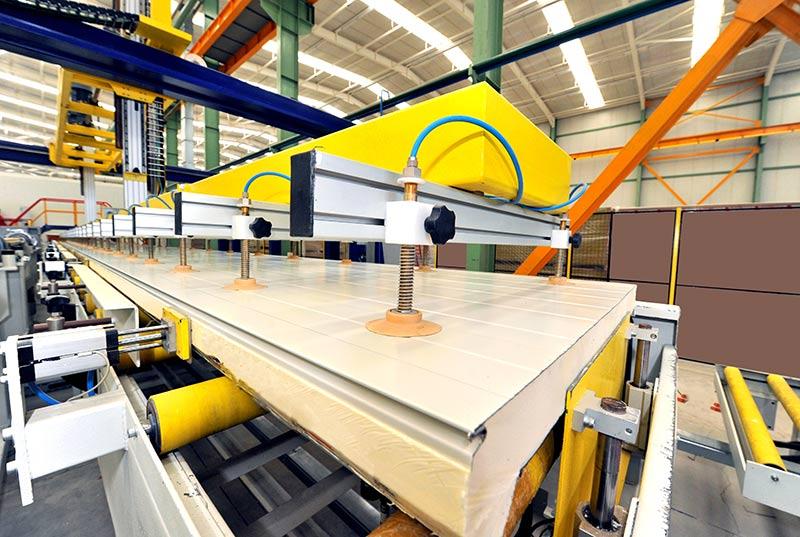
Eef: Innovative foam and tape solutions play a key role in sealing, dampening, and isolating joints in prefabricated panels. Since no two panel designs or production lines are identical, there is no one‑size‑fits‑all solution. Instead, materials must match both the application requirements and the manufacturing process.
In continuous production lines, materials like Dynafoam®, spooled PVC foams with Mylar® liner, and Norseal® Extrusions supplied on long spools support inline application without interrupting production. This enables high throughput, consistent quality, and reliable sealing even under demanding conditions – all essential for industrial prefabrication environments.
A great product for continuous as well as controlled and secure application on sandwich panels has proven to be our PVC with Mylar, when applied in-line from large spools on the production line. The permanent Mylar® liner provides maximum strength and precision during application, yet excellent and much needed low-friction properties during final assembly.
But there are other factors to consider, such as the environmental footprint of materials.
As an unrivalled bio-based polyurethane foam, Norseal AGP200 offers superior sealing performance, perfectly suitable for applications requiring watertightness yet high softness and conformability. It provides extremely low fogging and VOC (Volatile Organic Content) emissions, low odour, and flame resistance in line with FMVSS 302, making it ideal for direct use in interior applications (Sulphur Free formulations) of buildings and for building envelopes that meet the highest environmental standards, as it is not only free from plasticisers but its polyol is largely based on bio-based materials.
Eef: In continuous production, all materials are processed simultaneously, and finished panels are cut to length without stopping the line. This requires sealing solutions that can be applied continuously, precisely, and at high speed.
In discontinuous manufacturing, flexibility is key. Solutions like Norseal BCF or FS1000 intumescent foam offer excellent conformability and sealing performance, making them ideal for complex joints or varying panel geometries. FS1000 also adds value through fire and smoke propagation prevention, which is increasingly relevant for prefab industrial and commercial buildings.
Eef: While panel insulation values are often the first metric discussed, true energy efficiency is achieved through system tightness. Foams and tapes eliminate air leaks, reduce thermal bridges, and guarantee long-term sealing performance even as buildings expand, contract, or age.
Regardless of panel design or construction method, the correct materials greatly enhance airtightness, durability, and building quality, and can reduce both production and maintenance costs throughout the building’s lifetime.
If a seal does not properly close the panel gaps, over time the lack of airtightness (leakage, thermal bridging) will have a dramatic effect on energy losses, potentially resulting in increases of up to double-digit percentages.
Eef: Prefab construction is a growing market driven by demands for energy efficiency, speed, and cost control. Soft, conformable foams open up new design and manufacturing opportunities by compensating tolerances and ensuring consistent sealing at scale.
Focusing on these “small components” can have a significant impact on the performance, reliability, and reputation of prefab building systems, especially when manufacturers aim to expand without compromising on quality.
Eef: Innovative foam and tape products offer great potential for prefab construction in many ways. As the prefab landscape is very diverse and there are many different regional rules and regulations, let’s focus on some of the major topics within this industry where tapes can make a real difference.
For example, automation will become more important in this market. Panel and raw material manufacturers are looking for ways to improve efficiency. They may use robotics and smart solutions. Innovative tape materials can help protect surfaces with low-friction and highly durable mechanical, chemical and thermal resistant materials in robotic applications. Specialised tapes such as UHMW help reduce maintenance demands and manual work, which cuts costs and enhances throughput.
Another important area with immense potential for innovation is fire protection. Making a structure airtight not only supports energy conservation, but is also crucial for fire safety. Innovative foam materials can improve compartmentation and increase fire resistance. Norseal FS1000 is an excellent example of multifunctional, innovative materials with ideal sealing properties against moisture and air ingress, but which also forms a fire-blocking char that significantly improves fire resistance if applied between panels.
As mentioned earlier, sustainability is definitely one of the most important areas for innovation in foams and tapes for prefab construction. Airtight building envelopes for temperature and airflow control are perhaps the best-known application of foam and tape materials in construction. While energy preservation supports sustainability, we are constantly working towards products that provide specific added value in this field. Taking our Norseal 2720 PVC as an example, these features include:
- 100% biobased plasticiser
- Low phthalate concentration
- 57% biobased carbon content as per ASTM D8866-21 Method B (AMS)
- Meets Nordic Swan Ecolabel, fulfilling or exceeding regulatory requirements and industry standards for environmental performance and safety
We are also working on PFAS-free* solutions so we can provide a strong portfolio of high-performance products for demanding construction applications that combine excellent performance with a reduced environmental footprint, helping achieve demanding sustainability targets.
These are just three areas where I see significant innovation potential, but there are many more. This shows that construction – and prefabricated construction in particular – can benefit greatly from new foam and tape developments.
Thank you, Eef, for these insights into the materials that enable new sandwich panel construction to become even more efficient. As we have seen, prefab construction offers great potential to sustainably change the way we build in the future. As the best buildings are yet to be made, contact your tape expert and find out how your project can take the lead with innovative tape materials.
Our PFAS-free* designation means we do not intentionally add PFAS to our formulations during the manufacturing of the product. However, due to certain factors, trace amounts may be present as unintended impurities in the raw materials that we receive from our suppliers. The asterisk (*) reflects our commitment to transparency and scientific integrity, rather than making absolute claims that cannot be guaranteed or verified.