

Maximising Rail Passenger Safety and Comfort with Advanced Tape Solutions
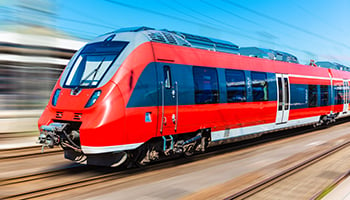
It may come as a surprise to learn that, as a means of transport, passenger rail is on the rise. New commuter rail projects or expansions are scheduled to begin service in Atlanta, Baltimore, Boston, Washington D.C., Minneapolis and Los Angeles. The European Union experienced a 3.4% increase in year-on-year train passengers in 2019. Additionally, tourists are increasingly opting for scenic, luxury train routes — where the train serves as both the destination and the mode of transport — as an alternative holiday option.
This is at least partly due to travellers’ interest in reducing their carbon footprint. Thanks to its reliance on fewer fossil fuels and the resulting lower levels of pollution, rail transport is more environmentally friendly. Europe has even witnessed the recent growth of a “flygskam” (translation: flight shame) movement, which originated in Sweden and encourages choosing trains over planes whenever possible.
At the same time, high urbanisation rates in regions such as Latin America have driven the revitalisation of urban rail infrastructure. China already boasts a high-speed rail network that is by far the longest and most extensively used in the world; the Asia/Pacific region is home to the majority of recently added track. Even in the United States, which has historically leaned towards a preference for car travel, there is reason for optimism, as unsustainable congestion in the skies and on the roads has led to a search for alternative routes.
A common factor in choosing rail is often the overall travel experience, including safety and comfort. Addressing these factors presents a challenge for railway car manufacturers, but also an opportunity: improving the travel experience could increase the number of rail passengers, benefiting both manufacturers and passengers. One highly effective way to enhance safety, comfort and the overall rail travel experience is to integrate advanced tape solutions into the construction of railway cars and components. As a materials solution provider, we have some recommendations.
Railway Material Safety and Standards
Safety is of utmost importance in any industry. While rail is an incredibly safe mode of travel, the occasional accident tends to receive greater media attention than the more frequent car crashes. Trains, after all, carry significantly more passengers. Making railway cars safer benefits not only passengers but also the industry’s overall reputation as a preferred mode of travel.
As in the aerospace industry, one critical safety consideration for passenger rail is flame retardancy. Saint-Gobain® Norseal® Foam and Sponge Products are used in transport applications to form protective gasket seals against intrusion from elements such as air and moisture; they are also used to protect against fire and smoke. The flame-retardancy ratings of the materials selected for rail-related construction are key parameters to consider, as they can mean the difference between a minor emergency and a major disaster.
Such ratings are based on testing against various standards, which vary by region. Examples include ASTM E162, which measures flame spread; ASTM E662, which measures smoke density; and ASTM C1166, which specifically examines flame propagation in elastomeric gaskets. The Bombardier SMP 800-C test measures toxic gas released during the combustion of certain materials commonly used in vehicle construction. EN 45545-2 is a European standard that also provides a fire resistance classification.
The ignition of silicones with relatively lenient ratings can create a dangerous “flaming gasket” situation, with the potential to spread fire to other areas of the vehicle. Advanced tape solutions, such as the Norseal Silicone Product Line, by contrast, provide low outgassing and high flame retardancy. This results in low-toxicity, cleaner white smoke when ignited, as well as a reduced potential for spreading flames.
Another safety measure to consider is the sealing of electronics, including those found in lighting, access panels and other enclosures. Relevant ratings include those based on UL 94, a standard used to test the flammability of plastic parts in devices and appliances, and UL 50E, which specifically addresses electrical equipment enclosures. This is another application for our Norseal Silicone Products.
Silicone Foams for Rail Comfort
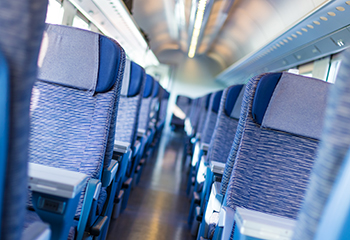
Comfort is a less tangible quality than safety; there are no published standards to measure the level of enjoyment a passenger experiences while on board a vehicle. However, an article in the journal Transportation Research Interdisciplinary Perspectives (TRIP) provides valuable insights for the rail industry, noting that “bus and train riders experience the most negative emotions compared to other transport modes such as private cars, walking and cycling.” The authors suggest that improving comfort and convenience could be a cost-effective way to boost ridership.
Foam solutions can enhance comfort in various areas of a railway car cabin, with applications including windows, HVAC seals and intake gaskets. As mentioned earlier, foam and sponge tapes are used to form gasket seals that provide a protective barrier against a variety of external elements, including air, dust and light; ultraviolet rays and ozone gas; and all types of moisture, including rain, sleet, snow and frost. Capable of withstanding wide temperature ranges, they can also serve as thermal insulation.
Additionally, tape solutions can be used for internal door seals and other applications to provide acoustic insulation, contributing to the quiet comfort of a cabin through noise damping or soundproofing. Floor panels and seating cushioned by tape can also help reduce vibration and maximise seat comfort.
Norseal Silicone Products
It is no exaggeration to say that we have a product for every conceivable application — and if a novel application arises, our experts can engineer a custom solution. The Norseal Product Line is already well-suited to meet the safety, comfort and travel experience needs of rail passengers.
F-12/F-20
Norseal F-12 and Norseal F-20 Silicone Foam Products offer excellent flame resistance, low toxicity and smoke generation, meeting the highest EN 45545-2 hazard classification (HL3). Both types can withstand a wide temperature range (-51°C / -60°F to 204°C / 440°F) and offer an excellent compression set value, meaning that a low percentage of permanent deformation occurs under pressure (5% for F-12, <5% for F-20).
One difference between the two types is evident in cell structure and density properties. F-12 provides a low-density (192 kg/m3) modified cell structure, making it lightweight and easy to process. Used as a fire-blocking foam for gaskets, seals and cushioning, it can also be laminated to seat cover fabrics and carpeting to serve as a flame-resistant backing. Its weight savings are so significant that it is used in aircraft and aerospace applications for increased fuel efficiency.
F-20 offers a medium-density (320 kg/m3) closed cell structure and is used for flame-retardant performance in gasketing, insulation and dampening applications. It offers excellent resistance to environmental conditions, with a dual-sided smooth surface that provides sealing against air, dust, light and moisture.
Applications for both types include window gaskets, door nosing, inter-car diaphragms, lighting seals and access panel seals. We can also apply a film-supported adhesive to either type, creating a pressure-sensitive adhesive form that aids in gasket placement. In this scenario, the F-12 becomes SNS 512AF, and the F-20 becomes SNS 520AF.
R10400/R10460
Norseal R10400 and Norseal R10460 flame-retardant silicone sponge rubber products offer very good flame resistance, low toxicity and smoke generation, meeting EN 45545-2 classification HL2. Both types can withstand an extreme temperature range (-73°C / -99°F to 260°C / 500°F) and offer excellent mechanical properties; respective compression set values are 10% (R10400) and 5% (R10460).
Both are closed cell structure tapes, with respective densities of 560 kg/m3 (R10400) and 470 kg/m3 (R10460). Flexible and compressible, they offer excellent weatherability and non-stick properties. Applications for both types include seat frame coverings, thermal/acoustic insulation and HVAC seals.
One difference between the two types is their silicone rubber chemistry. R10400 utilises high consistency silicone rubber (HCR) chemistry with flame-retardancy meeting UL 94-V0, giving it superior mechanical strength properties over other silicone rubber systems — improved tear strength, tensile strength and abrasion resistance. R10460 is a medium-grade silicone sponge with flame-retardancy meeting UL 94 HBF that can be used in most gasketing applications.
FS1000 Series
The Norseal FS1000 Series is a fire-blocking polyurethane foam tape designed to be airtight, watertight and thermally insulating. It offers the unique property of intumescence: when exposed to heat greater than 200°C / 392°F, it expands to a fire-resistant char, sealing gaps and blocking fire, smoke and hot gases. Meeting EN 45545-2 classification HL2, it can withstand a modest temperature range (-40°C / -40°F to 100°C / 212°F). Compression set value is 5%; density is 240 kg/m3.
Soft and highly conformable to uneven surfaces, the tape can be compressed with minimal force to create air and water seals. Its resilience also provides vibration damping properties. It is used in multiple industries for its protective abilities, including aerospace (seats, freight compartments), automotive (fuel tanks, battery packs) and construction (building joints, HVAC).
Common Norseal features
All Norseal Silicone Products are suitable for both internal and external seals, with compression set values that ensure shape recovery after extended compression; this creates long-lasting seals that reduce maintenance costs. This is particularly relevant in the rail industry, sealing sensitive components and absorbing vibration from travel on the rails and from the frequent cycling of railway car doors.
While the advanced, high-performance nature of the Norseal Silicone Products represents a premium solution, it also translates to a high durability and lifespan of over 10 years, allowing manufacturers to achieve cost savings over the product’s lifecycle.
Available form factors include dry-back gasketing or pressure-sensitive/strip-n-stick (SNS) tapes for instant gasketing. Sealing capabilities can also be adjusted by modifying surface qualities.
On the Right Track
When it comes to addressing current opportunities and challenges, there is more than one possible track for railway manufacturers to follow. The advanced tape solutions outlined here offer value that becomes increasingly apparent over time; while initial costs could be reduced by compromising on material quality, this would create obstacles on the path to achieving both comfort and safety. We are committed to taking the long-term view towards building a sustainable future for the promising world of passenger rail.
Contact us to learn how you can benefit from our solutions for railway applications.


