
Fueling Future Energy Strategies with Norgard® Material Components

Hydrogen is one of the most abundant elements in the universe, which can be harnessed to produce energy with water as the only by-product. Harnessing and extending the power of hydrogen to various sectors such as transport, industry, and power generation can be vital for reducing carbon emissions.
Both hydrogen electrolysers and fuel cells are rapidly emerging as critical sources of sustainable energy, promising to form a foundation in this new era of energy usage.
Integral to various applications across all hydrogen value chains are Norgard Specialty Products and components. These products can be used in tight-tolerance, media-resistant fuel cells as well as electrolyser gaskets and seals. They also ensure optimal performance in demanding environments by offering effective release solutions for decal processes.
In this article, we’ve partnered with Eliot Hield-Ryder, Business Development Manager at Saint-Gobain® Tape Solutions, to discuss two ways that small parts like Norgard Specialty Films can aid in the creation and use of green hydrogen.
Let’s start with the basics: What is green hydrogen?
Green hydrogen is a type of hydrogen produced in a climate-neutral manner. Water is split into both hydrogen and oxygen through the use of renewable electricity and electrolysis. According to the global Green Hydrogen standard, the definition is “hydrogen produced through the electrolysis of water with 100% or near 100% renewable energy with close to zero greenhouse gas emissions.”
The bottom line is that we are striving for more green hydrogen, which will result in significantly lower emissions of greenhouse gases than alternatives such as blue hydrogen, grey hydrogen, or turquoise hydrogen, which still rely on natural gas as the energy source.
What are the techniques for extracting green hydrogen?
One pathway to produce hydrogen is through electrolysis. In this process, a high voltage and electric current split water into hydrogen and oxygen.
Electrolysis takes place in a unit called an electrolyser, which consists of an anode and cathode separated by an electrolyte. There are different types of electrolysers which can function in different ways due to the varying type of electrolyte materials. However, for the purpose of this blog, I want to focus on polymer electrolyte membrane electrolysers (PEM).
PEM electrolysers function by utilising a solid speciality plastic material as the electrolyte. What generally happens is:
- Positively charged hydrogen ions are formed when water reacts at the anode to create oxygen.
- The hydrogen ions move across the PEM to the cathode by flowing through an external circuit.
- Once the cathode is reached, the hydrogen ions are combined with electrons from the external circuit to create hydrogen gas.
Now, while electrolysers convert electrical energy into molecules, PEM fuel cells are electrochemical cells that create electricity by converting chemical energy. The main function of fuel cells is to use hydrogen to produce heat and electricity more efficiently than traditional methodologies such as power generators.
What can SG offer in terms of assisting in production of catalyst-coated membranes (CCM)?
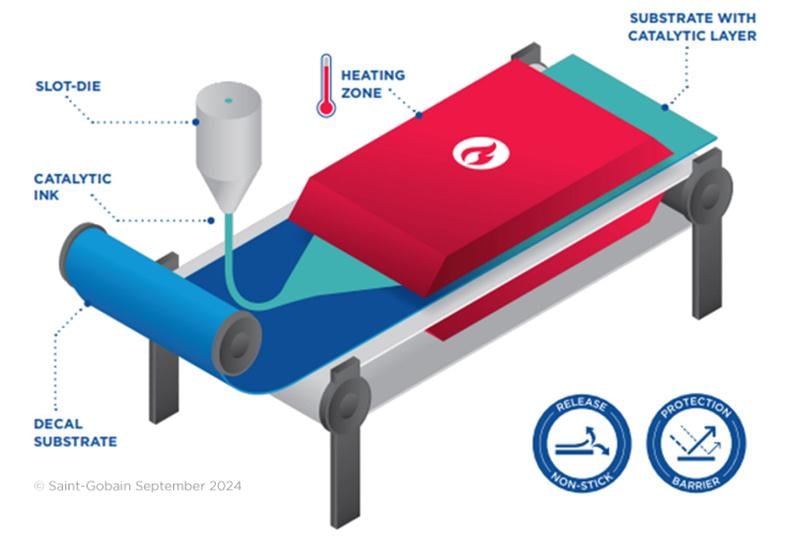
Norgard Films are used as release and protective solutions. As processing belts and release sheets for thermal curing and lamination processes, Norgard Films can provide very flat, smooth and mechanically stable substrate surfaces upon which the catalytic ink can be evenly distributed in a controlled manner.
ETFE could be utilised within this process. It has excellent high-temperature thermal stability and, due to its hysteresis behaviour, it is suitable for most decal processes. At the end of the production of the catalyst-coated membrane by the decal transfer method, the substrates can be easily removed to allow for 100% transfer of the catalytic layer.
Products such as ETFE or E124 are proven, reliable products, with smooth uniform surface and durable release for decal substrates.
This film is a processing aid to create the catalyst-coated membranes that are later put into the fuel cells in stackable layers.
How can these products help increase the Catalyst Coated Membrane (CCM) output?
Our solutions have helped customers achieve up to a threefold increase in the output of CCM per roll, and our film has been used as the carrier belt for the CCM wind-up. Norgard Films possess exceptional tensile strength and release surfaces that can be optimised, enabling customers to optimise the ratio of the carrier to CCM on the roll by significantly reducing thickness.
Why is having a homogeneous surface important for the production of catalyst-coated membranes?
When catalyst-coated membranes are produced, they are manufactured to the exact dimensions specified by the customer. If there are surface inconsistencies, the customer may notice variations in the thickness of the catalyst-coated membrane, resulting in changes and inconsistencies in efficiency.
Please explain how Norgard Materials are utilised in the production of membrane exchange assemblies (MEA)?
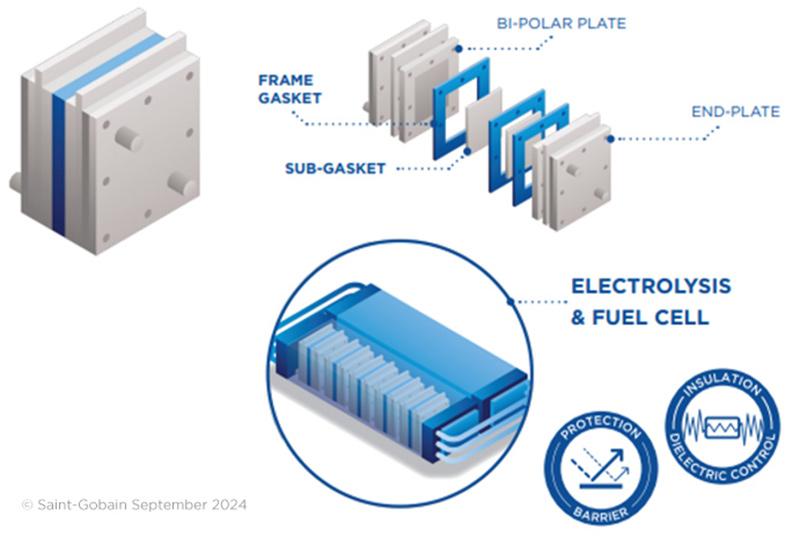
Our Norgard Materials can be utilised within PEM electrolysers or PEM fuel cells as gaskets or subgaskets within the MEA. Products such as high-quality skived PTFE film are often a go-to for flat gasket applications.
When we look at the actual fuel cells and electrolysers, could you explain how, where and why Norgard Products have a significant impact?
Due to features like excellent dielectric properties, chemical resistance, configurability, high temperature resistance, and low shrinkage/hysteresis, Norgard Products, as I mentioned, are ideal for utilisation as gaskets and seals.
Norgard Products can perform exceptionally well in challenging conditions and accommodate peak excursions of up to 570°F/ 300°C, frequent flexing, elevated pressures and multiple chemical exposures. Additionally, their fire resistance is vital to providing a protection barrier within the fuel cell and electrolyser systems.
A typical fuel cell stack is made up of about 50–200 MEA layers. Our skived PTFE materials are applied as gaskets to each MEA within the fuel stack. These gaskets help to protect the internal components of the fuel cell.
Fuel cell stack efficiency is ensured because these products aid in preventing gas leakage and maintaining system safety as well as energy efficiency. Norgard Films provide consistency and repeatability within the fuel cell system, preventing tolerance stack up and discrepancies.
Norgard Film Gaskets have low risk of failure due to chemical and environmental resistance, thermal stability, mechanical strength, durable sealing and low permeability.
Where are fuel cells utilised the most?
In terms of applications, hydrogen fuel cells are utilised in both stationary and mobile applications. Hydrogen technology can power warehouse logistics, act as a primary power source for data centres, commercial, residential or industrial buildings, or fuel transportation such as buses, trains, planes, boats/submarines and personal vehicles.
As the hydrogen fuel cell industry continues to evolve, it is vital to select the right materials. Norgard Films can play a crucial role in helping to advance the development and progress of this sustainable energy technology.
Norgard Products have high mechanical strength, a smooth surface, and outstanding dielectric properties and release behaviour, even at elevated temperatures and exposure to aggressive chemicals. Connect with our teams today to learn more about product customisation and gain first-hand access to our global technical expertise and manufacturing capabilities.