
Cobots, Robots, Automation – Improve Assembly, Process and Costs

Industry 4.0, automation and robotic applications have transformed manufacturing in numerous ways and industries. Although traditional craftsmanship is being revived in many areas, automation is spreading across industries and countries due to the various advantages robotic applications offer.
Metal, plastic, energy, software, data — and sometimes Terminator™ — are often among the first things that come to mind when thinking about robots and automated assembly. Tapes are not usually among the first associations and may not be as exciting as action films, but that could change as we explore how supplying robots with specialised tapes and materials can help boost productivity and quality.
Below, an illustration of an automated foam application by a robot. Source: www.robotape.com.
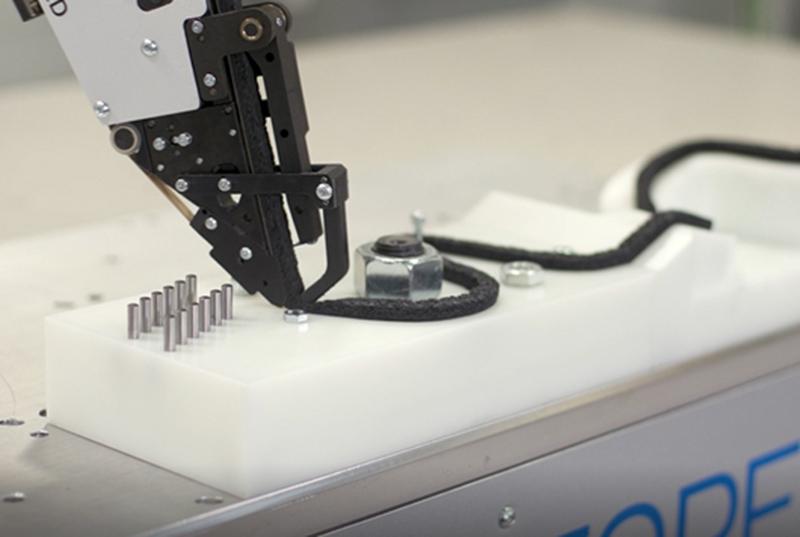
The first industrial robot, the Unimate, was introduced in 1961 by the American engineers George Devol and Joseph Engelberger. It was designed to perform repetitive tasks in a factory setting to lift and move hot pieces of metal from one area to another. This breakthrough in automation has revolutionised the manufacturing industry by allowing machines to perform tasks previously done by humans. This has led to continuous production opportunities around the clock and therefore increased productivity, reduced labour costs, and improved accuracy, precision and product quality with reduced risk of error.
Even more important than efficiency increases, robots and cobots can ease human workers’ lives or enhance safety in carrying out tasks that are too dangerous or difficult for humans to perform, such as working with heavy loads, hazardous materials or under extreme conditions.
There are two main types of machines in industrial automation that are mainly differentiated by their intended use and level of human interaction:
- Robots usually operate without direct human supervision to carry out highly repetitive or dangerous tasks with high speed and precision, especially in mass production. They are commonly used in assembly lines like the automotive industry and are specially designed for a limited number of tasks with limited options to be adapted to change.
- Cobots, or collaborative robots, are typically smaller, more flexible, and easier to programme than traditional robots, making them ideal for working alongside humans on small-batch manufacturing. They are also a first choice where more frequently changing tasks, short programming time and flexibility are required.
Let us now turn the spotlight to the adhesive tapes mentioned at the beginning, which, as highly specific components, play decisive roles in automated production processes and can offer tangible competitive advantages.
Robots don’t eat; therefore, they don’t need to be fed. Really? Well, robots also need to be fed. Maybe not with food but with energy and — to be able to fulfil their tasks — oftentimes with tapes or other materials they need for assembly.
By far not every adhesive tape is suitable for robotic applications or automated assembly processes. But those that are add significant value, as we will see in three examples from Saint-Gobain® Tape Solutions.
Norseal® Extruded Foam Profiles have long lengths in a continuous format that lends itself to automation. These profiles have been used to make gaskets for sandwich panels, and they are also used in other industries where they seal the interfaces of walk-in refrigerators and appliances. Because the format is continuous, there is no need to stop the robot or machinery until after an exceptionally long running time. This continuous length enables faster machine speed, less stoppage time, and improved quality due to fewer spliced sections. Many profiles are available as a round gasket, but other shapes can be made as well.
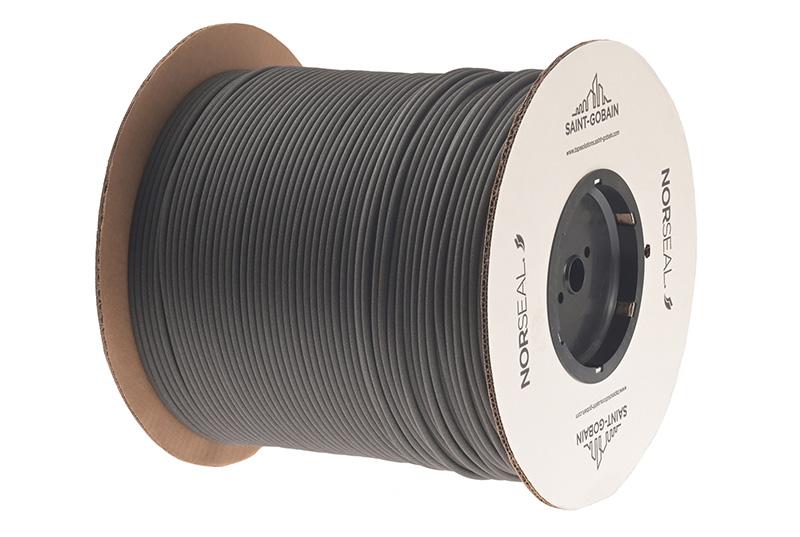
In many automotive exterior bonding applications, acrylic tapes such as Norbond Z3000, Norbond Z2000 and many others are converted to spools with secondary release liners and are used extensively in automotive exterior trim component bonding, such as body side mouldings or pillars. Unwound from spools and applied in fixed or flexible automation, tapes can significantly facilitate automotive and electric vehicle manufacturing. Double-sided acrylic foam tapes in a spool format can be applied using a tape application head operated by a robot. These robots can repeatedly apply pressure-sensitive tapes to curved surfaces with much greater efficiency than applying them by hand. It is possible to pre-qualify a tape with a robot to test that the robot applies the tape properly and that the tape feeds through the head efficiently.
Although not a tape, Dynafoam® Foam-in-Place (FIP) polyurethane foam has been developed to seal out water, air or dust as well as decouple noise vibrations. Thanks to its engineered viscosity and its mechanical foaming, Dynafoam exhibits excellent thixotropic behaviour, allowing three-dimensional and upside-down automated application. For industries such as automotive and construction, seamless and continuous application to complex shapes makes it ideal for door and other automotive gasketing applications, as well as sealing sandwich panels in prefab construction to ensure consistent quality, performance and save time and labour costs through automated application.
For robots being used for inventory management, process flow and other applications, UHMW tapes are an interesting topic for many companies. PTFE, UHMW and silicone rubber products are ideal for applications requiring durability, long life and contamination-free wear surfaces.
Below, another depiction of an automated foam application by a robot. Source: www.robotape.com.
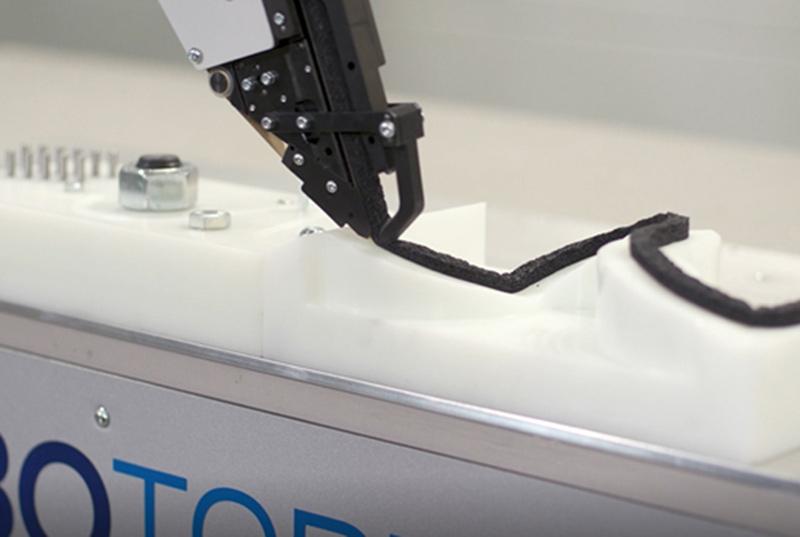
While the above-mentioned Terminator was a robot sent from the future to save the planet, the industrial robots we are discussing here are real-life helpers in the present day. However, they too can contribute to saving the planet, albeit in a very different way from the one depicted in action films.
“I’ll be back!” is one of the most famous quotes from robot action films. In addition to offering companies more efficient and profitable production methods, robots have more recently “returned” to assist in improving sustainability efforts by reducing waste, enhancing product performance, and even planting trees or working with artificial intelligence (AI) to make recycling easier and more efficient. The shift towards greater automation in production is well underway, and if you’d like to see how your business can benefit from this trend, find out which tapes and materials are best suited to feed to your robots and bring your business to life.