

Innovative Compression Pads for Maximum EV Battery Cell Performance
The electric vehicle (EV) surge continues unabated, with no signs of slowing down. According to the Edison Electric Institute, the number of EVs on UK roads is projected to reach 18.7 million by 2030, up from one million at the end of 2018. Furthermore, the UK Department for Energy Security and Net Zero reported that in 2008 there were fewer than 500 EV charging stations in the UK; by 2019, this number had risen to over 20,000 with more than 68,800 connectors.
This rise in EVs will lead to growing demand for batteries, with recent forecasts projecting a 20% compound annual growth rate to a £12 billion market by 2026, according to IDTechEx.
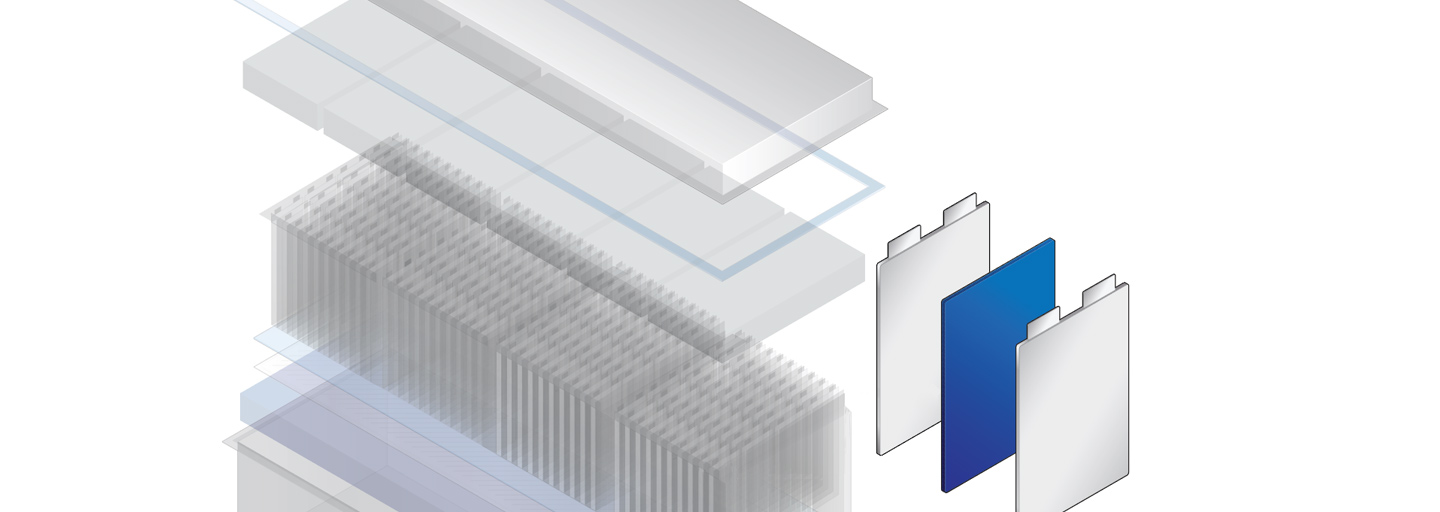
There is a caveat, however. The promise of efficient, long-range EVs will only be realised through improvements in battery technology — specifically, batteries that charge faster and last longer. While much of this depends on the choice of battery chemistry and advances in it, there is still significant progress to be made in the selection of material components used in the battery.
EV Battery Cell Types
Battery cells are the most basic units that store energy for hybrid vehicles and EVs. There are three types of battery cells that can be used in EVs: cylindrical, prismatic and pouch. Each battery cell has an anode and a cathode that are separated from each other, but the implementation differs in each cell type.
Cylindrical cells are the least expensive to produce per kilowatt-hour (kWh) of energy storage. However, due to their circular cross-section, they do not pack as efficiently as other cells, making cylindrical packs larger and heavier than other cell types.
Prismatic cells make optimal use of space due to their rectangular shape and layered approach. Apart from their application in mobile phones, tablets and laptops, prismatic cells are also available in large formats that can be used for electric powertrains in hybrid vehicles and EVs. In operation, some swelling is normal, and growth allowance must be made.
Pouch cells are the smallest and lightest cell technology. The soft-bodied pouch style is becoming popular because of its highly efficient packaging. A pouch cell can achieve 90% to 95% packaging efficiency, the highest among battery packs. In operation, pouch cells exhibit swelling that is typically higher than what is seen in a prismatic cell. In both cases, this swelling should be managed as discussed below.
Whether a battery uses a single pouch (or prismatic) cell or several cells in a series, optimal pressure on all cells must be maintained to ensure minimal capacity fade. To achieve this, battery compression pads are typically used.
Battery Cell Contraction and Expansion
In most commonly adopted battery chemistries for EVs, two types of physical dimension changes occur in the battery due to the electrochemical reaction taking place in the batteries. The first is the expansion and contraction during charging and discharging, causing changes in the cell thickness cyclically. These changes are, for the most part, reversible. The second change is the cell thickness increase from BoL (beginning of life) to EoL (end of life). This change is typically not reversible. This irreversible thickness increase of the cell is gradual and occurs over repetitive charge and discharge cycles.
When considering the first dimensional change, which is reversible, studies have shown that applying an optimal amount of restriction allows cells to retain their capacity for a longer time. If the cells are restricted more than optimal, the capacity fades faster, and it can also compromise the stability of the cells, leading to unsafe conditions such as thermal runaway. On the other hand, too little pressure can allow the cells to expand freely in one direction, which could result in the cells losing electrical connections or contact with the cooling plate (for thermal management). Therefore, an optimal pressure is required for the cells to retain their capacity for longer (Cannarella & Arnold, 2014). This optimal pressure can be achieved by using the appropriate elastomeric pad (or compression pad) between the cells, which has the resilience to accommodate the compression and expansion of the cells over a long period of time.
Thermal management refers to the ability to control the temperature of a battery array. Batteries tend to heat up quickly when operating at full capacity or during fast charging. The main goal of battery pack thermal management is to reduce uneven temperature distribution, or, in other words, to maintain the temperature within the battery pack within a narrow range (usually between 3°C and 4°C in ambient conditions ranging from -35°C to 50°C).
There are two different approaches to managing the heat generated inside a battery pack. One is to evacuate the heat, which can be complex as it involves a cooling system with a cooling plate and cooling fluids (circulating a glycol-based fluid through the cooling plate). The second option is to insulate each battery component from the others using a thermal material, usually an elastomeric foam with intrinsic heat resistance properties.
EV Battery Compression Pads
Compression pads are responsible for maintaining pressure on the face of a pouch cell (and in some cases, a prismatic cell). If the elastomeric compression pad demonstrates poor resilience or poor recovery, this can cause the cells to expand freely to some extent, leading to their capacity fading quickly, as discussed earlier. Additionally, they insulate the cells from each other, ensuring that heat flows primarily to the cooling plate through the thermal interface material, promoting a uniform temperature across the cell stack.
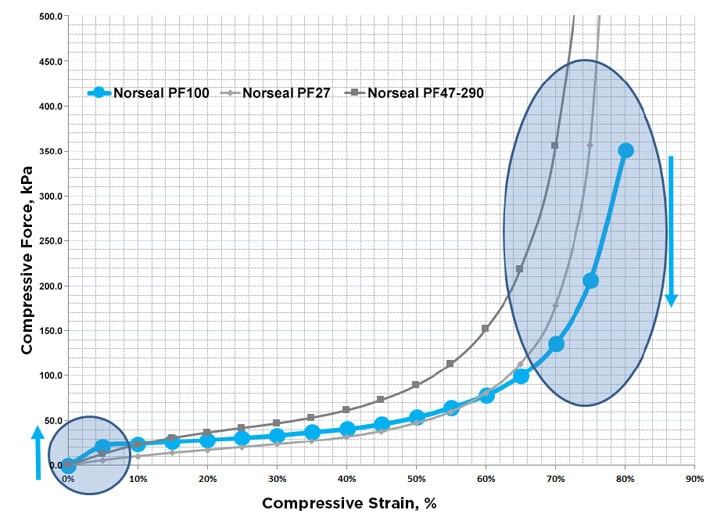
Saint-Gobain battery pack compression pad options include silicone and micro-cellular polyurethane foams. The foam’s spring-like characteristics provide consistent deflection force over a wide range of compression and temperature — a property called compression force deflection (CFD). This is the stress at any particular strain, taking into account the stress relaxation within the material. This is the actual stress that would come into play while the cell is expanding during the charging cycle. This cell expansion is slow enough that the foam material will already have time to relax. Additionally, as the cell ages, its thickness increases as previously demonstrated. This results in a continuous and gradual increase in the nominal stress on the pad. Consequently, the pad should not exert excessive stress on the cell, as this can be detrimental to the cell’s performance, as previously noted. Therefore, it is important for the pad behaviour to exhibit a narrow range of stress over a wide range of strain so that ‘optimal’ pressure is consistently exerted on the cell over many charge and discharge cycles. The importance of the CFD curve in selecting a compression pad for higher performance and longer battery life should not be underestimated. The foam should also be highly resistant to permanent deformation (compression set) when subjected to extreme pressure or compression loads, as well as electrically insulating to minimise and prevent arcing within modules.
Saint-Gobain Norseal PF Series Compression Pads provide more than just compliance to swelling cells; they also provide mechanical support by minimising the relative motion between the cells in case of shock or vibration, thereby helping to maintain the integrity of the pack. As automation becomes more prevalent, minimising the number of steps and parts in the manufacturing process becomes crucial. PF Series Compression Pads were developed to have an inherent tackiness, eliminating the need for adhesive or glue to hold the pads to individual cells during assembly, making the process easier to automate. To accommodate other types of automation processes, the level of ‘tackiness’ in the pads can be modified. Overall, these pads feature a customisable range of densities, thicknesses and tackiness.
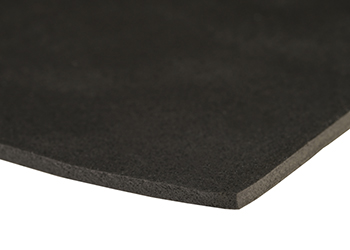
Norseal PF Series Compression Pads (Figure 2), including the PF27, PF47 and PF100 Series products, provide the widest range of thicknesses in the industry, even at densities of 140 kg/cm3. Density is one of the keys to minimising the overall weight of the module, pack and the vehicle itself. The Norseal PF Series’ flexibility, which is available in different densities and thicknesses, enables it to be adaptable to different cell chemistries and pack configurations.
Norseal PF27 is available in thicknesses as low as 1 mm, which aids in achieving higher energy density in a pack. Norseal PF20 Series also meets flame performance per ASTM D4986 (equivalent to UL94 HBF). Importantly, the properties and resulting function of the foam are very consistent over time and across a range of environmental conditions.
Like the PF27, the Norseal PF47 is also a line of micro-cellular polyurethane foams specifically developed for the efficient functioning of batteries in a pack, but the PF40 is available in thicknesses of greater than or equal to 2 mm.
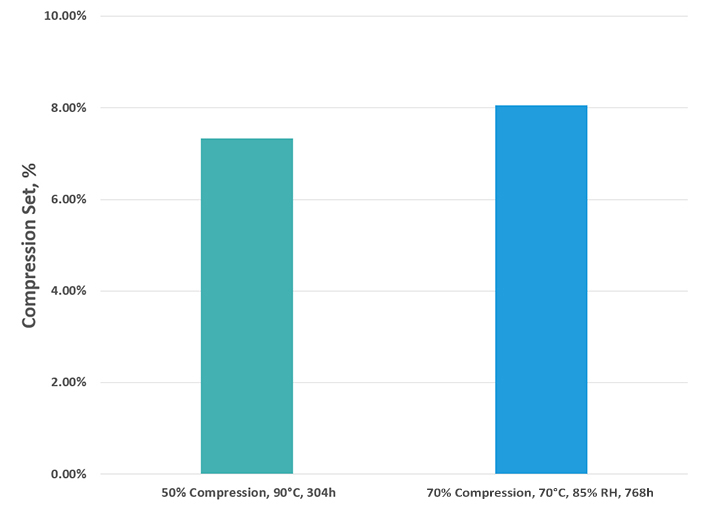
The recently developed Norseal PF100 Series features premium micro-cellular polyurethane foam that provides the widest and flattest compression range of the PF Series portfolio, a critical performance measurement commonly required by today’s battery pack designers. The PF100 Series exhibits outstanding, industry-leading “aged” compression set resistance at elevated temperatures (up to 90°C) and humidity conditions, essential for extending the life of the battery pack. PF100 Series performance is delivered in the lowest thickness/density combination in the industry, allowing design engineers to maximise energy density and space while minimising overall weight.
These properties and resulting functions of the foam are consistent over time and across a range of environmental conditions, ensuring a long life for the pack. As previously noted, the key to performance is seen in the CFD curve (Figure 3). Figure 4 highlights the excellent compression set resistance exhibited by PF100 Series Compression Pads even at elevated temperatures, for example, 90°C and high humidity conditions like 85% RH.
Additionally, Norseal F-12 and F-20 Compression Pads are soft, lightweight silicone foams that provide excellent flame resistance with low toxicity and smoke generation, meeting the highest flame rating of UL94 V-0. Norseal F-12 has a modified cell structure and low density, while Norseal F-20 has a finer closed cell structure with a medium density.
Conclusion
The promise of efficient, low-cost and long-range EVs will only be realised through improvements in battery manufacturing technology. Modern foam materials, such as the Norseal PF Series, offer consistency and reliability over wide temperature ranges, are designed with automation in the manufacturing and placement processes in mind, and provide low weight while improving battery robustness. Their use will be key to the growth of EVs.
Discover more information on what materials and products to consider for EV battery thermal management or contact us today to discuss the specifics of your application needs.


