

Improve Composite Moulding Efficiency with Tapes

Moulds are used extensively to lay-up large-scale composite structures, such as wings, fuselages, propellers, antennas, wind turbine blades, boat hulls and vehicles (Figure 1). These moulds are then placed into autoclaves, which subject the composite lay-ups to elevated temperatures and pressures until they are cured, after which the moulds are taken apart and the finished composite parts are removed.
In the past, these applications would have needed to be assembled using screws, clips or other fasteners, which caused other problems. For example, the use of mechanical fasteners increases part count and assembly time, increasing material, labour and tooling costs. It is also difficult for mechanical fasteners to make assemblies watertight, leading to premature rusting and failure of the fasteners or connecting parts. Mechanical fasteners can also increase forces and stresses in the vicinity of the fastener, causing unsightly waviness and compromising aesthetic appearance.
In order to facilitate the removal of the parts from the moulds, silicone-based coatings have typically been sprayed, painted or dipped onto the surface of the mould prior to the lay-up of each part.
This process could be labour-intensive and prone to error if the mould surface is not properly coated, leading to undesirable surface defects in the composite parts. Furthermore, certain materials in the composite lay-up may not be compatible with silicone, leading to undesirable chemical reactions, poor surface finish or sticking of the part to the mould.
An alternative to silicone coatings, composite moulding tapes may offer certain advantages, such as reduced labour costs, longer tool life, greater production throughput and better part quality. Discover some of the important properties and characteristics of composite moulding tapes and the products and services we offer for composite manufacturers and OEM suppliers.
Applied to the inside of moulds to facilitate the removal of the composite parts (Figure 2)
Used to protect mould or tool surfaces, which may extend their lifespan or increase the time between preventive maintenance intervals
Applied to mould surfaces to ensure smooth bond lines and to remove or minimise flash
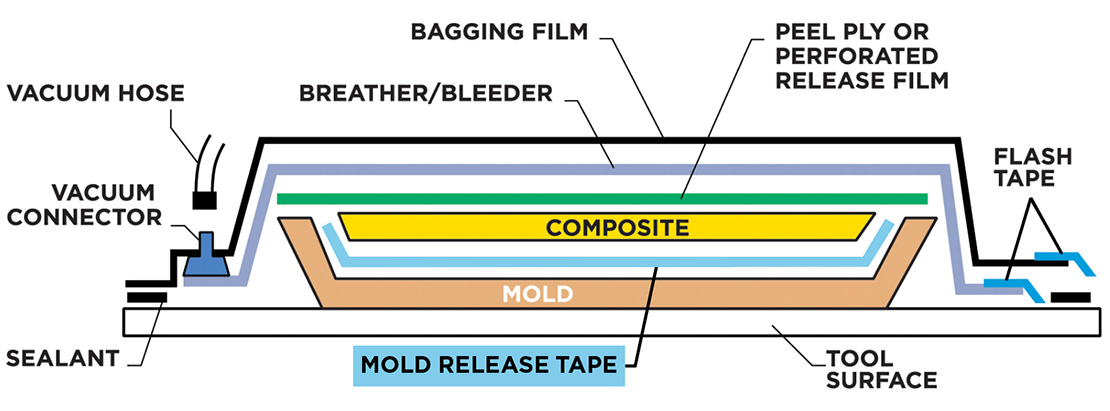
One of the major advantages of composite moulding tapes is that they can be used and reused several times, eliminating the need to apply silicone coatings to the moulds for each part. While material costs of composite moulding tapes may be greater than silicone coatings, they offer a net labour saving since it is not necessary to clean the tooling and re-apply the silicone coatings for each part fabricated.
Furthermore, in some composite moulding processes, silicone release products are not compatible with the binder of the composite material. These incompatibilities can create defects such as cracks, pinholes, surface defects and spots. Non-silicone composite tapes can solve this problem by providing a silicone-free solution when silicones become troublesome.
Composite moulding tapes can have a lower coefficient of friction (COF) than silicone. Because of this lower COF, the part will remove from the mould much more easily. This can be especially important for large parts and large moulds. The tapes can also provide a visual indicator showing which portions of the mould are covered, reducing the likelihood of the composite part sticking to the mould. These and other advantages make composite moulding tapes an attractive alternative to silicone coatings.
Composite Moulding Tape Characteristics
Composite moulding tapes consist of a substrate, which is the surface that comes into contact with the composite, and an adhesive, typically silicone, that is used to bond the tape rigidly to the mould or tooling. During the autoclaving process, the tapes are subjected to high temperatures and pressures, so they must be dimensionally stable, and have a high tensile and yield strength. The substrates must be smooth, have low friction and low surface energy to prevent the composite materials from sticking to them over a wide temperature range, enabling their easy removal from the mould. The adhesives must have a high peel strength so that the tape does not de-bond from the mould during the release process after the parts have been cured.
Certain properties or characteristics of the tapes make them appropriate for use as a mould release liner, protection and seaming tape, or a flash masking and hold down tape, as follows.
Mould release liners have a substrate made of polytetrafluoroethylene (PTFE), which is commonly known by the DuPont brand name Teflon™, for its superior non-stick properties and temperature resistance. The PTFE material is typically configured as a glass cloth, laminate or film. Our unique process ensures the PTFE has a smooth surface finish that is free of cracks and pinholes. This defect-free surface is the key to the PTFE tapes lasting longer in a composite moulding process.
Tool protection and seaming tapes consist of extruded, high modulus and skived tapes, which have better conformability than PTFE glass cloth tapes. Conformability is important for applying the tape to complex geometries without wrinkles and without the tape lifting prematurely.
Flash masking and hold down tapes use polyester substrate materials to enable operation at high temperatures without leaving residue. These tapes may use a silicone adhesive, or if contamination is an issue, may use a rubber adhesive.
Aerospace, Wind Turbine and Large Composite Moulding Materials

Saint-Gobain® Composite Moulding Tapes
As a leading manufacturer of fluoropolymers, we offer a complete range of tapes that can be used for mould release, tool protection and flash masking. Besides having expertise in silicone adhesives, we’ve developed the highest temperature non-silicone masking tapes in the industry. These tapes can be custom-engineered and tailored to meet the performance, cost and manufacturing requirements for specific composite moulding applications.
For example, we produce some of the widest tapes in the industry, with film-based tapes in widths up to 1219 mm, and PTFE/glass cloth tapes in widths up to 1524 mm. The Saint-Gobain CHR® M851, M852, M783 and M855 are the highest temperature non-silicone masking tapes available. They can perform at curing temperatures of 200°C, which is very close to the temperature performance of a silicone adhesive. Furthermore, our Chemlam® fabrics have longer lifespans than dip-coated competitive products.
Discover more information on composite moulding tapes used for mould release, tool protection and flash moulding applications or contact us today to discuss your specific needs.


