

HVAC Solutions for Cleaner Air, Health Benefits and Energy Efficiency
Sustainability enhancements in commercial construction are the way forward. With a growing global population and increasing environmental changes, the demand for heating, ventilation, and air conditioning (HVAC) within construction is also rising. Acting as the respiratory system for buildings, it is crucial to explore opportunities to improve or revolutionise HVAC systems in the pursuit of carbon neutrality.
HVAC systems account for 40–60% of energy usage within buildings, equating to approximately 15% of total energy consumption globally. For this reason, HVAC systems are key targets for efficiency improvements. Companies are investing in more sustainable technologies and equipment to use less energy for heating, cooling, and operating appliances, working collectively towards achieving net-zero carbon emissions.
A major opportunity to improve the efficiency of HVAC systems lies at the design stage. A well-thought-out design helps reduce energy consumption while ensuring a safe and comfortable indoor environment. To achieve optimal performance and meet energy-saving objectives, design engineers consider all components that make up HVAC systems. High-quality gasketing and sealing materials in HVAC applications contribute to lower energy bills and an enhanced indoor environment with significantly less dust and other pollutants, resulting in cleaner air and greater health benefits.
Gasketing and Tape Solutions for Modern Day HVAC Requirements
| The most common HVAC gasketing requirements include: | |
|---|---|
|
A soft material with good compressibility and an appropriate thickness is ideal for both dimensional variation and uneven edges often found in HVAC ductwork. As metal ductwork often experiences dimensional changes and shifts between warmed and cooled air, gaskets that provide leak-tight sealing and have good compression recovery are ideal for responding to these frequent changes. |
|
The cellular structure of the gasket can assist in absorbing the vibration caused by HVAC fans and motors. These gasketing applications help to avoid the low humming noises and prevent noise complaints from building occupants. |
|
Many HVAC systems, especially commercial ones, are installed outdoors, on the roofs of buildings. These outdoor applications require gasketing solutions that can act as a buffer against environmental factors such as water ingress, dust, or sunlight. Potential solutions include PVC, EPDM, neoprene rubber, or premium silicones. The best solutions can withstand the challenges of UV light, extreme temperatures, moisture penetration, and ozone resistance. |
Saint-Gobain® offers a wide range of thermally conductive products, polyurethane and PVC foam materials that are ideal for HVAC requirements. Our sealing and gasketing materials ensure thermal comfort and consistent air quality in indoor environments by preventing leakage into or out of the system boundaries.
Modern Day Commercial HVAC

Most commercial buildings such as office spaces, hospitals, laboratories or factories utilise centralised HVAC systems, where air is heated or cooled in a central location and later distributed to numerous rooms via fans and ductwork. One major component of a centralised system is referred to as the Air Handling Unit (AHU), often thought of as the heart of central air conditioning. AHUs create comfortable, quality indoor air by collecting air from the outside, filtering, heating, cooling, humidifying or dehumidifying air as it passes through the unit to achieve optimal room conditions.
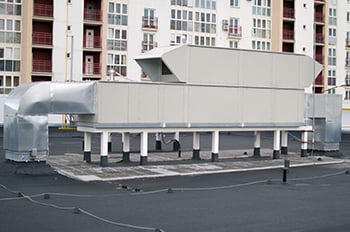
AHUs are generally comprised of a large metal enclosure, containing a blower (fan), heat exchanger, filter chambers, a humidifier, dampers and sound attenuators. The way the conditioned air gets distributed to various zones within a commercial building is dependent on whether the AHUs utilise CAV (Constant Air Volume) or VAV (Variable Air Volume) control. While VAVs maintain constant temperatures to supply variable air flow, CAVs have varying temperatures while supplying constant airflow. VAV is the more modern and efficient demand control system, with an ability to adjust to changing demand within a building and reduce the supply of treated air in spaces where it is not needed. VAV-based air distribution systems are made up of AHU and VAV boxes, with one VAV box allocated per building zone and connected to a dedicated thermostat.
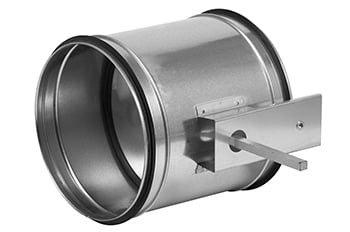
Additionally, the system consists of dampers that modulate based on airflow and zone temperature sensors. These dampers help to conserve energy by stopping air from flowing into spaces that do not require heating or cooling and can also protect against smoke or fire.
In VAV systems, Smart Air Valves with intelligent air control manage the volume of air flow to maintain optimum air change rates, minimise energy use and maximise comfort.
Although demand control ventilation systems like VAVs generally have a higher up-front price tag, they are the premier choice for modern energy-efficient buildings.
Enhancing HVAC energy, safety and performance
Sealing and gasketing materials are vital components for efficient, high-performance HVAC systems. They seal access panels, louvres and doors, helping to reduce unwanted noises caused by motor or fan vibrations. They prevent unwanted air leaks and energy waste and can also accommodate thermal expansion and contraction. The Saint-Gobain product portfolio, consisting of high-performance silicone, polyurethane, and PVC foams, provides optimal solutions that meet the demanding needs of HVAC applications.
Silicone foam rubber
While premium silicone materials are a more expensive option, they offer outstanding performance in applications requiring excellent flame retardancy with low toxicity and smoke generation.
Norseal® Silicone Foams are ideal for applications that include fireblocks, thermal barriers, noise and vibration dampeners, and insulation. Additionally, their resistance to weather, moisture, ozone, UV and fungus makes them perfect gasketing materials that can withstand harsh environmental stressors found in outdoor applications.
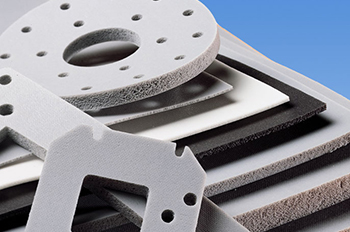
Norseal F-12 has a unique cellular structure, high temperature stability, general inertness and low compression set. This premium, soft and easy-to-compress silicone foam is ideal for applications that require high temperature resistance and fire retardancy. Such applications may include ventilation control dampers and enclosure seals near the heating section of the AHU. Carrying a UL94 V-0 rating, this product is highly effective for maintaining the overall safety and performance of a commercial HVAC system. It is also an ideal product for use in smart valves due to its ease of compression, low compression set at elevated temperatures, ability to be die-cut for fitting within the valve, resistance to microbial growth and ability to serve as a gasket for both the inner and outer damper.
Norseal F-20 is a silicone foam with medium density for a more durable seal. It has outstanding compression set resistance as well as excellent flame resistance (UL94 V-0) with low toxicity and smoke generation. Often used in outdoor sealing applications, F-20 is exceptionally resistant to environmental conditions, providing excellent water sealing capabilities.
SNS silicone tapes
Norseal Silicone can be supplied with optional Silicone or Acrylic pressure-sensitive adhesive. SNS Tapes are compressible, flexible and can conform to irregular surfaces and shapes for sealing and gasketing applications. These tapes are also perfect for vibration dampening and thermal insulation.
Norseal SNS100S and 200A: These products are specially designed to form gaskets that can withstand high temperatures, without the need for complex tools. They are optimal for applications on and within access panels or inspection doors that are adjacent to burners or other heating elements.
Polyurethane gasketing foams
Norseal Polyurethane Gasketing Foams (PUR) are easy to apply, have excellent gap-filling, cushioning and environmental resistance properties, making them a solid choice for HVAC gasketing or sealing needs with a modest temperature range (up to 212°F/100°C). They are optimal for providing protection from mechanical or environmental stressors. They help to protect longevity and performance by dissipating stress and motion and dampening shock and vibration.
The micro-cellular structure of PUR gaskets allows for excellent resiliency. Consequently, these products allow for the frequent opening and re-closing of the service doors within HVAC systems, enabling hassle-free maintenance and a consistent seal of the foam gasket in panel applications.
PVC gasketing foams
Norseal Foam Gaskets are perhaps the most economical. While they have good compression properties, are highly conformable and adapt easily to irregular surfaces, they are often used in applications that require less severe temperature requirements (160°F) and are most suitable for fixed joint applications.
Norbond® Bonding Tapes to enhance HVAC aesthetics
Saint-Gobain Tape Solutions offers other material solutions for HVAC application needs, including the Norbond Bonding Tapes. These tapes are used for HVAC emblem and frame bonding applications. They can be die-cut to various shapes and sizes and have good resistance to external environmental stressors such as harsh weather, fungi or oxidation. Bonding tapes are optimal for creating more lightweight HVAC systems by removing the need for mechanical fasteners, rivets and screws.
Making the right HVAC material choice
HVAC systems and the AHUs connected to them for circulating air are often difficult and expensive to install. Incorporating necessary gasketing solutions is vital for the optimal performance of the AHU. Proper gasketing materials can protect the AHU from environmental stressors and ensure that all internal components of the AHU work efficiently.
Common factors that result in HVAC unit breakdown include overheating, vibration damage, or seal and gasket failure. By considering premium silicone foam and sponges, HVAC design engineers can help to increase HVAC process efficiency and longevity, minimise repairs, and ensure the safety and security of building occupants.
There is no single gasket solution for every HVAC application, and choosing the right one can help solve common HVAC challenges. The ideal solution depends on needs as well as a variety of criteria such as temperature resistance, compression requirements, environmental factors and costs.
To meet specific functional or aesthetic needs, we offer custom solutions that are designed to take into account anticipated environmental conditions and expected wear over the life expectancy of your HVAC system. Get in touch today to learn more about products that are optimal for protecting today’s investment and provide long-lasting resiliency that meets the requirements of tomorrow.


