
What are Splicing Tapes and Why do They Matter?

Did you know that splicing tapes are used in several manufacturing production processes? The primary purpose of these tapes is to help streamline production, make it more seamless, and minimise downtime.
How?
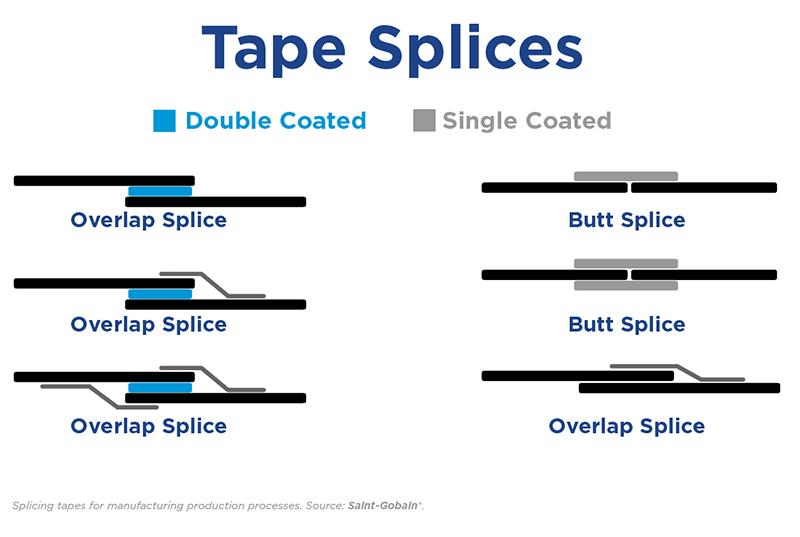
By joining two rolls of a product using splicing tape. By using these tapes, manufacturers can ensure a continuous production line without stopping the line to switch out tape rolls, making the manufacturing operations process more efficient. Instead of stopping the line, they can simply cut the section at the end of the roll and splice another roll on top. A variety of products such as paper, laminate, plastic, foam or cardboard all come in roll form and are fed into machines to be converted into an end product.
Splicing tapes are used for a variety of industrial purposes. They can provide superior bonding to a wide range of treated papers, films and foils due to their quick stick properties. Additionally, they are available in a wide range of colours and thicknesses to meet demanding splicing applications. They offer an economical method to hold, insulate and/or protect materials.
To learn more about these tapes, their features, benefits and applications, we’ve spoken with Nirmal Patel, Product Manager, CHR® Tapes.
Could you tell us about this product range?
When we refer to our Saint-Gobain® CHR M Series, we are primarily talking about our 1 millimetre polyester silicone adhesive tape. It is made from polyester film and has a silicone pressure-sensitive adhesive applied. This polyester backing combined with silicone adhesive makes the products highly conformable.
We offer products that can be supplied with or without a liner and with moderate to aggressive adhesion. They are available in master log form and can be slit to master log width. Additionally, we provide a variety of different colour options, including white, clear, green, red, blue, yellow, black, and orange.
Could you share some examples of applications where splicing tapes are utilised?
Some of the uses of splicing tapes include low-voltage electrical insulation applications, print applications, liner manufacturing and labelling applications.
Why would a customer choose aggressive adhesion vs. moderate adhesion?
Most liners are silicone-release liners. Whether customers choose moderate or aggressive adhesion depends on the release coat that is used as a backing. Sometimes customers are looking for something to adhere to the release coat straight away and with silicone they could achieve a good bond.
With these types of liners, customers generally look for aggressive PSA (Pressure Sensitive Adhesive) because they do not want to wait for the tape to bond with the liner, as waiting could cause a break with the liner.
We can make silicone very tacky, which impacts what we call its aggressiveness. The tackier the silicone, the more aggressive it is. This means the easier and quicker it is to apply. It is a quick-stick solution. It can often be applied with hand pressure and does not need a lot of tension to work.
However, sometimes a customer requires a product they can remove quickly and without leaving residue. This need also impacts tackiness and adhesion. CHR M746 was specially designed with lower tack and adhesion than the standard silicone adhesive tape in order to allow for clean removal.
What types of materials are spliced?
Many different materials needed within industrial applications are spliced. These materials could include paper, rubber, metal, foam, cardboard, foil, etc.
We always ask what materials the tape needs to adhere to, as it will impact selection. For example, coated paper like cardboard is more difficult to splice. It often needs a splicing tape that sticks quickly and is more aggressive. Products such as CHR M741, M751 and M824 offer superior bonding to a wide variety of treated papers, films and foils with their excellent quick-stick properties.
What other considerations are made when selecting splicing tape products?
It depends on what the customer requires and the application. Products such as CHR M823 and M824 serve most splicing applications well, even oven-splicing applications which require good wet-out capabilities.
If a customer needs electrical insulation, great resistance to high and low temperatures or chemical resistance, we have appropriate products to fit these specific needs. For example, products such as M66 offer easy electrical insulation. M717 offers a chemically resistant barrier. M746 can be easily removed without leaving residue. M50, M52, M758 and M803 offer excellent high/low temperature resistance. M751 is used in the manufacturing of label, decal and pressure-sensitive materials. M803 is a protective circuit board masking tape.
If key needs are insulation and protection of materials, M50, M52, M66, M717, M741, M758 and M803 offer an economical method to hold, insulate and/or protect materials.
For materials selection, customers work directly with our team to ensure a tape best suited to specific needs and application requirements.
These products can come in long length rolls, why is this an advantage for customers?
This is an advantage for customers who are trying to make their manufacturing processes quicker and more seamless. Long length rolls are very suitable for automatic dispensing processes. Customers do not have to stop and replace the product, and this reduces both lead times and machine downtime.
I must also mention that with these splicing tape products, our machines are well equipped to run long length for polyester products, which allows us to significantly cut lead time and get the customers the products they need — faster.
There is lots of interest in enhancing automation by utilising robotics in industrial manufacturing, are these products conducive to robotics handling?
Absolutely. With robotics applications, more aggressive adhesion is required. CHR 5369 is a yellow-coloured product that works exceptionally well with robotics handling and automatic application because the silicone is much tackier. It could be applied without worry of it not adhering correctly.
Applications that require release liners often also require the joining or splicing of siliconised materials. CHR Splicing Tapes are ideal solutions for helping to generate more seamless production, processing, and coating of silicone release liners. Splicing tapes are vital for reducing lead times and ensuring process efficiency. They eliminate the need to disturb the machinery to switch out the rolls of tape, allowing for maximised output of production, reduced costs and greater manufacturing efficiency.