
Spooling Toward a Faster, More Efficient Future

"Time is money."
This well-known saying encapsulates a fundamental truth in manufacturing: speed and efficiency are vital for productivity, scalability, consistency, and customer satisfaction. The ability to deliver high-quality products swiftly and reliably can be the defining factor between market leadership and falling behind.
One technology supporting manufacturers in achieving both speed and efficiency is spooling, a process that facilitates streamlined, high-volume production. Spooling involves winding long, continuous lengths of material such as foam, film, or tape onto a spool, a cylindrical device designed to efficiently store and dispense these materials. This format enables extended production runs with fewer interruptions, reduces changeovers, enhances repeatability, and minimises downtime, all whilst maximising throughput.
At the Granville, New York site, the Tape Solutions team has installed advanced spooling equipment to complement our robust product portfolio of bonding and gasketing tapes, and to provide additional value to our customers.
To gain greater insight into the strategic reasoning behind this new capability and the benefits it offers customers, we spoke with Joe MacDonald, Development Manager, and Rachael Dufour, Product Manager for Norbond® and Green Glue®.

How is Tape Solutions positioning itself to stay competitive in the growing acrylic bonding market?
Joe: The global acrylic bonding market is projected to reach $20.14 billion by 2028, growing at a 6.10% CAGR, driven by demand in the automotive, aerospace, and construction industries.
Tape Solutions is addressing this demand with Norbond UV Acrylics, a cleaner alternative to solvent-based tapes, offering a significantly reduced environmental impact.
To support high-volume applications, particularly in automotive and EV, Tape Solutions has invested in spooling technology to provide customised, automation-ready products.
What does the new spooling capability involve, and how does it benefit customers?
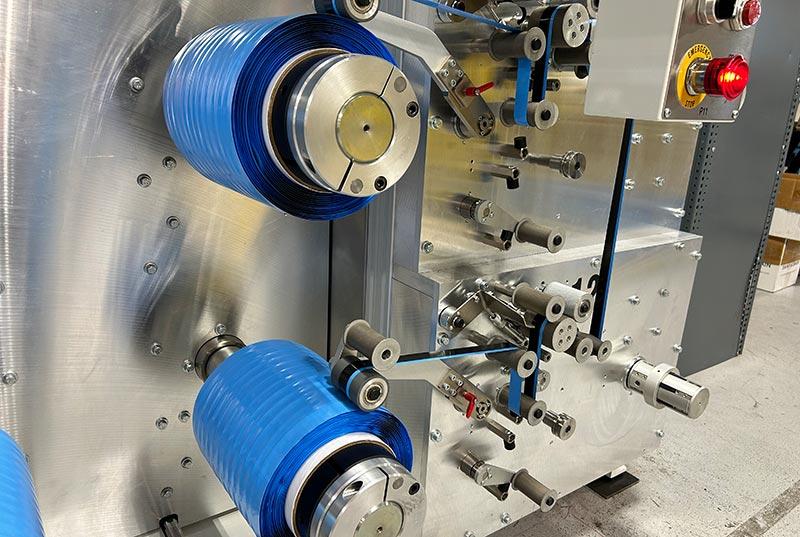
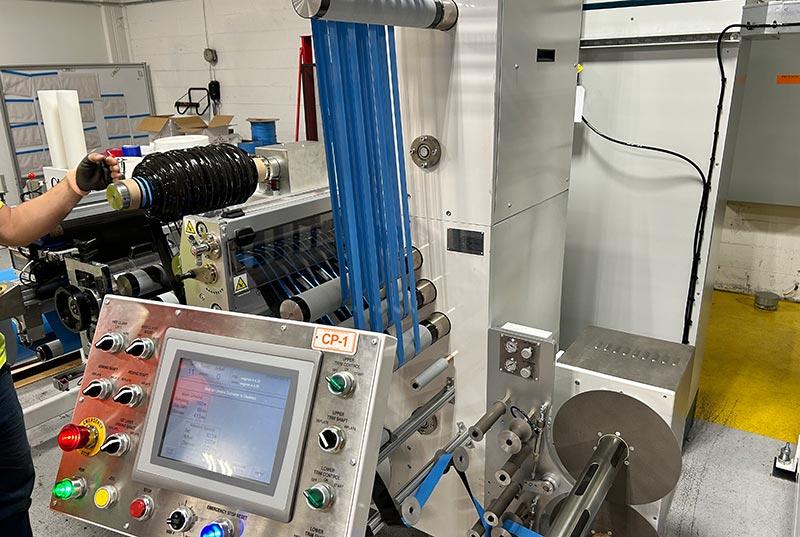
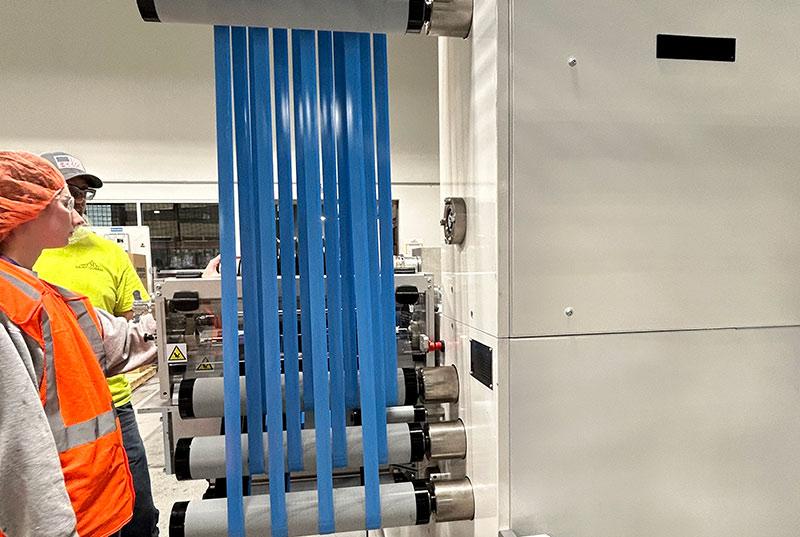
Joe: Our new spooling machine installation is intended to produce two-sided adhesive materials, primarily foams, in a spooled format (see picture above). The process includes die cutting, applying a secondary liner, and traverse winding. The equipment is engineered to meet critical specifications and deliver key features, including:
- Slit widths: 4–25 mm (±0.3 mm)
- Secondary liner widths: 8mm–40 mm
- Kiss-cutting/fingerlift capability
- Product lengths: <1,600 metres with -0% / +1% length accuracy
- Spooled widths: <305 mm
- Spool OD: <360 mm
- Configurations: Biconical and Flat
Which industries benefit most from spooled tape products, and how are they used?
Rachael: Spooled tapes are particularly valuable in the mobility and industrial sectors.
In mobility, they support automation-driven applications such as wheel weight attachment, OEM exterior bonding, and trim attachment, where precision and long continuous runs are essential.
In industrial markets, they are used for bonding trims and profiles, and in residential window framing, where extended lengths improve installation speed and reduce waste. Custom formats, including specific widths and liner configurations, are tailored to meet the requirements of fabricators and construction professionals.
What role does automation play in the need for spooled formats?
Joe: Spooled formats are vital for high-volume taping applications. Automation providers are entering the market with solutions for sectors such as automotive and construction, and these systems depend significantly on tapes in spooled format.
A major differentiator is the capacity to rapidly deliver trial-ready spooling solutions for customer testing. Our internal spooling capability provides greater control over production quality and lead times, improving responsiveness and speeding up validation.
Which Tape Solutions products are most suited for spooled formats?
Rachael: Products such as Norbond Polyurethane Tapes (V2800, Z500, E500) and Acrylic Tapes (Z3100, Z2000, Z800, A7600) are commonly used in high-volume applications.
We also supply single-sided Norseal® Foam Tapes and Norgard® Film Tapes in spooled formats. Nevertheless, the most suitable solution depends on the customer’s process and substrates.
Our applications team collaborates closely with customers, often starting with a Spooling PRO (Product Requirements Outline), to ensure the format is optimised for their automation equipment.
What’s next for Tape Solutions in its spooling journey?
Joe: Whilst we’re currently concentrating on optimising spooling for acrylics and polyurethanes, we are actively investigating further formats, including foam and film tapes for the construction and industrial markets. This forms part of our broader strategy to support automation and deliver bespoke solutions across key industries and best support evolving customer requirements.
As global manufacturing accelerates towards higher levels of automation, material providers must adapt to meet these demands. Tape Solutions is investing in spooling capabilities to deliver customised adhesive roll formats designed for high-volume, automated applications. Alongside our robust portfolio of bonding and protection tapes, these capabilities position us to grow with industries such as automotive, EV, industrial, construction and mobility.
In a world where “Time is Money,” Tape Solutions is shaping the future of advanced manufacturing. Connect with our team today to discover how our new solutions can support your requirements, now and in the future.