
Maximise EV Success with 8 Key Solutions to Mitigate the Toughest Challenges

When it comes to the success of your electric vehicle, the products and solutions must demonstrate proven functionality and performance in tackling key challenges. But what are these key challenges, and how do our foam and tape solutions measure up in addressing them?
We’ve interviewed Dominique Burgeff, Saint-Gobain® Global EV Marketing Manager, to explore five main challenges and the top eight solutions that help overcome them.
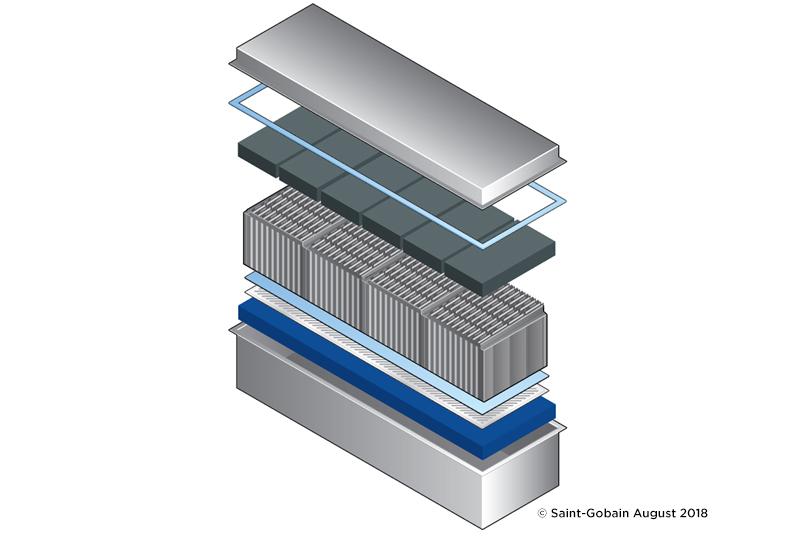
We have structured our solution portfolio around five key “Functional Domains”, in line with the challenges our customers face in the design and operation of EV battery packs.
Challenge #1: Improve and Manage Structure
Solution 1: Assembly and attachment tapes
Lighter electric vehicles mean lower energy usage and costs, improved driving range, smaller battery packs, maximised battery power and energy density, as well as enhanced performance handling. Assembly and attachment tapes are not only lightweight but also facilitate EV design due to their ability to bond nearly all types of materials. They can be specially tailored and customised to match the requirements for a particular assembly type or speed. With high energy absorption capacity, tailored tack and adhesion, our diverse portfolio of acrylic and polyurethane tapes improves the structural integrity of the battery pack. They enable flexible automotive bonding, providing the strong holding power EV applications require. Additionally, they offer a range of options for attaching cells and the casing.
Solution 2: Cushioning pads/dampening foams
The battery pack requires reliable protection against shock, vibration and mechanical influences. Materials with low compression set, outstanding rebound properties and high resilience, such as our polyurethane cushioning foams, maximise battery life, improve durability and ensure functional dampening and NVH protection throughout the lifespan of the EV. Cushioning pads and dampening foams serve as a connection between the cooling plate and the battery case, ensuring continuous contact between the heat source and heat sink to properly evacuate excess heat. These low-density materials have inherent tack, the ability to dampen mechanical vibrations and retain flexibility, form and function throughout the lifetime of the battery pack. Not only are they cost-effective, but they also have superior flame performance for improved passenger safety.
Challenge #2: Improve Thermal Management
Solution 3: Thermal interface materials (TIM)
Thermally conductive gap fillers provide a thermal path for heat to flow away from the battery, optimising the thermal operation of the cell and prolonging battery life. Properties such as good dielectric strength, excellent electrical insulation and UL94 V-0 rated flame-retardant performance ensure these products can evacuate excess heat and support an optimal temperature range. TIM can ensure electrical isolation between cells and cooling plates. They have tailored thermal characteristics and are easily customisable in terms of hardness, surface tack or liner. These characteristics ease assembly, rework and the creation of the ideal TIM. Our thermal interface materials have both thermal conductivity and compression force deflection to help tackle your thermal management challenges.
Challenge #3: Mitigate Fire Risks and Propagation
Solution 4: Venting and thermal protection
Thermal protection pads with tunable mechanical cushioning, high dielectric strength and high temperature resistance contribute to passenger and vehicle safety in the event of a fire caused by thermal runaway. These busbar protection materials keep busbars and other pack circuitry materials operational during safety events by shielding the busbar from gases and matter ejected by cells going into thermal runaway mode. They also offer necessary cushioning for normal battery operation.
Surface protection materials, such as venting covers, support the control and management of vented gases caused during thermal runaway. Additionally, they help channel the vented gases away to protect adjacent cells and circuitry.
Fire retardant foams provide sealing between compartments within large battery packs. Under both normal and safety modes, these compartments need to be sealed from each other to better control and seal gaps during thermal runaway conditions.
Challenge #4: Manage Cell Swelling and Reinforce Safety
Solution 5: Compression pads
Compression pads — or tolerance pads — maximise both battery life and performance, ensuring safe battery operation and electrical isolation between cells. With silicone and micro-cellular PUR materials options, they provide optimum cushioning support for the dimensional change of the cell during the breathing process as well as the gradual swelling that occurs throughout the battery lifespan. With customised thickness and CFD combination, compression pads can adapt to different battery types (prismatic vs. pouch) and materials (cathode, anode or electrolyte). The tunable compression curves, added benefit of flame resistance and our robust simulation capabilities mean our compression pads can support the most diverse battery configurations and be seamlessly integrated into assembly lines.
Solution 6: Thermal runaway protection (TRP) pads
TRP materials have excellent compression resistance, thermal insulation with fire-blocking characteristics and electrical insulation between cells. TRP is the ideal product for providing mechanical and thermal cushioning in the event of thermal runaway. These materials isolate hot cells by thermal insulation and delay thermal propagation to adjacent cells. These dielectric foams are engineered with a predictable compression force deflection (CFD) which allows them to deliver consistent return force over a wide range of compression and temperatures throughout battery pack life. With low compression set, these materials are designed to optimise battery performance and durability while supporting safe vehicle operation and passenger safety.
Challenge #5: Protect from Environment and Electrical Insulation
Solution 7: Electrical insulation
The increased density of wiring and components within EV charging stations requires proper bundling and insulation. For proper functioning of the charging station, communication modules also need to be shielded from external environmental factors. Thermally conductive, insulated, intumescent materials and silicone and micro-cellular polyurethane foams can provide the high dielectric strength, temperature, chemical and mechanical resistance that is needed to support the safe operation of the BEV high-voltage drive train. These high-end electrical insulation and thermal management materials protect the enclosures of the charging stations from the external environment, dissipate heat and insulate components.
Solution 8: Pack gasketing
Materials such as foam-in-place gasketing, silicone foam rubbers, butyl-coated PVC or micro-cellular PUR foams have low compression set and fire-blocking characteristics that protect the battery pack from external elements, such as air and water. This protection ensures the performance, longevity and safety of the EV.
Explore EV solutions with our Tape Solutions team
No matter what the current industry challenge may be: Thermal management, safety, support of an ever-growing charging infrastructure, lightweighting, material durability or enhanced EV battery protection, we have both the know-how and the solutions to meet the most challenging demands. Our team is ready and eager to support creating EVs that are safe, perform under pressure and withstand the toughest conditions. Start exploring proven solutions to some of your most common challenges today.