
Learn More About Applications, Benefits and Features of Bonding Tapes

Bonding tapes are a strong option for many applications. They are often utilised in place of mechanical fasteners such as rivets, bolts, screws or welding materials and are often preferred due to ease of application. They have high strength, provide durable sealing against environmental conditions and can withstand high levels of vibration, making them ideal choices for automotive bonding applications.
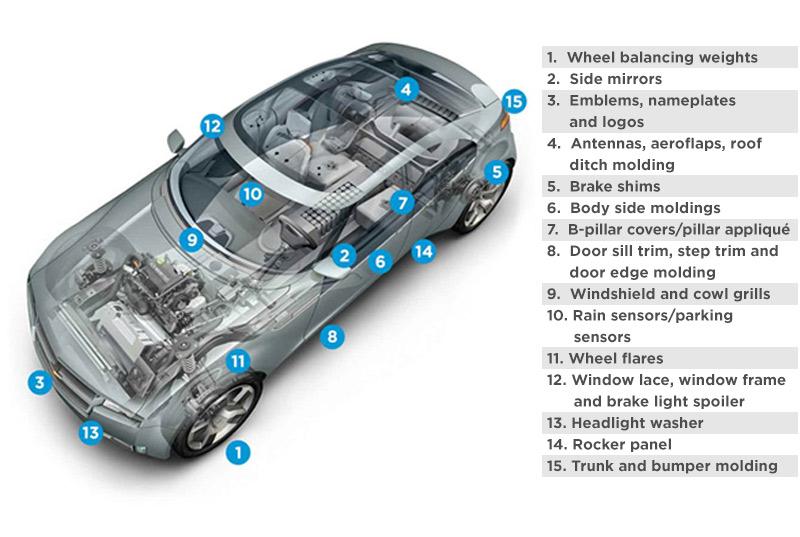
Saint-Gobain® Bonding Tapes are fully tested against many OEM requirements and meet automaker needs for applications such as emblem attachment, lighting systems, NVH control, wheel weights or automotive sealing, offering durable, long-lasting bonds that stand the test of time.
To better understand typical automotive tape applications as well as frequent questions that often arise, we interviewed Bryan Harrison, Regional Applications & Technical Services Manager, to learn more.

Tapes typically offer a neat-looking edge that is aesthetically pleasing. They are easy to apply and provide a strong bond that forms within seconds of application.
In contrast, mechanical fasteners require physical holes through a surface. They are more prone to corrosion and can create stress points that may cause the surface to buckle.
Meanwhile, liquid adhesives can be messy to apply. They often need to be held in place while curing and can produce more waste compared to a tape product.
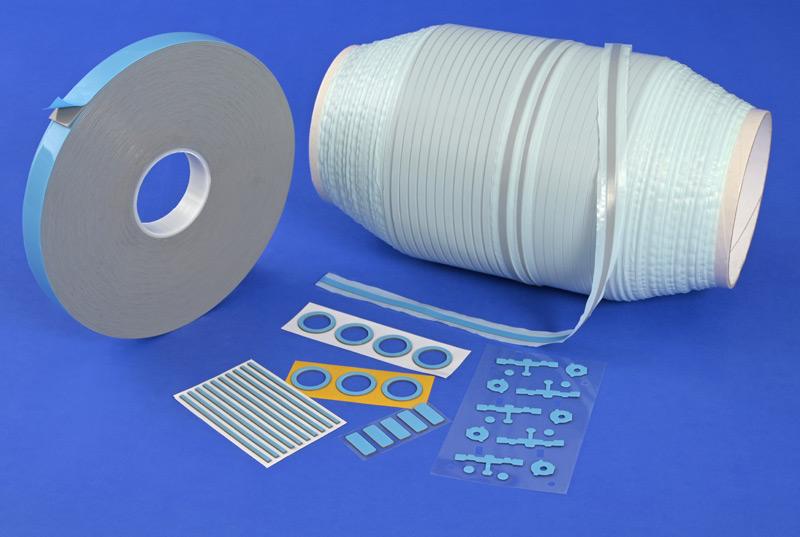
Yes. This can be done through methods such as die-cutting, slitting into roll form, or through water jet or laser jet techniques.
How much tape is needed to bond a component?
Heavier parts or parts that experience more stress require more tape than components under less stress. I recommend discussing specific application details with one of our application engineers, as they can provide additional guidance.
How much pressure do I need to apply to attach the tape?
In many cases, 15 PSI for several seconds is sufficient to achieve a good bond. You should press the tape down to ensure the adhesive makes good, even contact with the surface.
Is it better to press the parts together or roll them down with a roller?
Rolling pressure is best to help avoid air pockets forming between the adhesive and the surface you are bonding to. We recommend gently rolling the tape to ensure maximum wet-out and, therefore, the best adhesion with that tape.
How far in advance can I remove the liner?
We recommend keeping the liner in place to protect the adhesive until just before you are ready to press the parts together.
Which liner is best for each application, and why would I want a stronger release on certain parts?
A tighter release, typical of raw poly liners, might be necessary to prevent the liner from exposing the adhesive. Additionally, it is ideal for flexible applications such as spooling or for applications with long plastic parts like bumpers or cut-to-length trim applications.
A higher-density release-coated liner may be easier to use when applying wheel weights or alloys. Clear liners are sometimes required for optimal quality systems, which are common in high-speed converting and assembly processes.
How long does it take before the tape reaches full bond strength?
Most tapes reach full bond strength after 72 hours at room temperature. You can expect approximately 75 to 85% bond strength within the first 15 minutes and around 95% by the end of the first day. Full bond strength is typically achieved by the 72-hour mark. It is important to note that temperature impacts adhesion build-up – warmer temperatures are better!
How does the tape performance change at high temperature versus low temperature?
Tape cores and adhesives become softer as the temperature rises and firmer as temperatures drop below freezing. Once the bond forms, most tapes exhibit lower adhesion results when exposed to extreme heat and higher adhesion results when exposed to extreme cold. At cold temperatures, such as -30°F, some tapes become very rigid and glass-like.
Although this provides significant adhesive strength, the tape also becomes more prone to shattering. As long as the temperatures the tape is exposed to remain within its standard operating range, the tape will typically return to its standard bond strength level when brought back to room temperature.
Can I reposition a part after it’s attached?
It is difficult to remove tapes once they are bonded. Immediate removal may sometimes work, but since bonds typically build very quickly, prompt removal must occur to avoid damaging the part.
If a part is not adhering to the vehicle, what could be wrong?
In a factory with automated assembly lines, pressure is the most common root cause of adhesion issues – application jigs wear down over time, and gaps increase. This is often undetected because the air pressure used to bond parts still shows the proper pressures being applied.
The important thing to remember is that the pressure in the line does not necessarily mean the body surface is experiencing the same amount of pressure. Increasing the travel distance by using a piece of felt can often diagnose a jig wear problem.
Surface contamination is likely the second most common issue. Finger marks on the adhesive surface or simply not clearing off contamination are two common causes. If cleaning resolves the issue, then you have a contamination problem.
The third common issue is surface mismatch, especially on curved parts. If the two parts being bonded are not flat or well-matched, the contact area may be too small for proper bonding.
What kind of cleaning is required before applying tape?
We recommend wiping the surface with either a 50/50 mixture of isopropyl alcohol and water or even 100% isopropyl alcohol, as leaving a contaminated surface can weaken the bond.
Does tape colour matter?
Colour is all about aesthetics. Black colours are often preferred on edges that are visible because our eyes tend to ignore shadows. On a vehicle, you would notice the shiny emblem on a painted body but not the line connecting the two if using black tape. In this case, a grey or white tape is often more noticeable.
If joining two semi-transparent plastics, a black tape may be visible through the material, an effect called backlighting. In applications where the tape will be outside the sightlines, colour is typically not important.
How long do the tapes last?
Longevity depends on the tape and application, but we have had applications last as long as we’ve been making bonding tapes – well over 40 years!
Bonding tape allows for increased efficiencies, reduced costs and improved design flexibility for attaching parts.
Our team has the expertise and willingness to work with you to design a highly effective tape product or solve engineering challenges related to automotive sealing tape.
To find a tape solution with the perfect backing materials, seamless process integration and superb performance, or simply get your questions answered, contact us today.