
Enhancing Mechanical Stability in EV Battery Packs

As the transition towards zero-emission mobility accelerates, automotive engineers are under increasing pressure to design safer, longer-lasting, and thermally stable EV battery systems. Whilst traditional discussions have focused heavily on chemistry and new battery technologies such as solid state and thermal management, the mechanical stability of the cells plays just as crucial a role in vehicle safety and performance.
Saint‑Gobain® Tape Solutions addresses today's EV battery challenges on multiple fronts, for example with compression pads for inter-cell pressure control, cushioning pads that protect the battery pack from road-induced vibration and mechanical impact, or advanced thermal interface materials (TIM). Explore in depth five major EV battery challenges and discover how innovative materials are helping to solve them, with insights from our expert Patricia Adame, Senior Applications Engineer, Saint-Gobain Tape Solutions.
In this article
- Improving Thermal Stability and Mitigating Heat Transfer Between Cells
- Ensuring Proper Pressure Management Inside the Battery Pack
- Protecting the Battery Pack from Shock, Vibration, and Structural Loads
- Optimizing Manufacturing Through Tailored Material Properties
- Verifying Material Performance Through Application‑Relevant Testing
- Mechanical Stability Is a System-Level Challenge
Managing heat build-up within EV battery packs remains one of the biggest engineering challenges. Car manufacturers must keep cells within an optimal operating range. This varies between battery types, designs, technologies and chemistries but typically lies between 20°C and 45°C, with occasional peaks up to 60°C for safe performance. When temperatures rise rapidly due to abnormal conditions, a thermal runaway event can be triggered and, without proper mitigation, it can quickly spread to neighbouring cells.
Our Norseal® TRP Series materials are designed to help tackle this challenge. While their main role is heat absorption and flame-resistant insulation, they also support mechanical stability by helping to compartmentalise modules and maintain structural spacing. This reinforcing effect subtly improves pack robustness, acting as a complementary layer to cushioning materials used at the pack level.
Patricia, what additional mechanical or thermal behaviours should engineers consider when selecting multi-functional protective layers for cell-to-cell separation?
As mentioned earlier, mechanical and thermal behaviours are strongly dependent on the cell’s format and chemistry. A prismatic cell will not display the same wall expansion throughout its lifespan as a pouch cell, and an LFP battery compared to an NMC one will differ in thermal stability, so it’s always essential to begin by understanding the cell technology.
The lifespan of both prismatic and pouch cells can be enhanced by having a compression pad between the cells that constantly maintains pressure on the cell wall. It’s important to consider cell expansion and ideal pressure to define the best compression pad technology.
With regard to thermal performance, depending on the cell chemistry and the battery pack design, we can offer a multi-layer solution providing both mechanical and thermal performance. The multi-layer construction typically consists of a compressible foam that offers mechanical performance and a high temperature-resistant, flexible layer that enhances thermal protection. Finding the right combination is a challenge we are always keen to tackle!
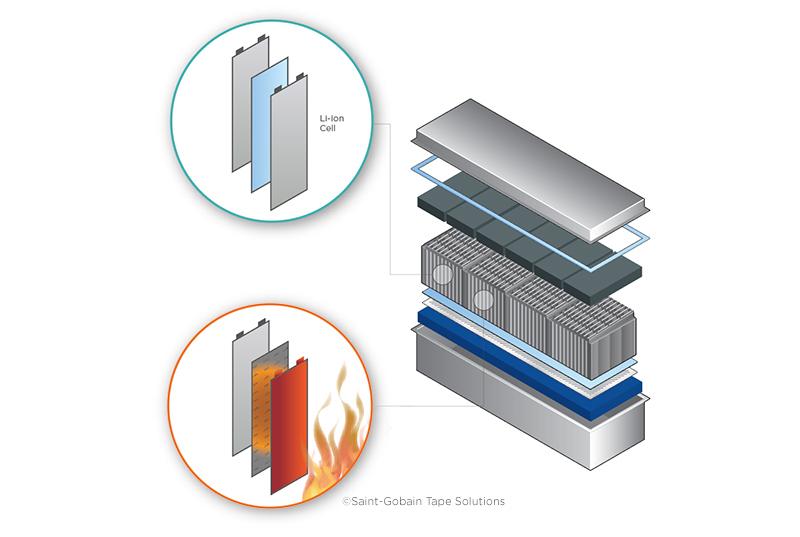
Inside every battery module, intercell pads play a crucial role in managing the expansion and contraction of pouch and prismatic cells. As cells swell over thousands of cycles, they require a controlled, consistent pressure to:
- Maintain optimal performance
- Preserve electrical pathways
- Enhance the cell’s lifespan
- Prevent mechanical damage throughout the battery’s lifetime
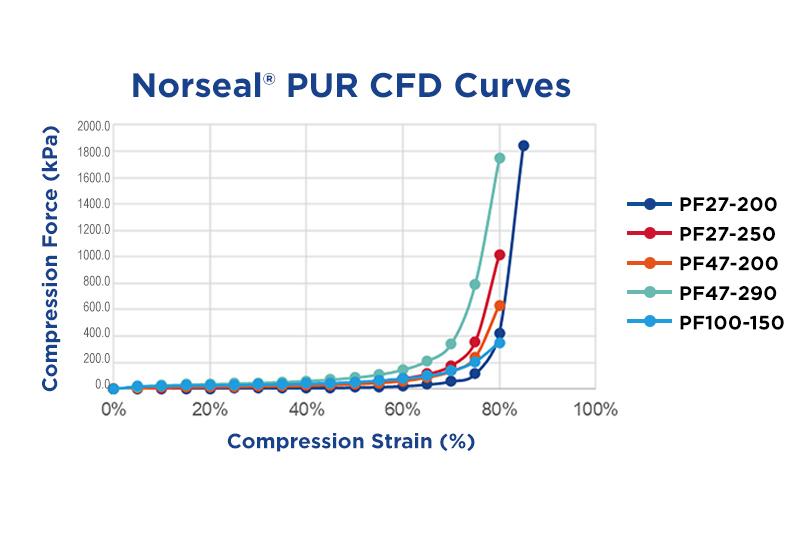
These pads are engineered with a defined Compression Force Deflection (CFD) profile, meaning they apply a precisely tuned force within a specific compression range. If the force is too low, cell performance and lifespan are reduced. If it’s too high, cell stability and performance may be compromised.
Saint‑Gobain engineers work closely with EV manufacturers to identify the optimum CFD range, ensuring consistent force retention even after prolonged temperature exposure and mechanical cycling.
Patricia, what CFD shifts (fresh vs. aged) do we typically observe in real customer applications, and what factors most influence force retention?
It is well known that EV requirements evolve quite rapidly, and this mechanical property is one such requirement; however, it’s understood that the pressure required at BOL (fresh, beginning of life) will always be less than the pressure required at EOL (aged, end of life).
The CFD shift between fresh and aged samples depends greatly on the material’s formulation and its temperature resilience under compression. Some material technologies exposed to high temperatures over extended periods may show a permanent set, harden, and lose their viscoelastic capability, which could negatively affect the cell’s performance by failing to provide the necessary pressure.
It is a standard accepted practice to provide stress/strain curves for fresh materials when tested at room temperature, but over time—and due to the operating temperatures that battery packs are subjected to—engineers have begun to examine any performance impact and data to support the material’s behaviour. We can offer cyclic compression curves at different temperatures that demonstrate our solutions’ resilience, giving our customers confidence that force retention will not be an issue.
While intercell pads stabilise cells inside a module, cushioning pads are designed to protect the entire battery pack from external vibration originating from the road when driving vehicles. These materials are typically made from polyurethane or microcellular foams and are engineered to:
- Absorb and dampen vibration
- Minimise impact loads
- Maintain low compression set
- Preserve structural alignment during long-term cycling
Cushioning pads help prevent excessive mechanical stress on module housings and pack components. They compensate for tolerances, distribute loads evenly, and help the pack maintain both form and function despite significant dynamic forces.
Improved pack-level mechanical stability helps boost EV durability expectations and extend service life.
Patricia, which long-term compression set or rebound behaviours are most critical for cushioning pads in under-floor battery packs?
The main function of cushioning pads is to consistently close the gap between components that require protection from vibration, typically situated between cooling plates and the battery pack housing. Compression set is a useful property that can help identify the appropriate material technology that will not deform over time, thus retaining its viscoelastic properties and preventing the creation of a gap between components, which would otherwise lead to vibration issues.
We usually recommend a service life estimation analysis based on the maximum permitted compression set. We subject our materials to accelerated ageing conditions depending on the material technology, then use Arrhenius extrapolation to better estimate long-term performance.
What real-world improvements have customers noticed from technically advanced cushioning pads?
Cushioning pads have been used by automotive OEMs for several applications, mainly to reduce noise transmission through the passenger compartment, which can otherwise negatively impact the driving experience. The quieter the cabin, the better the driving experience. However, we now also consider safety—where a cushioning pad is required inside the battery pack. If these high-performance solutions are not incorporated into the design, vibration and undesirable impact between components can occur within the battery pack, potentially resulting in safety risks.
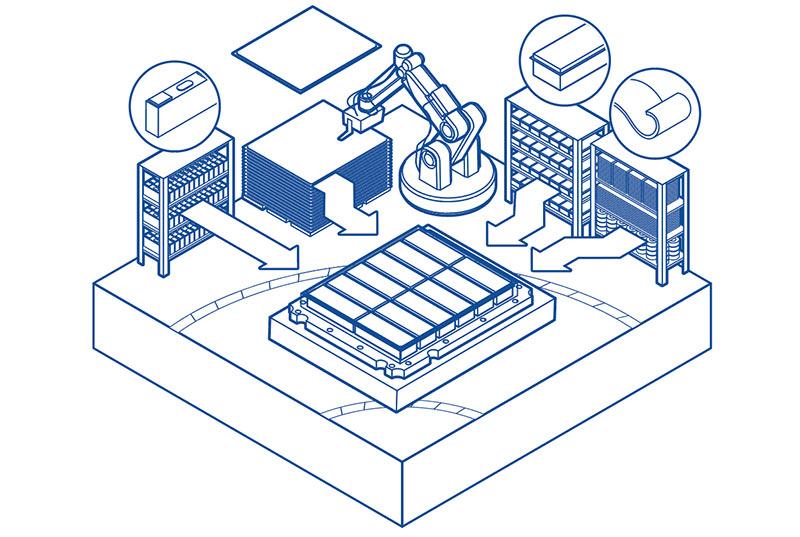
Manufacturability is essential, especially as battery volumes scale globally. Both intercell and cushioning pads can be engineered with features that improve assembly speed and consistency:
- Surface tack to hold components in place during assembly
- Liner and pull-tab options for automated or manual placement
- Customised hardness and CFD for consistent gap-filling
- Material surface handling properties for precise pick-and-place
Our compression pads and other foam solutions can be tuned so that assembly steps remain stable and repeatable, reducing variability and production delays.
Patricia, which geometric or liner-based features have proven most effective at improving placement accuracy in automated lines?
I wish I could say there is an option that will fit all applications, but that would be too easy! Commonly, finger lifts are incorporated during the conversion process to ease automated assembly at the customer’s facility; this finger lift geometry can be designed as needed based on the automation equipment and its capabilities. The finger lift can be as short as possible (a few mm) or sometimes larger to accommodate the robot feature/arm that will grab the finger lift to remove the protective liner. This feature is basically defined project by project.
Battery components must endure combined mechanical, thermal, and environmental stresses that go far beyond standard laboratory tests. Saint‑Gobain supports customers with application-specific validation, providing early insight into material behaviour before full prototypes are constructed.
Typical evaluations include:
- Compression set testing at various temperatures and dwell times
- CFD measurement before and after ageing
- Vibration and shock testing for cushioning materials
- Thermal cycling and environmental ageing
- Combined mechanical-thermal tests that replicate real-world EV operating conditions
This in-house capability helps ensure that compression pads and cushioning pads retain their performance throughout the full expected life of the battery.
Which combined testing sequence (thermal + mechanical) most accurately predicts long-term field behaviour for mechanical pad materials?
I would say that cyclic compression at different temperatures provides relevant data and confidence regarding long-term material performance.
Thank you, Patricia, for providing expert insight into how compression and cushioning pads can improve mechanical stability across the entire battery system. From managing inter‑cell pressure to protecting pack‑level structures with cushioning pads, Saint‑Gobain Tape Solutions offers materials designed to support the evolving durability standards of modern EV platforms.
As EV battery technology evolves and batteries become thinner, more energy‑dense, and subject to harsher duty cycles, addressing both micro‑scale (cell/module) and macro‑scale (battery pack) mechanical behaviour will be essential to achieving the next generation of performance and safety benchmarks.
Our engineering teams welcome the opportunity to share deeper insights with you and tailor recommendations to your application.