
Acrylic, Rubber or Silicone Adhesive

With innovative technologies and materials, adhesive tapes have become increasingly important in various industries, from automotive and aerospace to electronics and construction. The right adhesive system and its combination with different carriers, liners, etc., can make a significant difference in the performance and reliability of demanding tape applications and add true value in many ways.
Finding the right tape for specific needs can be a challenge. A good starting point to narrow down the options is to understand the differences and characteristics of adhesive systems.
In this blog post, we will take you on a journey to explore three types of adhesives commonly used in tapes:
- Acrylic
- Rubber
- Silicone
We will discuss their characteristics, benefits, applications, and limitations, and provide tips on how to choose the right adhesive system for your specific tape application. Let us help you move in the right direction and make your adhesive tape journey a successful one with fond memories to remember and share.
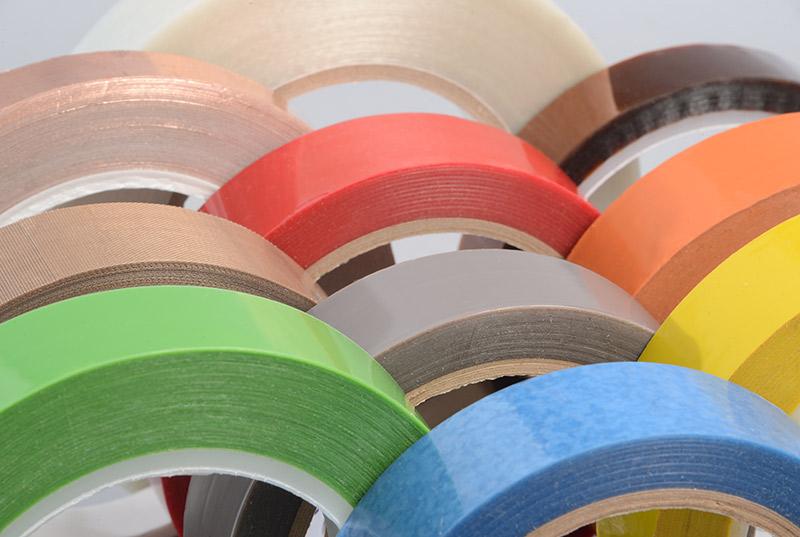
Before taking the first step, the most important piece of knowledge to pack into your rucksack is that acrylic, rubber, and silicone adhesives are all pressure-sensitive adhesives (PSAs). However, the chemical structure of acrylic, rubber, and silicone-based adhesives differs significantly, and their properties can also be modified within one adhesive type to best suit specific needs.
Acrylic adhesives are made from acrylic ester using solvents or solvent-free manufacturing processes such as our unique UV curing technology. Regardless of the underlying technology, acrylic adhesives provide excellent UV resistance, good temperature and chemical resistance, and can be designed to provide good adhesion to a wide range of surfaces, including plastics, metals, and glass. Acrylic adhesives can be formulated to have distinct levels of initial tack, peel and shear strength to meet specific application requirements. With our special technology, UV-cured acrylics can also be designed for residue-free removability, making them suitable for many automotive, aerospace, and outdoor applications. However, in high indoor applications and at room temperature, the adhesion of acrylics is usually less strong compared to rubber.
Rubber adhesives are made from natural or synthetic rubber and usually provide high initial tack, meaning they can create a bond quickly. Rubber-based tapes offer good flexibility, and their conformability makes them a viable choice for uneven or even dirty surfaces. However, most rubber adhesives are limited in temperature, UV, or chemical resistance to solvents, acids, and bases, and are not ideal for maintaining bond strength over time. To overcome this limitation, tapes like CHR® M783 or CHR M852 are designed with special rubber formulations that perform well after high-temperature exposure. Rubber adhesive systems are often used in sealing and gasketing, automotive, HVAC (Heating, Ventilation and Air Conditioning), or electro-mechanical applications.
Temperature is where silicone adhesives excel! Silicone adhesives not only withstand extreme temperatures and maintain their properties over time, but they also outperform other chemistries at very low temperatures. This adhesive system combines temperature resistance, chemical resistance, and electrical insulation properties with good adhesion to a wide range of surfaces, including plastics, metals, and glass. Good removability without residues is also an advantage in many applications. On the downside, such high-end performance comes at a comparatively high price, and other adhesive systems perform better in terms of adhesion, initial tack, and shorter curing time. Common applications for silicone adhesives include EV (electric vehicles), electro-mechanical, automotive, aerospace, or industrial applications where high-temperature resistance is crucial, such as in thermal spray or masking applications.
In addition to this overview and the typical characteristics of different adhesive types, acrylic, rubber, and silicone adhesives can be modified to meet specific application requirements. Common modifications include, for example, adding fillers, stabilisers, or adhesion promoters that can increase the flame retardance of tapes where safety is essential, such as in aerospace, automotive, rail, or marine applications.
Saint-Gobain® Norbond® Z3000/Z3100 Series is a good example of how modifying the adhesive system can lead to substantial benefits. In this case, eliminating the need for primers in automotive bonding, this acrylic tape can facilitate assembly processes while providing lasting performance on difficult surfaces.
But with our unique acrylic UV curing technology, for example, customising the adhesive system can go far beyond placing additives into the formulations and lead to fresh solutions. As you can see, knowing the typical characteristics of different adhesive systems is a good start, but there is more to understand about why choosing the right adhesive system for your application is important.
Based on the typical characteristics we discussed above, choosing the right adhesive system for a tape – or the correct path at a crossroads of our journey – can be essential for several reasons. First, the adhesive system determines the basic suitability of the tape for the respective application and its compatibility. Choosing the right adhesive needs to take into account the substrate material and surface texture to avoid failure that could lead to damage, safety issues or costly rework.
Second, the adhesive system selection affects the tape's performance in different environments and over time. It should consider various factors such as the temperature range, chemical exposure and other environmental factors like moisture or UV radiation.
Finally, choosing the ideal adhesive system can have significant effects beyond pure performance considerations. Unlike over-engineered solutions, the right solution can influence the overall costs and process efficiency by increasing production speed, throughput, or automation options. By reducing the need for special handling, training or equipment, the right adhesive system can add even greater value.
After exploring three types of adhesives that are commonly used in tapes and discussing their characteristics, benefits, applications, and limitations, we hope you are well prepared to start finding the right adhesive system for your tape application. Of course, this is only the beginning, and we hope you enjoyed this brief journey of knowledge into the tape landscape and are ready to go further.
To help you reach your goal and achieve your personal peak performance, let our tape experts guide you through the maze of alternatives in the quickest way possible!