
5 Ways Tape Solutions Can Enhance the Performance and Longevity of Your EV Battery

As the transition to zero-emission vehicles gathers pace, many major vehicle manufacturers are signalling the end of the era of internal combustion engines (ICE). By 2030, one in four passenger cars is likely to be electric. Despite its unprecedented growth, the EV industry is still making improvements in terms of performance, safety and longevity of the battery pack.
We’ve spoken to Patricia Adame, Senior Applications Engineer, and learned about five ways that Saint-Gobain® Tape Solutions can help deliver more powerful batteries.

In this article
- #1 Providing Solutions to Mitigate Risk of Fire Propagation
- #2 Making Sound Choices for Material Components Inside the Batteries
- #3 Providing Battery Pack Protection from Mechanical and Environmental Influences
- #4 Product and Assembly Process Optimization
- #5 Providing Internal Testing Capabilities and Expertise
- Accelerate Your EV Projects
All automakers face challenges in maintaining an optimal temperature for a battery to operate (between 20-40°C with occasional peaks up to 60°C). The heat generated inside the modules and the pack during normal use or charging needs to be managed to prevent a thermal runaway event. Some solutions aid in providing thermal barrier protection to the adjacent cells and delay heat distribution in the event of one cell going into thermal runaway.
Our Norseal® TRP Series is specially designed to protect adjacent cells from going exothermic. These products help mitigate the propagation of a thermal event from one cell to another due to heat absorbent, flame resistant, properties. Because the Norseal TRP Series is electrically insulating, it also prevents arcing within modules.
Materials utilised within a battery pack need to maintain their properties over the life of the vehicle. For example, compression pads are responsible for maintaining pressure on the face of a pouch cell (or prismatic cell). These compression pads need to function properly for prolonged periods of time and be resilient to the compression and expansion of the cells. They need to have spring-like characteristics to provide a consistent deflection force over a wide range of compression and temperature. This is a property called compression force deflection (CFD).
When there is too little pressure on a cell, cells can expand freely in one direction, resulting in losing contact with the cooling plate (for thermal management) or losing electrical connections. In contrast, too much pressure on the cell can be detrimental to its stability, leading to dangerous conditions such as thermal runaway. Our team can help you choose the right battery pack compression option for your specific application needs, ensuring functionality and performance that lasts.
Another example is that of thermal interface materials (TIM). These materials are utilised within the battery pack to help dissipate heat and aid in the energy transfer between battery components and cooling devices. Saint-Gobain engineers work with customers to determine the most efficient and effective way to integrate the use of TIM within battery modules.
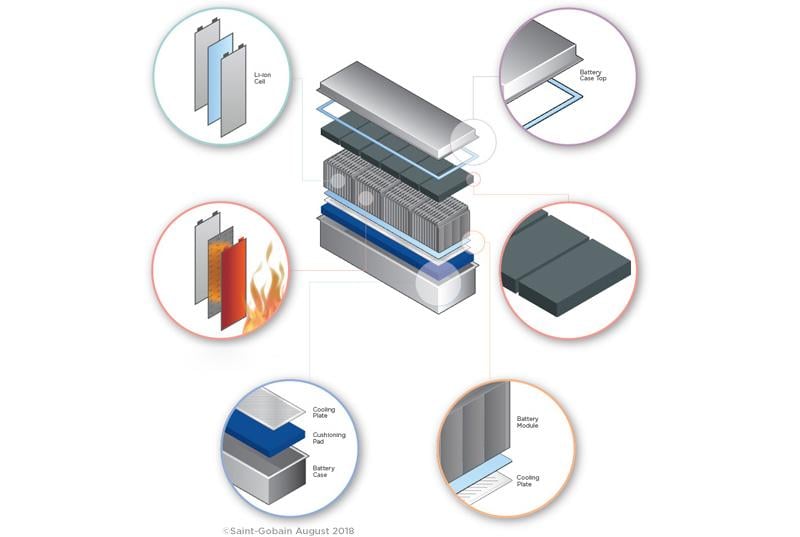
The battery pack is the heart of an electric vehicle. It needs to be protected from mechanical and environmental influences as well as shocks and vibrations. Tape Solutions offers unique polyurethane cushioning pads that help to absorb the impact between the pack and the vehicle. These materials offer outstanding rebound properties and low compression set to dampen mechanical vibrations, retain flexibility, form and function throughout the battery lifecycle.
Our engineers are eager to discuss products such as foam-in-place gasketing, silicone foam rubbers, butyl-coated PVC and microcellular foam options to ensure that your battery pack remains sealed and protected from external elements.
Our applications engineering and R&D teams understand and value the customisation of mechanical properties, tackiness, and hardness of a product, specific to customer needs. In cases where customisation isn’t enough, we explore innovation and co-develop unique tape solutions that meet critical or unique technical and performance requirements.
Our material properties can be tailored for assembly process optimisation. For example, in our Norseal Compression Pad solutions, properties such as surface tack and liner options can be customised to make automated assembly easier. Our ThermaCool® product properties can also be customised for:
- Hardness/CFD: ability to conform to gaps between modules/cell assembly without exerting too much pressure on the cells
- Surface Tack: to help position the module/cell on heat sink and minimise movement during the assembly process
- Pull Tab Options: to aid in the ease of assembly and to automate the placement of pads in the process. Adding pull tabs can make the removal of liner easier.
Customers often look for accelerated tests, different conditions or parameters that are application-dependent and may not be covered by OEM standards or ASTM/other industry testing methods. The most common test methods include:
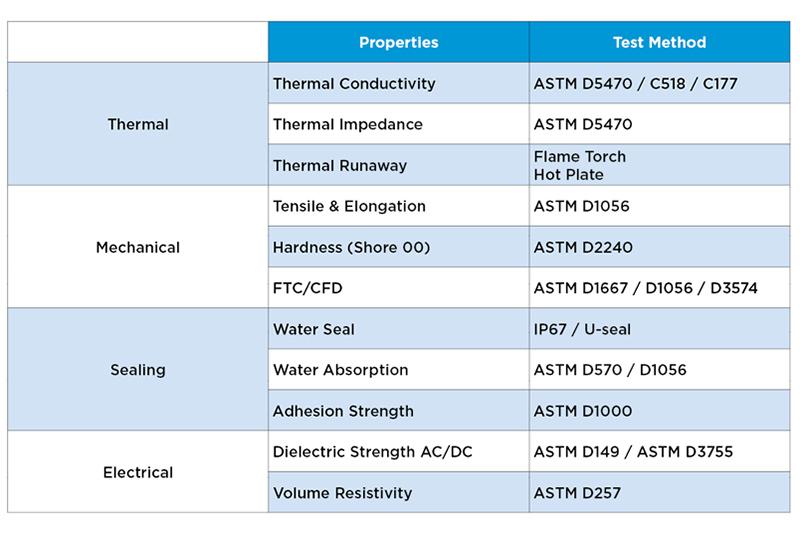
When additional testing is required, we have the internal capability and expertise to demonstrate material performance based on application targets. These tests help eliminate any material shortcomings and help you maintain your brand integrity.
As the energy transition gathers pace, our team is energised for the future of e-mobility. We have the drive and expertise to help accelerate your EV projects.
Our extensive portfolio of products and battery pack protection materials addresses extreme conditions of temperature, smoke, fire, air, and water to keep electric vehicles on the roads for longer.