

Leading the Electric Transformation
The transformation to a sustainable, electrified future that isn’t reliant on fossil fuels is well underway. Projections show that approximately half of the world’s consumption of energy could be in the form of electricity by 2050. Modern day technologies that support these efforts for widespread electrification are all around us. Look no further than the ongoing proliferation of electric vehicles (EVs) around the globe.
Plugging in and decarbonization of vehicles isn’t the only way to achieve electrification of our world. This task is quite challenging, as it includes everything from EV supply equipment (EVSE, often referred to as chargers) and energy storage systems to grid upgrades. Success means being able to replace machines and technologies that pollute with versions that are electric and can run on cleaner sources of energy. To support these electrification efforts, an entire energy and technological ecosystem is needed. Unseen — yet critical — tapes and materials make the technologies in this ecosystem possible.
Conquering Modern Day Challenges for an Energy-efficient Ecosystem
High-quality tapes, seals and compression pads are important to meeting the challenges of EVSE and EVs themselves, as well as in grid infrastructure. Each situation is critical and requires interface components that are up to the task now and after years of wear and tear.
To help meet these challenges, Saint-Gobain® Tape Solutions has a wide portfolio of highly engineered materials for demanding applications, such as silicone elastomers, polyurethane foam, polyamide and reinforced polyesters, which are capable of working in extreme conditions over an extended lifetime.
EVSE: last-mile EV power delivery
By 2032, the number of electric vehicles sold will make up over 67% and plugging in is only the beginning when it comes to cutting emissions. When used for automobile transportation, electric power must be transferred to an EV for usage via EVSE. On the consumer level, EVSE is little more than a plug, adapting either a 120 V AC or 220 V AC outlet to a vehicle’s power input port. The EV charging electronics, which reside onboard the vehicle itself, convert this AC power into the DC supply needed to supply the vehicle’s battery pack.
Transportation is an EV’s primary function, but longer trips and a better commuting experience wouldn’t be possible without the help of an ever-evolving EV charging network. When it comes to public EVSE, consumers are often unwilling to wait the many hours needed to charge via AC current. Devices like Tesla’s Superchargers instead provide inverted DC power directly from the plug. This allows for a high energy transfer rate, adding up to hundreds of miles of EV range in minutes.
Such high energy transfer rates make safety and electrical isolation even more critical than in residential applications. Additionally, public-facing EVSE typically receives higher usage and more wear-and-tear, meaning they must endure hot and cold temperatures, rain, grime and other abuses, making this a truly challenging application. To meet these requirements, high-quality sealing and thermal management components can be implemented to increase resilience of EVSE and safety for users. To enhance the EV charging infrastructure and stand up to its key challenges, customers often rely on:
- Norseal® Series products for providing protection from extreme environmental exposures at component interfaces and equipment enclosures.
- ThermaCool® products, which offer a range of solutions that dissipate excess heat generated by high power electrical components during charging cycles.
- CHR® Tapes for proven performance in a wide range of insulation and wire harness applications.
- Norbond® Series products for permanent adhesive bonding such as for emblems, exterior attachments and structural panels.
Power destination and storage
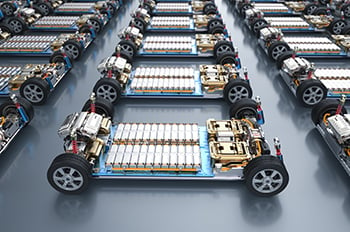
Another critical feature of EVs is their ability to serve as impromptu energy storage. This allows them to double as an excellent grid backup device, putting their massive energy storage capabilities to use when connected.
EVs experience many of the same isolation and durability issues as the equipment used to supply them, while constrained to a compact, mobile shell. EV battery packs must therefore be extremely well designed from a mechanical and thermal perspective and use high-quality components.
In this application, compression pads offer a moderate contact pressure against the battery cells. Each time a battery charges and discharges, a chemical reaction causes the cells to swell ever so slightly. Although minute, this dimensional change can stress electrical and thermal connections and induce rattle in battery components. Thermal interface materials and cushioning pads provide a secure base for cells in the battery pack. Compression pads provide optimum cushioning support to the batteries, which includes the reversible breathing (dimensional change) of the cell during its charge and discharge cycle as well as the gradual swelling that occurs throughout the battery lifespan. Thermal interface materials work as a heat sink providing a thermal path for heat to flow away from the battery and they must have good, soft conformability without any compromise on thermal conductivity, something that a product like TC2009 could offer. Gasket seals such as F-15, R10404 Series, or the more economical micro-cellular polyurethane PS-V0, provide isolation from the external environment. And, perhaps most importantly, our thermal runaway protection materials are designed to protect EV battery cells from thermal runaway events and minimize/mitigate fire propagation.
These solutions, altogether, add up to safer, more reliable battery packs and can be utilized to also design a more safe and reliable energy distribution system, essentially a BESS on wheels.
Grid infrastructure technology: the foundation
The trend today is toward a distributed power generation and storage model, where consumers generate power on-site via solar arrays and that energy can be used, stored or potentially fed into the grid.
Transformers are a key link here, enabling energy transfer between high-voltage transmission lines and consumer equipment. Some power loss is inherent in transformer use, so efficiency is critical to maximize the energy transaction between sources and uses. Since power transformers have a service life of 25 years or more and are subject to climate extremes, durable designs and materials are needed. Internally, coil windings and dielectric materials may be secured with robust adhesive tape, which may be required to work in an oil-filled environment.
Distributed generation (e.g., home solar) means that some power is produced and used locally. This eliminates the transformer and its associated losses but requires a more thoughtful grid setup. This power may be used immediately or stored on-site, either to supplement high demand or as a resource during blackouts. This power is typically stored in a battery energy storage system (BESS), which is a dedicated power storage module inside or outside of the home. Increasingly, as EV ownership grows, this can also take the shape of a vehicle-to-home system, where the vehicle can double as a standby power supply.
Regardless, such energy storage devices are often based on lithium-ion technology, which must safely and efficiently undergo thousands of charge and discharge cycles. Lithium-ion’s volatility is well-known, so any Li-ion technology placed in or near someone’s home needs the utmost reliability and safety.
As with power transformers, interface and attachment materials like high performance tapes and compression pads make safe, efficient and reliable operation possible. This helps prevent dangerous arcing between battery cells, ensures electrical and thermal interfaces are in full contact and mitigates the risk of thermal runaway. Solutions such as our TRP series help design engineers get ahead of thermal runaway and mitigate the risk of fire propagation from one cell to the other in the event of a thermal runaway. Our Norseal TRP1000 product (coming soon) is a proprietary formulated silicone foam with mica surface layers, designed to offer high resistance to temperature and flame as well as greater durability of withstanding a thermal event.
Extreme customized solutions to meet the toughest challenges
Our Tape Solutions team is ready and eager to customize and co-develop custom products that stand up to today’s most common challenges and aid in innovations within electrification. Success with electrification will aid in creating more efficiencies, less waste, less pollution and, most importantly, less CO2 emissions, leading to a more sustainable world. When it comes to taking on a specific EV, EVSE or smart grid challenge, we’re ready to think about the future today.


