

Driven by advancements in consumer electronics, artificial intelligence, data centers, automotive technologies, and the rollout of 5G, global demand for semiconductor chips continues to surge. As a result, pressure to scale production while maintaining precision and efficiency is on the rise. The semiconductor market is just one of the many requiring the precision cushioning products we manufacture.
A critical precision cushioning product in semiconductor manufacturing, Chemical Mechanical Planarization (CMP) is used to smooth and flatten silicon wafer surfaces to ensure optimal performance of microelectronic devices.
CMP combines chemical etching and physical grinding to remove excess material from the wafer. A polishing pad, often made of engineered foam, and a slurry containing micro-abrasives and reactive chemicals are used together. The slurry chemically softens the wafer surface while the pad applies mechanical abrasion, resulting in a smooth, planar finish.

CMP is Critical to Semiconductor Performance
- It helps create uniform layers of metal and interlayer dielectric
- It helps reduce interconnect resistance
- It helps improve device reliability
- It helps ensure a smooth topography for metallization and photolithography
Explore Saint-Gobain Tape Solutions microcellular polyurethane foam substrates
Foam pads play a vital role in the CMP polishing processes, acting as a carrier for the slurry (mixture of abrasive particles and chemicals that are applied to the wafer surface), ensuring even distribution of abrasive particles across the wafer.
This helps achieve more consistent wafer quality, reduced waste, and improved throughput, ultimately streamlining manufacturing and boosting overall efficiency. Additionally, the foam pad provides a cushioning effect, helping to protect the delicate wafer surface from mechanical damage during polishing. By enhancing uniformity and reducing surface tension, foam solutions minimize defects and improve planarization performance. This leads to better yield and lower cost per chip, key advantages in today’s competitive semiconductor landscape.
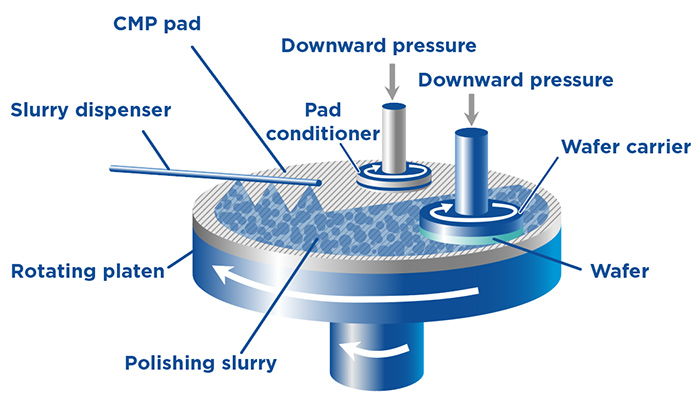
Pads and slurries are consumables in the CMP process, and their selection is crucial. Choosing the right foam pad involves balancing technical performance, process optimization, and cost-of-ownership.
Layer By Layer: Construction of the CMP Pad Matters
A layered construction of the CMP pad helps achieve custom tuning of pad performance based on process requirements, wafer types, and desired outcomes.
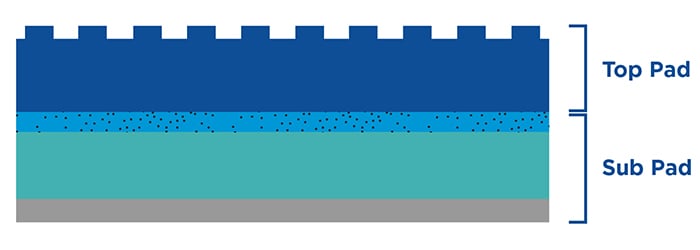
Exploring the Benefits of Saint-Gobain Tape Solutions Foam Sub Pads
- Proven, World-class Expertise & Capability: Trusted supplier with over 15 years of experience in CMP sub pad foam solutions, with access to global R&D and measured manufacturing for high-performance microcellular cast polyurethane foam substrates.
- Customized Solutions: Complete CMP pad designs are unique per the manufacturer. We will work closely with you to fine tune our sub pad solution to ensure optimal properties of the final CMP pad design.
- Made in the USA: Manufactured locally in Granville, NY, ensuring quality and supply chain reliability.
- Collaborative Development: Deep understanding of multi-year qualification cycles and end-user approval processes. Our global teams can work with you to co-develop tailored solutions to best meet specific needs.


