
Why Consistent Pressure Management Is Critical for ASSB Reliability

What if the next leap in electric vehicle battery technology hinged not just on chemistry, but on something as simple, and as complex, as pressure? Since battery-electric mobility gained momentum in the early 2010s, innovation has advanced at breathtaking speed—today’s EV technology is hardly comparable to what first hit the roads. While lithium-ion batteries have dominated this transformation, a new generation is poised to redefine performance: all-solid-state batteries (ASSBs).
ASSBs promise higher energy density, improved safety, and longer lifespan compared to conventional lithium-ion technology. Yet, beyond breakthroughs in solid electrolytes and cathode materials, there’s a less obvious factor that can make or break ASSB performance: precise pressure management.
Even slight inconsistencies in pressure can lead to interfacial gaps, increased resistance, fire or thermal events and ultimately, premature failure. Is pressure management more than just a design detail— or is it a reliability enabler?
This article explores why pressure management is the unsung hero of ASSB reliability, the engineering hurdles it presents, and how advanced materials are shaping the future of solid-state battery design.
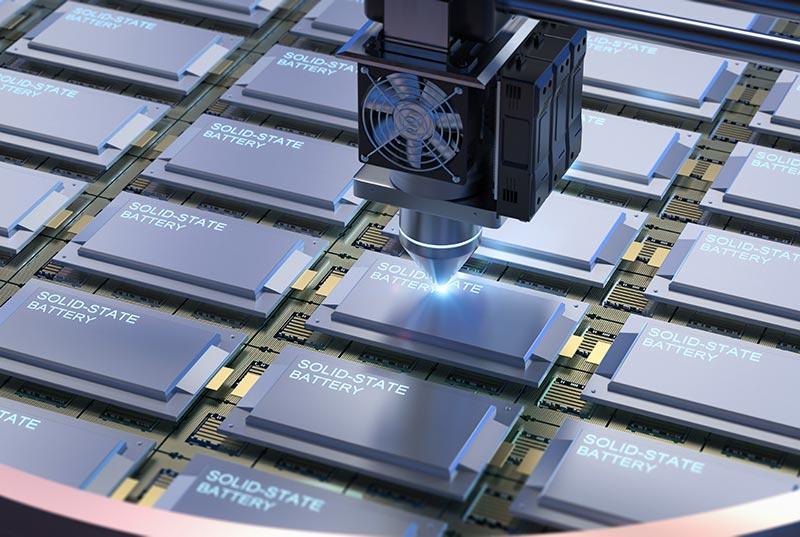
First, let us have a closer look at what ASSB technology is. In all-solid-state battery technology, the liquid electrolyte used in traditional lithium-ion (Li-ion) batteries is replaced with a solid electrolyte. This fundamental change brings several differences in design, performance, and safety.
- Safety: Using solid electrolytes promises enhanced thermal stability and a significantly lower risk of fire or leakage thanks to the absence of flammable liquid electrolytes—delivering improved safety and a longer lifespan compared to conventional lithium-ion batteries.
- Lifetime: ASSB technology potentially provides a longer lifespan due to reduced side reactions and better stability at high voltages.
- Performance: Increased energy density is maybe the most important performance advantage ASSB technology offers. These higher energy densities are achieved with the use of metal anodes which store more energy than graphite. In addition, solid electrolytes can support higher current densities, which allows for enormous fast charging rates.
As we see, ASSBs promise lighter, safer, and more energy-dense batteries, making them ideal for electric vehicles and high-performance applications. However, they introduce new engineering challenges—especially pressure management, thermal control, and manufacturing scalability.
Putting the right pressure on EV battery cells is nothing new and has led to significant improvements in safety, performance and lifetime of Li-ion EV batteries. But due to the different design, does that apply to ASSB technology as well?
The answer is: Yes. ASSBs rely on solid-solid interfaces for ionic transport. These interfaces must remain in close contact throughout the battery life cycle. Consistent pressure ensures low interfacial resistance for efficient ion flow, stable mechanical integrity during charge/discharge cycles and prevention of lithium dendrite formation as a cause of short circuits.
Therefore, without uniform pressure, microscopic gaps can form between layers with the risk of reducing conductivity and accelerating degradation. In short: the right pressure in ASSB batteries isn’t optional, it’s fundamental.
We learned that applying the right pressure in ASSB is important, but it is also far from simple. In operation, ASSBs see volume changes during cycling through expansion and contraction as well as thermal expansion and temperature fluctuations. These and other factors make the application of the right pressure challenging which could lead to cycle life drops, reduced energy efficiency, increased safety risks caused by gaps that could trigger dendrite growth or the emergence of thermal hotspots.
Innovative foam materials optimized for consistent pressure application in ASSB operation could be the solution. Let us see how.
Pressure management in ASSBs is not a secondary design consideration, it is a core reliability factor. Unlike liquid-based systems, solid-state batteries depend on intimate contact between solid electrolyte layers and electrodes to maintain ionic conductivity. Any loss of contact increases interfacial resistance, reduces efficiency, and accelerates degradation.
There are different material strategies for pressure management and to achieve uniform pressure across the stack in combination with mechanical resilience, thermal stability, and long-term reliability.
Compression Pads for Uniform Pressure Distribution
Advanced compression pads with controlled elasticity and creep resistance help compensate expansion and contraction and maintain consistent pressure for improved stack integrity even under dynamic conditions. Key properties include:
- Elastic modulus tuning for predictable deformation under load.
- Long-term compression set resistance to prevent pressure loss over time.
- Custom geometries for integration into complex module designs.
Specialty Foams for Stress Absorption and Thermal Control
High-performance foams serve a dual role by absorbing mechanical stress and managing heat during operation. Closed-cell structures provide cushioning while maintaining dimensional stability, and formulations can be tailored for thermal conductivity. Benefits include:
- Vibration damping to protect fragile interfaces during vehicle operation.
- Thermal insulation or heat spreading to mitigate hotspots during fast charging.
- Lightweight design to support EV efficiency targets.
These advanced materials could be further optimized with adhesive properties and pre-cut foam components that simplify assembly to streamline production processes, reduce labor costs and ensure repeatable quality.
ASSBs represent a major leap forward for EV technology but their success depends on more than chemistry. Mechanical design, specifically pressure management, is a hidden key to reliability. By leveraging the expertise and unique capabilities of Saint-Gobain® Tape Solutions, our experts can help create advanced compression pads and foams to overcome challenges in solid-state battery development.