
Unraveling the Solutions that Help Mitigate Fire Risk and Propagation

Without a doubt, thermal runaway protection (TRP) continues to be a key concern when it comes to high-powered electric batteries. As electrical vehicles (EVs) become more advanced with improved motor performance, higher capacity and extended driving range, the path ahead will require game-changing materials to help provide a positive impact on thermal safety. These materials will have to support OEM customization requirements to maintain intelligent battery safeguards, while helping to support electrifying new innovations.
Saint-Gobain® Tape Solutions has a wide range of customizable solutions that can help mitigate fire risks and propagation, improve thermal management as well as aid in managing cell swelling to reinforce battery safety.
We’d like to introduce you to Dr. Fei Wang, the subject matter expert on solutions that make a real impact on thermal safety.
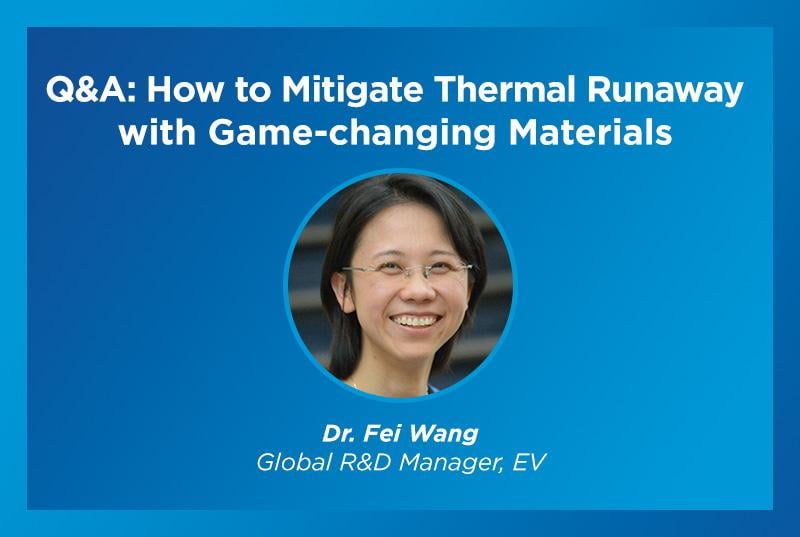
Dr. Wang is the Global R&D Manager for EV at Saint-Gobain Tape Solutions and has a PhD in polymer science from MIT. She joined Saint-Gobain in 2010 and has been actively developing new product solutions for various applications.
Her expertise is in the development of products that mitigate thermal propagation and manage cell swelling in batteries for EVs.
We’ve asked Dr. Wang a few questions regarding the technical article and, more specifically, about the role of compression pads and how they impact thermal stability.
Dr. Wang, could you please provide a short summary of the “Material Solutions for Battery Pack Thermal Runaway Propagation Protection” article?
Yes, I do not want to give away too much detail as I hope interested parties will take the time to review the article content. The main purpose of the article was to explain how our TRP products can combine thermal runaway protection functions with other functions such as cell-to-cell cushioning, electrical insulation, gasketing and sealing. At Tape Solutions, our goal is to provide our customers with multifunctional solutions. This article touches on some of those solutions.
What is the role of compression pads and how can they work in relation to TRP?
Lithium battery (LIB) cells are stacked in a configuration such as a module or a pack to achieve high-energy density of EVs. Such a design requires an outer bracing to retain mechanical integrity and safety, which applies an external pressure on the LIB cells’ surfaces after assembly.
When in service, LIB cells undergo a reversible thickness change during charge/discharge cycle (“breathing” mode) and a gradual irreversible increase of thickness over their lifespan (“swelling” mode). A significant internal stress will build up within the LIB cell stack under the mechanical constraints of the module or pack. It has been reported in many studies that too low or too high pressure negatively affects the cell lifetime performance due to various factors, including electrode layer delamination, Li-plating, SEI (solid electrolyte interphase) growth, and others. Controlling the pressure exerted on LIB cells in an optimal range is crucial to improve cell efficiency and prolong cell lifetime.
We have high-performing compression pad technology to effectively manage the pressure on LIB cells; one family of compression pads has thermal runaway propagation protection via thermal stability and insulation.
ASTM test methodology is the most common, but what if the customer application is different?
To answer this question, let’s look at compression pad as example. Cell breathing is a lot slower than in a typical ASTM (American Society for Testing and Materials) test method. Because of this, our team performs testing at different compression speeds and utilizes material simulation to better understand how materials perform in real-life situations.
The bottom line is that battery designs vary. To best support our customers in achieving their best design, we need to have a conversation and explore capabilities and options. Please don’t hesitate to reach out to us to find a solution together. Through a collaborative approach, we work cross-functionally to seek powerful solutions that will perform today, but also carry us forward to a more sustainable future. With R&D colleagues such as Dr. Ying Wang and Dr. Sheng Zhao, we’re driven to be your reliable partner for specialized product development and new innovations.
Our R&D aims at pioneering high-performance products, driven by a commitment to innovation and customer-centric solutions. Emphasizing sustainability, our focus has extended to reducing carbon emissions and embracing circular economics, to foster a more resilient future. For example, we are developing more sustainable silicone products using recycled raw materials that could achieve more than 60% CO2 reduction compared to silicone products made from virgin materials. We also plan to launch silicone products that have extremely low level off-gassing of cyclic siloxane.
— Dr. Ying Wang, R&D Manager, Silicones Core Technology
At Tape Solutions our primary goal is to ensure that you, our customer, are part of the conversation, whether it involves enhancing current solutions or coming up with something entirely new. We know that several existing options can help secure thermal protection at optimal levels and we are committed to research and development of products that can help balance the safety, performance and longevity of the heart of your EV- the battery pack.