
Explore the Solutions that Address Your Most Pressing EV Challenges

As we ramp up towards mass adoption of electric vehicles (EVs) by 2030, innovations in the world of EVs are getting a turbocharged boost. Protecting the battery pack, the heart of the EV, is crucial. Solutions engineered to conquer key challenges such as thermal runaway protection and maintaining safety and performance of the vehicle are of utmost importance. Our products often emerge as the ideal answer to a spectrum of needs, including compression and tolerance pads, thermal runaway safeguards, pack sealing, gasketing, cushioning, electrical insulation and thermal interface applications.
In our latest interview with Patrick Lynch, Commercial Manager for EV, we explore the solutions that help our customers propel the future of battery-operated vehicles and conquer the toughest challenges at the cell level, pack level or within the e-motor.

When you talk with customers, what questions does your team first ask to ensure that you steer them toward the products and solutions they need?
When we engage with customers, we like to understand what area in a battery pack application they are focused on. Understanding whether the customer is looking for solutions at the cell level or the pack module level helps us to steer customers in the direction they need to go and point them towards the solutions they seek. In that application area, understanding how the rest of the components come together is also useful.
Can you specify what a customer may be seeking if they are focused on the cell level of the battery pack?
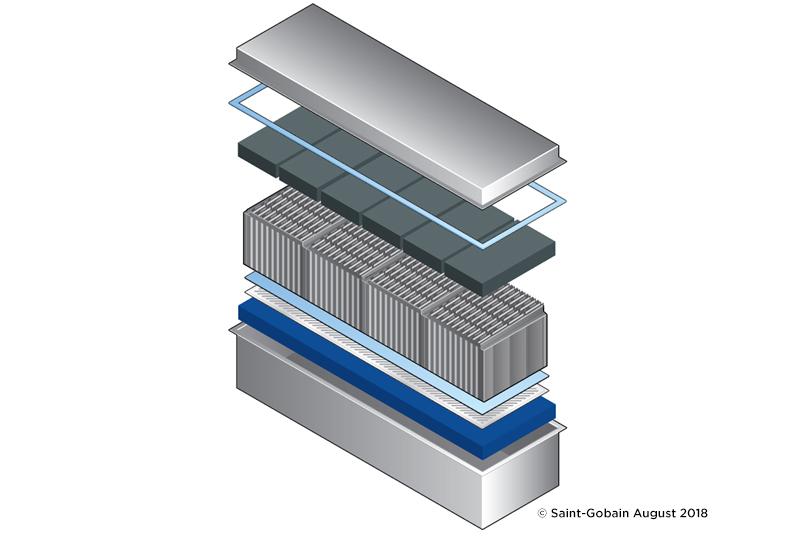
At the cell level, customers are mostly looking for compression pads. These are the foam materials that go between each cell and help to control the expansion and contraction (“breathing”) of the cell during charge and discharge cycles, extending the life of the cell. These materials are usually polyurethane foams or silicone foams. We can easily offer these solutions in different thicknesses or densities. We even offer die-cut converted parts for prototype development parts in different shapes, depending on customer needs and specifications.
Sometimes, customers also seek a bonding tape that can attach the compression pad to the cell. We have some thin transfer tapes or double-coated tapes that are ideal for these types of applications. Additionally, we have cases where customers seek materials that can provide thermal runaway protection in between the cells and we have a couple of new products that perform exceptionally well in slowing thermal runaway. Thermal runaway protection is an issue that is a huge topic and a requirement at the cell level, pack level or module level.
Can you specify some of the key applications that customers seek at the pack level?
When looking at the battery pack, we’ve got several different applications. One of the primary applications is what we call pack sealing gaskets. A common application might be for the seal that goes on the battery pack lid, or the cover of the pack. Other areas where gasketing solutions are applied within the pack include vent areas or areas where hoses and wires may come into the pack. Our gasketing materials are typically comprised of polyurethane or silicone and we have solutions for both! Customers also look to put in another layer of material to provide additional thermal runaway protection within the pack itself. Thermal interface materials are also used within the pack. They are silicone materials that can provide heat transfer between cells and a cooling plate or some sort of heat sink. Foam materials are also utilized around the pack itself to help cushion certain areas and keep some sort of vibration cushioning between two different surfaces within the pack.
A cooling plate works to keep the battery cool, correct? Could you explain what other Tape Solutions materials can help with this?
Correct. A cooling plate is similar to what you would consider like a radiator inside a vehicle where they might run fluids through a plate to help keep the battery cool. Thermal interface materials play a key role in keeping this cool. Customers also utilize cushioning pads underneath these cooling plates to help compress or stabilize all the different layers in the battery pack assembly. These cushioning pads help cushion and keep everything together and eliminate the possibility of transferring heat if the thermal interface materials ever get separated from the cooling plate.
There are a lot of electronics that go into a battery pack. The circuit board itself is like the brains of the battery pack. What materials are utilized to protect these elements?
A lot of electronics-specific applications require what is called a V0 rating. This means the materials need very high flame retardancy. These V0 rated solutions are often applied inside the interconnect board or battery disconnect units. Within these types of parts insulation tapes are often utilized. These tapes are also utilized in and around the battery pack. These electrical insulation tapes are made of various materials like polyimide, polyester, PTFE film and glass cloth tapes and they protect the metal areas inside of a pack. A new product we offer is called mica tape and it has been popular due to its very high-temperature resistance as well as good insulation properties.
Saint-Gobain® Tape Solutions has an extensive array of products that are dedicated to safeguarding battery packs and maintaining the safety, performance, and longevity of your EV. Additionally, our customized solutions, technical and global expertise can help you go the extra mile and shape the future of electric mobility.