
Driving Battery Innovation Forward: The Norseal® TRP Advantage

What are the key factors that drive the success and effectiveness of a battery pack?
Success isn’t defined by a single metric. It’s the result of a carefully balanced combination of technical performance, safety, economic viability, and operational efficiency. At the core of this balance are a well-integrated Battery Management System (BMS) and a robust thermal management strategy. These systems ensure the battery pack remains reliable, safe, and durable over time, while also enabling high-performance capabilities. They play a crucial role in meeting operational demands such as fast charging, high energy density, and efficient power delivery, making them key to the overall success of the battery system.
However, understanding what makes a battery pack successful also means recognizing what can cause it to fail and learning from it.
As Henry Ford once famously said, “Failure is simply the opportunity to begin again, this time more intelligently.” This quote emphasizes the notion that failure is never the end. It is a critical step necessary for true innovation, refined ideas, and improved systems.
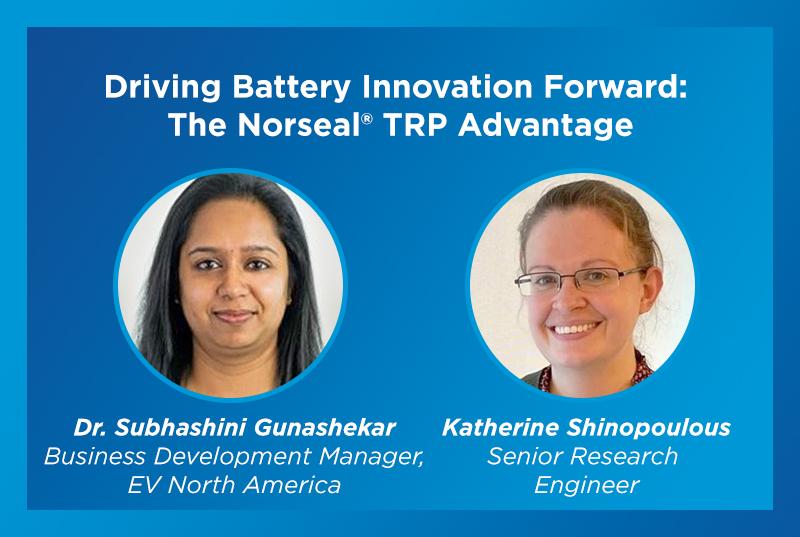
In this blog, we connected with Dr. Subha Gunashekar, Business Development Manager and Dr. Katherine Shinopoulous, Senior Research Engineer, to learn more about the most common challenges in battery design and discover how new material innovation can help prevent failures and pave the way for a more reliable and electrified future.
In a battery pack, failure can stem from internal or external sources.
Internally, battery cell degradation is one of the most common issues, often caused by lithium plating or electrolyte breakdown. Manufacturing defects in the cells or issues with the BMS, (essentially- the brain of the system) can also lead to failure, especially in instances when sensor data is compromised.
Externally, battery packs are vulnerable to thermal abuse from environmental conditions such as extreme heat or nearby fires which can trigger thermal runaway. Mechanical abuse such as damage from a crash or puncture, and electrical abuse during charging or discharging, especially if the system is compromised by water entry, are additional risks that can negatively affect safety and performance.
But, what stands out as the cornerstone of battery pack design?
The answer? Thermal management. With a wide range of battery cell formats, including cylindrical, pouch, and prismatic, as well as varying chemistries, cathodes, anodes, and electrolyte compositions, battery pack design is inherently complex. Yet, one constant remains: all cells require sufficient pressure and effective thermal insulation to ensure safe and optimal performance.
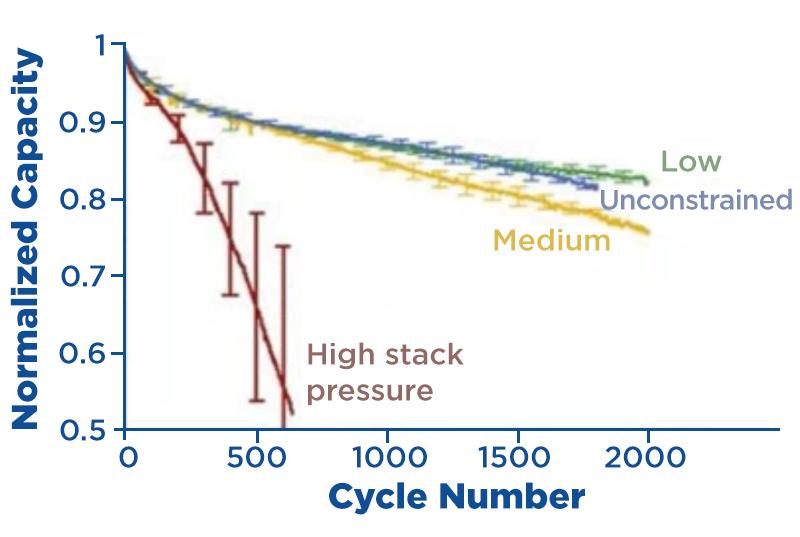
Optimal stack pressure improves both cell performance and longevity. If pressure is too high, normalized cell capacity decreases; if it’s too low, the cells lifetime shortens. The right amount of cushioning material can significantly extend the cell’s life, translating into better performance and reliability for the end user (Fig 1).
Now, what about thermal insulation?
Equally vital. Without any insulating barrier, simulation studies and real-world tests show that structural breakdown can occur in less than five minutes. Even a thin insulating layer can help delay this breakdown by approximately 13–14 minutes. But, the ideal solution is to prevent thermal propagation altogether. This is vital to ensuring better protection for both the vehicle and its occupants. To be successful, the materials used for thermal barriers must possess the following factors:
- Low thermal conductivity
- High temperature resistance
- Structural integrity at elevated temperatures
Material selection in battery pack design is a decision that leaves no room for compromise. The chosen material must endure extreme thermal and mechanical conditions without degrading over time.
Today’s EV battery packs rely on a variety of insulation barrier materials, each with its own strengths and limitations. Ceramic-based materials like aerogels and ceramic paper offer excellent thermal resistance but often fall short in mechanical durability. On the other hand, organic materials such as polymers, plastics, and cork provide solid mechanical support but tend to underperform in high-temperature environments where thermal stability is critical.
These trade-offs highlight a clear need: a solution that combines the best of both worlds, offering both thermal protection and mechanical integrity.
Driven by a desire to keep innovation in the fast lane, the Saint-Gobain® Tape Solutions team developed the Norseal TRP Series to provide a multifunctional thermal barrier, engineered to deliver both mechanical strength and thermal protection.
What did the development process look like?
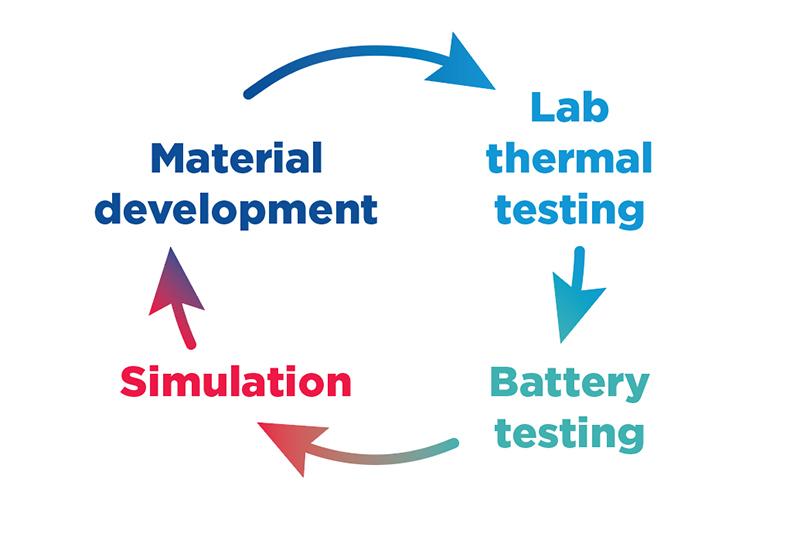
The team followed a model-assisted, iterative development process. It began with material formulation and lab testing, including thermal conductivity measurements under compression and high-temperature proxy tests. Promising materials then underwent battery testing to simulate real-world thermal runaway scenarios, which vary depending on battery type and system configuration. These insights informed simulation models and sensitivity analyses, helping identify the most critical parameters influencing thermal behavior. This feedback loop allowed the team to refine materials and confirm their performance in actual applications, not just in lab settings.
Recognizing that pouch and prismatic cell formats require tailored mechanical support to extend their lifespan, the Norseal TRP Series was carefully tuned to deliver across a wide compression range. It offers robust thermal protection compatible with various chemistries, including LFP and NMC, ensuring safety without compromising performance.
But what truly sets Norseal TRP apart is its customizability. Available in multiple thicknesses and surface finishes, it can be configured with or without adhesives and on tacky/matte surfaces to meet specific application needs. Whether you're designing for battery electric vehicles, energy storage systems, materials handling equipment, or heavy-duty platforms, Norseal TRP is built to adapt.
Its functional versatility makes it ideal for:
- Cell-to-cell thermal barriers
- Pack covers
- Fire protection
- Venting solutions
- High-temperature gasketing
By delivering both high-performance thermal protection and dependable mechanical support, Norseal TRP sets a new benchmark for battery safety and durability. It’s not just a barrier, but rather it’s a breakthrough, engineered to keep electrified systems cooler, stronger, and more reliable for the long haul.
Whether you're designing for electric vehicles, energy storage systems, or industrial applications, our team is here to help you find the right solution. Connect with us today to learn more about Norseal TRP and explore how our customization capabilities can support your specific performance and design goals.