

Accelerating Automotive Assembly with Norbond® Attachment Tapes
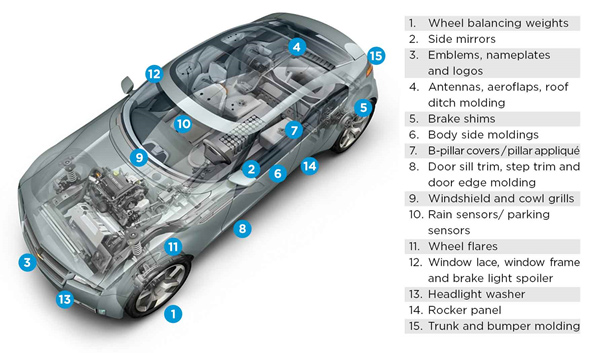
During the automotive assembly process, there are several components which are permanently attached to the vehicle exterior, including emblems and nameplates, wheel weights, and body side moldings. These parts require a high-performing and reliable attachment technology that lends itself well to the demanding automotive manufacturing processes. Although there are several attachment methods available, including mechanical fastening and liquid adhesives, foam bonding tapes are the industry’s preferred technology due to their reliability, cost efficiency, and performance capability.
Saint-Gobain Norbond® Attachment Tapes, using their combination of elastomeric foam cores and a durable pressure-sensitive acrylic adhesive (PSA), are designed for durable, long-lasting adhesion across a variety of vehicle applications. Norbond Attachment Tapes are the ideal choice for exterior applications, with the ability to provide unparalleled resistance to a wide range of environmental conditions.
Component Attachment Methods
Norbond Attachment Tapes are specifically engineered to overcome many of the typical assembly problems where other attachment technologies fall short. Adhesive tape attachment is quicker and simpler in comparison to liquid adhesives. Tape attachment requires only assembly line presses for applying adequate pressure to the tape, with no further special processing equipment. Generally, foam attachment tapes should be applied with 15 PSI pressure for at least five seconds. It is easy to dispense slit rolls of attachment tape or pre-cut tape pads matched to the bond area. Norbond Attachment Tape solutions are able to work in automated lines, improving efficiency and reducing manual errors. A key recommendation is to always first clean the surface with isopropyl alcohol (IPA) or a mixture of IPA and water.
Tape attachment methods provide a clean appearance without creating holes or stress concentrations, reducing chances of leaks, corrosion, and damaged surfaces. For applications using mechanical clips, the combination of tape can help keep the part tight to the vehicle, improving sightlines and reducing noise and rattle of the parts.
Norbond Attachment Tapes provide several advantages for bond integrity:
- The joint load is distributed across a wider surface area. This eliminates stress concentrations and minimizes material property differences, such as mismatches in elastic modulus and thermal expansion coefficient.
- Adhesives and foam are flexible and are therefore resilient to light impacts and are more forgiving compared to more brittle assembly methods.
- Foam’s flexibility allows the tape to conform to body contours and shapes, providing a complete bond and better load distribution.
- Foam accommodates dimensional variations and mismatch arising from stack-up tolerances.
- There are no residual stresses from fasteners or thermal curing shrinkage, which is important when bonding long trim parts, where fasteners might lead to buckling or distortion depending on thermal expansion coefficients.
- Bond strength increases after initial assembly, reaching peak strength after 72 hours as additional adhesive bonds form.
Additionally, Norbond Attachment Tapes offer several performance benefits including:
- Vibration and shock isolation
- Good thermal and acoustical insulation
- Sealing, in addition to bonding
- Non-conductive joints, which are important for bonding dissimilar metals and alloys
- Reduction or elimination of rattling noise from mechanical fasteners
- A clean, neat appearance
- Improvement in manufacturing throughput
- Streamlined automotive body surfaces to minimize parasitic drag
Types of Norbond Foam Attachment Tapes
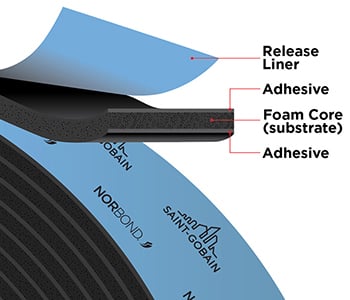
Foam attachment tapes consist of a foam core which has been coated on each side with an adhesive material. Adhesive chemistries may be acrylic, silicone, or rubber based. Adhesive technologies include pressure-sensitive adhesives (PSA’s), heat-activated adhesives, and hot-melt adhesives. Norbond Attachment Tapes consist of acrylic PSA coatings on a variety of foam cores.
The tape type is usually named for the core or carrier material that it is made up of; foam attachment tapes are so-called due to the carrier or backing consisting of flexible foam. Saint-Gobain offers two types of attachment tapes: Norbond Acrylic Foam Attachment Tapes and Norbond Polyurethane (PUR) Foam Attachment Tapes.
Foam attachment tape performance properties
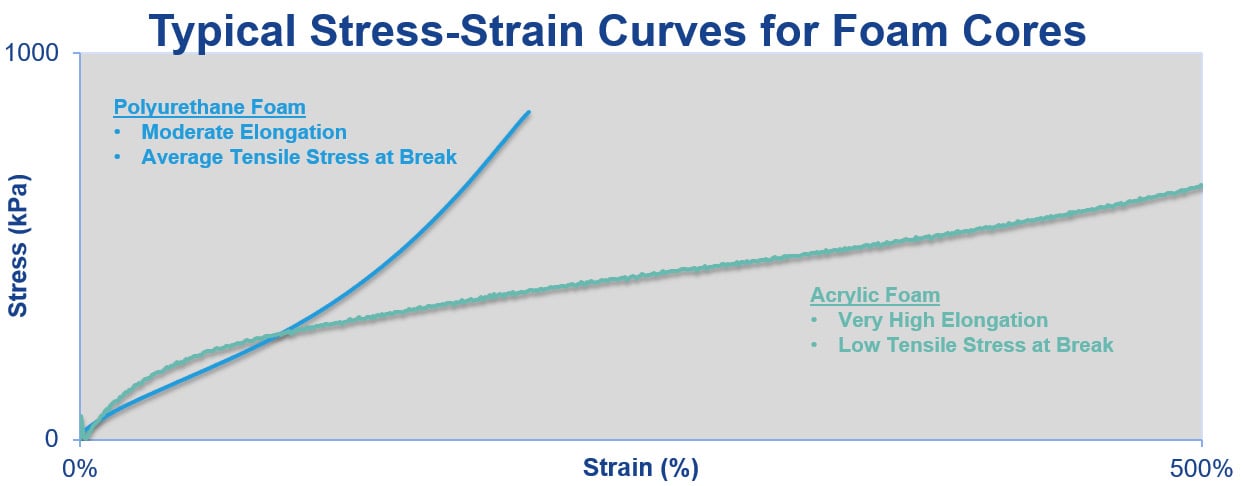
Before selecting which Norbond Foam Attachment Tape shall be used for an assembly application, it is critical to first understand the tensile properties of each of the foam tapes. Polyurethane (PUR) foam cores have a greater tensile break strength than acrylic foam, but acrylic foams have higher flexibility or ductility based on their elongation values. This increased elongation lets Norbond Acrylic Foam Tapes withstand larger strain before failure, which is useful in bonding large flat components to body panels where CTE mismatches occur. Norbond PUR Attachment Tape is beneficial in applications where higher tensile strength may be required, such as bonding small parts like emblems.
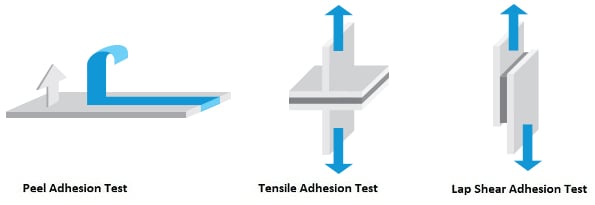
Determining the precise adhesive properties and bond strength depends on how the stress is applied. Tensile (pluck), peel, and lap shear modes may present in loads across the joint. These field conditions can be simulated by specific adhesion tests. Adhesion strength will vary with a number of factors in including the type of substrate, applied pressure, temperature, and surface pre-treatment. There are also substrates with low energy surfaces such as polypropylene (PP), polyethylene (PE), and thermoplastic olefin (TPO) that impair surface wetting. Surface wetting is necessary for strong adhesive bonds, and can be improved by increasing the surface energy with adhesion promoter, corona treatment, or similar surface treatments. For any specific recommendations or queries, consult the foam tape manufacturer. Saint-Gobain is a well-respected attachment tape manufacturer, with a long history of developing automotive exterior bonding systems. Choosing Saint-Gobain as your partner in developing the attachment systems for your automotive body and exterior components can ensure the success of a design project.
After the engineer has undertaken the stress analysis studies and understands how the joint will be loaded, the optimal attachment tape materials can be selected based on the peel, tensile, and shear adhesion properties desired. In some cases, it may be that there is a single or primary loading mode, although multimodal loading could occur in others. Polyurethane would provide the best bonding performance in smaller parts such as emblems, nameplates, shark fin antennas, and sensors, due to the high tensile and shear resistance. Long, narrow, flexible components like body side moldings, fender or wheel flares, window frames, rocker panels, and pillar appliqués undergo peel and cleavage type stress, so an acrylic attachment foam would typically be preferred.
Attachment | Average Continuous Peel | Peak Dynamic Tensile | Peak Dynamic Shear |
|---|---|---|---|
Acrylic Foam | 39 | 530 | 650 |
Polyurethane Foam | 14 | 840 | 850 |
For superior UV resistance, Norbond Acrylic Foam Attachment Tapes should be chosen over Norbond PUR Foam Tapes. However, in applications where noise, vibration, and harshness (NVH) is looking to be reduced, polyurethane foam would be recommended for its higher compressibility, cushioning, and damping characteristics.
| Tape Carrier Type | Distinct Advantages | General Performance | Typical Applications | Saint-Gobain Product Offering |
|---|---|---|---|---|
| Acrylic Tapes | UV Resistance | High Peel Adhesion | Body Side Molding | Norbond Z2000 Series Acrylic Tape |
| Viscoelastic | High Elongation | Longer Parts | Norbond Z3100 Series Acrylic Tape | |
| Low Water Vapor Transmission Rate | Stress Relaxation | Differential Expansion | ||
| Urethane Tapes (PUR) | Compressibility Cushioning / NVH | High Shear Resistance | Emblems | |
| Die Cutting | Great Tensile Adhesion | Wheel Weights | Norbond Z500 Series PUR Tape | |
| Conformability |
| Tape Carrier Type | Distinct Advantages | General Performance | Typical Applications | Saint-Gobain Product Offering |
|---|---|---|---|---|
| Acrylic Tapes | UV Resistance | High Peel Adhesion | Body Side Molding | Norbond Z2000 Series Acrylic Tape |
| Viscoelastic | High Elongation | Longer Parts | Norbond Z3000 Series Acrylic Tape | |
| Low Water Vapor Transmission Rate | Stress Relaxation | Differential Expansion | ||
| Urethane Tapes (PUR) | Compressibility Cushioning / NVH | High Shear Resistance | Emblems | |
| Die Cutting | Great Tensile Adhesion | Wheel Weights | Norbond Z500 Series PUR Tape | |
| Conformability |
Attachment Tape Design Tips and Next Steps
Before the design process is too far along, consult with experienced application engineers from Saint-Gobain. These experts have access to the materials, design, and manufacturing knowledge to ensure the right start to the development and material selection processes and keep it on the path toward success.
Components should be designed for exterior attachment with the largest bonding surface possible while avoiding any surface irregularities or voids.
- Bonding surfaces should be smooth and clean for optimal bond strength.
- Design the curvature of the part to match the mating body surface.
- Ribbing or webbing is sometimes designed into a body part to reduce material cost, add stiffness, or provide a uniform wall thickness for molding. Designing the part with a rib-free low profile and a larger bond area might be a better option.
- Hider lips on the edges of parts should be shallow enough, so they do not reduce the effective application pressure or contact the clear coat when assembly pressure is applied.
- Keep the Norbond Attachment Tape as close to the edge as possible to avoid ingress of water behind the part and possible freezing.
- Positioning pins or locating features can aid in proper part placement, but they should be designed to not interfere with the bonding surface.
- Tapes should be applied starting from one corner to avoid bubbles or folds that reduce the effective contact area.
It is vital that bonding surfaces have appropriate wettability. Increasing surface energy through primers or adhesion promoters can increase wetting. Some primers also contain coupling agents and catalysts. For recommendations, please consult with Saint-Gobain.
- Body parts made of polypropylene (PP), polyvinylchloride (PVC), ethylene propylene diene monomer rubber (EPDM), thermoplastic olefin (TPO) and thermoplastic polyurethane (TPU) materials typically require a primer coating. Norbond Z3000 is an excellent option to consider for primerless bonding to these types of LSE substrates.
- Body parts made of acrylic, nylon, polyamide, acrylonitrile-butadiene-styrene (ABS), reaction injection molded or thermoset polyurethane and polycarbonate materials sometimes require a primer coating. Norbond Z2000 is an excellent option to consider for primerless bonding to these types of MSE substrates.
- When bonding dissimilar materials, consult with Saint-Gobain to determine if a differential foam attachment tape with different adhesives on each side is suitable.
The minimum Norbond Tape thickness is linked to the maximum dimensional changes in the part (or the difference in expansion between the part and panel), which is a function of the operating temperature ranges and the coefficients of expansion.
Conclusion
Delivering the highest quality and longest lasting foam attachment tapes for automotive exterior attachment applications is just a call or click away. Contact us for details.


