

High-Performance Tapes Create Efficiencies in Appliance Manufacturing

The intense consumer demand for modern, new home appliances — also known as white goods — shows no sign of slowing down. There are several reasons for this trend. Affordable mortgage rates are encouraging a new wave of property buyers, who see a new home or apartment as a chance to renew or renovate. The number of homeowners has steadily grown since 2015 and today almost surely tops the estimated 124 million homeowners at the start of 2020.
Another factor is energy use; consumers are increasingly considerate of their energy usage, for both cost and environmental concerns. More people are also spending more time home than ever before, with consistent growth in telecommuting for both office workers and students. This means added wear and tear on appliances, as well as more scrutiny on inefficient and inadequate white goods.
This has led to a surge in demand for large household appliances, which manufacturers have had trouble matching. As a result, manufacturers are seeking dedicated assembly solutions that increase assembly speed, yet deliver the longevity, performance and aesthetic consumers expect.
The capabilities of premium tape solutions provide an answer to these challenges, by meeting the operational efficiency goals of appliance manufacturers while also maximizing energy efficiency of the appliances themselves. There are two important end uses for appliances: tapes designed for bonding, and tapes designed for attachment.
How Bonding Tapes Can Outperform Traditional Fastening Methods
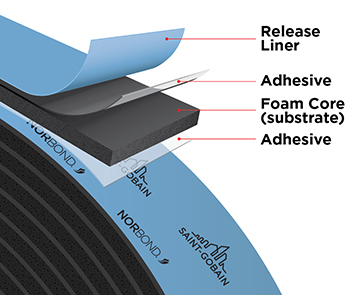
Whether used for assembly, mounting, fastening or sealing, bonding tapes such as transfer adhesives and double-coated adhesive foams outperform traditional mechanical fasteners and liquid adhesives. Appliance applications include high bonding strength, ability to withstand high levels of vibration and durable sealing against environmental conditions. Appliance applications include the fascia and control panels of ovens and dishwashers; refrigerator evaporator plates; and logos, emblems and decorative trim.
From an operational efficiency standpoint, bonding tapes can be die-cut to exact specifications, which translates to quicker and more consistent application with less waste. Compared to mechanical fasteners, they are easier to apply, translating to less labor; they also do not need the drilling of holes that can create the potential for leakage. Unlike liquid adhesives, they do not require premixing, curing and cleanup time, or the use of special tools; they also do not dry up or congeal, translating to longer shelf life.
One example of the impact of bonding tapes on energy efficiency can be seen in the construction of refrigerators. Traditional methods create an imperfect seal between the evaporator plate and the fridge wall, leaving gaps into which insulating foam can get caught and interfere with cooling system function.
Generally speaking, tapes also offer better aesthetic qualities than traditional bonding methods. While this might seem like a minor point, it takes on greater significance in the context of lifespan. End users do not expect an appliance to require aftermarket maintenance; by offering a lifespan that exceeds the life of the product itself, tapes eliminate the potential for product issues such as emblems falling off. This type of adhesion failure has the power to greatly diminish brand and quality perception.
Exploring the range of available bonding tapes offers a deeper look into specific capabilities. We offer several options appropriate for appliance applications. Our bonding tapes include Saint-Gobain Norbond® Acrylic Bonding Tape, which features an acrylic foam core with the ability to withstand stress — redistributing it along the length of a joint, away from the adhesive bond line. The foam similarly dissipates vibration, and it provides exceptional holding power at elevated temperatures. Thermal expansion and contraction forces are relieved by its elasticity, which offers the highest possible capacity for elongation.
Norbond Polyurethane (PUR) and Polyethylene (PE) Foam Bonding Tapes are designed for applications requiring high shear and tensile performance, and their construction makes them easier to die-cut. There is also the Saint-Gobain Biolink® portfolio of acrylic adhesive tapes, which employ an environmentally friendly, solvent-free ultraviolet curing process; a variety of different Biolink tape types are available for resistance to a variety of stresses, including chemicals, moisture and temperature.
Norbond Polyurethane (PUR) Foam Bonding Tapes are designed for applications requiring high shear and tensile performance, and their construction makes them easier to die-cut. Another option is Norbond Transfer Tapes, like Norbond A7100, that are resistant to a variety of stresses and provide a thin tape profile for applications with critical visual aspects.
Key Benefits that Attachment Tapes Add to the Assembly Process
While bonding tapes can be used in a variety of appliance applications, the use of single-sided aluminum attachment tapes tends to be targeted toward specific needs. Inside the walls of a refrigerator, for example, tape can be used to attach the condenser tubes that enable the thermal exchange necessary to keep a system cool.
Operationally speaking, using tape in this context provides several advantages over the older practice of attachment via metal clamps. The latter is a slower process, requiring skilled labor and often extra finishing procedures to remove stray weld marks. By contrast, tape can be deployed from long rolls with high tensile strength through a continuous, automated process. This translates to production at increased speed, consistency and reliability, along with maximum contact. The tape’s close adhesion directly affects energy efficiency, as well. It acts as a fin against the cooling coils, increasing heat transfer performance and improving energy efficiency ratio (EER).
We offer the Saint-Gobain h-old® series of single- and double-sided aluminum and reinforced aluminum foil tapes for fridge applications, but also a variety of tapes based on glass cloth, polyester and other materials for the assembly, sealing and electrical insulation of appliances such as stovetops, ovens and microwaves.
Key Benefits that Attachment Tapes Add to the Assembly Process
While bonding tapes can be used in a variety of appliance applications, the use of single-sided aluminum attachment tapes tends to be targeted toward specific needs. Inside the walls of a refrigerator, for example, tape can be used to attach the condenser tubes that enable the thermal exchange necessary to keep a system cool.
Operationally speaking, using tape in this context provides several advantages over the older practice of attachment via metal clamps. The latter is a slower process, requiring skilled labor and often extra finishing procedures to remove stray weld marks. By contrast, tape can be deployed from long rolls with high tensile strength through a continuous, automated process. This translates to production at increased speed, consistency and reliability, along with maximum contact. The tape’s close adhesion directly affects energy efficiency, as well. It acts as a fin against the cooling coils, increasing heat transfer performance and improving energy efficiency ratio (EER).
Dedicated Capabilities for Customized Solutions
For every application, there is an ideal tape — yet the need for individual solutions often precedes their creation. While distributors can offer several tape options intended for general purposes, few offer the opportunity to work directly with those who design the tape.
We are capable of reverse-engineering products to meet process needs. Our customers have access not only to one of the widest portfolios of available off-the-shelf solutions, but also to the possibilities of solution co-development. This includes functional considerations such as materials and chemistry compatibility, as well as aesthetic considerations such as colors designed to match appliance components. Shapes can be cut to fit exact specifications, while plant production needs can be accommodated through what are essentially unlimited formatting options.
Moreover, the unique properties of the materials to be bonded, the environmental conditions in which they will function, and the expected wear over the intended life expectancy of the appliance are factored into the design of a custom solution. These qualities are used to guide the composition of adhesives; the development of tape substrate qualities such as thickness, density and cell structure; and the selection of appropriate release liners. We can also quickly create prototypes for testing in customer facilities and can offer solutions for subsequent conversion into production runs.
The Right Tapes Can Contribute to Success
The trend of workers and students completing their daily work from home is here to stay, and with it, increased demands on household appliances. Appliance manufacturers have the immense opportunity of a larger demand for consumer appliances than ever before — but only if they are prepared to scale production with proven technologies and assembly techniques.
Contact us today and let us help you to succeed in a redefined appliances market.


