

Advanced Stationary Energy Storage Solutions for Improved Energy Supply
The global economy and our daily lives are heavily based on the availability of energy. Production, transportation, services, communication and the device you are reading this article on – there is hardly anything in today’s world that does not require energy. And with growing digitalization, changes in mobility and globalization, the demand for energy is constantly growing. There are many sources of energy and sophisticated grids to provide energy wherever and whenever it is needed but current and past energy consumption comes with a price. The impact of intense use of fossil fuels and other limited resources is having negative impacts and the need for a more sustainable energy supply is one of the biggest challenges of humankind.
Renewable Energy Production on the Rise
Negative effects on people, health, environment and economies, dependencies on limited resources, geopolitical risks as well as new developments in making sustainable energy production more efficient and affordable have led to a rethinking of energy policy. Clean power projects are on the rise globally and according to the EMBER Global Electricity Review 2022, wind and solar, the fastest growing sources of electricity, reached a record 10% of global electricity in 2021 while all clean power totaled about 38% of supply.
Renewable energy supply is an important step in reducing the CO2 footprint and in mitigating climate change and consequences caused by the phenomenon. To help wind and solar energy supply get into pole position in renewable energy production and to grow even further, small parts like tapes play an important role. Our tapes for composite moulding are used to manufacture the largest wind turbine blades in the world. Special PET or PTFE tapes like the CHR® M-Series or CHR 2255 protect molds, tool surfaces and blades and can be re-used several times, reducing effort, cost and labor time. Due to their low coefficient of friction (CoF), the part will release from the mold much more readily reducing the amount of rework and improving the quality for down-steam processes. Continuous process improvements like these aimed at renewable energy production are making wind turbine manufacturing more efficient and cost-effective.

But renewable energy production is only one piece of the puzzle. Since renewable energy is mostly not consumed where it is produced, it needs to be transformed and transported. New generations of transformers and generators use special tapes like our full portfolio of Kapton® and Nomex® tapes with high mechanical, electrical, temperature and chemical resistance and ensure trouble-free energy supply. Validated by their UL recognized status, these tapes provide outstanding oil compatibility as a key factor to increase performance and durability of transformers and generators, and keep maintenance efforts in electro-mechanical applications to a minimum.
A common challenge in renewable energy production is intermittency as many renewable sources are not available 24/7. Generation of renewable electricity often does not align with peak demand hours, causing stress on grids due to fluctuations and power peaks, and there can be unpredictable weather events that disrupt these technologies. Also, the present infrastructure is mainly built for more regional fossil fuel and nuclear plants while renewable energy often needs to be transported over long distances to where it is consumed. There are many reasons why renewable energy sources pose a need for efficient storage systems that help to store the surplus energy for later use.

The Importance of Energy Storage in Future Energy Supply
Sustainability has become a major concern in most industries and our daily life and will become even more important for economic growth. Electric mobility, changed transportation, industrialization, digitalization and other global developments will influence the need for clean energy that increases performance and energy density while reducing costs. Stationary energy storage is seen to play a crucial role in the transition from a system based on fossil fuels to one with higher shares of renewable energy. Energy storage has become a ubiquitous component of the electricity grid, leading to a boom in storage capacity around the world as electricity is expected to make up half of our final energy consumption by 2050.
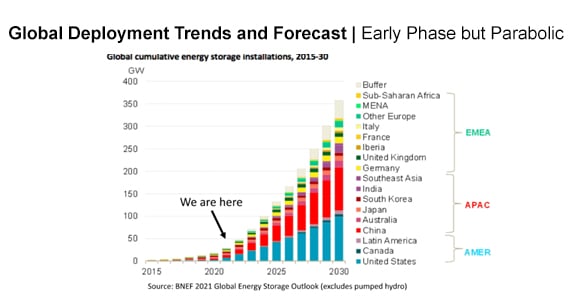
Efficient and Safe Energy Supply with Stationary Energy Storage
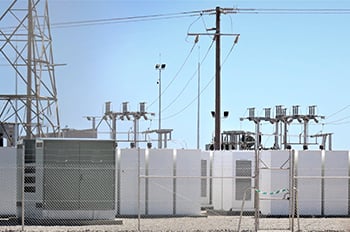
Optimized energy storage systems can help with grid stability and on-demand availability, thereby preventing blackouts. Today and even more so in the future, they play a key role in modern smart grids designed to fulfill changing energy demands like that for electric mobility. They also increase flexibility and offer new opportunities for remote areas. There are multiple storage technologies available, from electro-mechanical, chemical, thermal or electrochemical (batteries). Each has its advantages and disadvantages but advancements in battery technologies and decreasing costs can be seen as general enablers behind the rise of stationary energy storage technologies.
While long-term bulk energy storage is dominated by storing water in hydroelectric dams, more short-term solutions like electric batteries, flow batteries, flywheel energy storage or supercapacitors with different characteristics are used on various scales within electrical power grids. Among these technologies, grid-oriented rechargeable electrochemical battery energy storage systems (BESS) are currently the only storage solution that is widely deployed. These BESS batteries are mostly based on Lithium-ion (Li-ion) and less often on Sodium-ion based technology.
Though in the early stages of development, Sodium-ion batteries for BESS are an economical solution that allows lower power density than Lithium-ion based batteries. Conversely, Lithium-ion batteries are a more well-established automotive-oriented technology that features higher energy density. They require more high-end materials and thermal protection and form a good solution for the short-duration range but still offer potential for optimization in terms of energy density, safety, loading cycles and cost. As battery technology has advanced, so has our portfolio of material solutions designed to address these pain points for next-level Li-ion EV batteries.
Compression pads that combine increased loading cycles and energy density
To extend the lifetime, durability and performance of Li-ion batteries, battery energy storage systems can benefit from our compression pads that feature the lowest compression force deflection (CFD) curve on the market and provide optimal pressure on the cell for maximized loading cycles and lifetime. In BESS, one goal is to combine performance and minimized space requirements. Designed to allow maximized energy density, our Norseal® PF100 or PF47 Series micro-cellular polyurethane foams with optimal thicknesses allow more cells inside of a pack and therefore to increase its performance. In addition, it is important to keep the battery sealed from outside elements. Offering a full line of battery pack housing options, our products range in material from foam-in-place gasketing and silicone foam rubbers to butyl-coated PVC and micro-cellular PUR foams.
Maximize safety to enhance battery pack performance
In Li-ion battery-based energy storage, flammable materials are used to maximize performance and therefore, safety is crucial. Our Thermal Runaway Protection materials, which feature thermal insulation with fire-blocking characteristics as well as excellent compression set resistance, are enabling safer battery modules and packs for BESS systems. Our Norseal TRP Series prevents adjacent cells from going exothermic and helps prevent the propagation of a thermal runaway event from one cell to another, protecting the battery system.
Due to the high energy density of Li-ion batteries, it is important to control the heat of batteries. Special Thermal Interface Materials (TIM) like the ThermaCool® R10404 Series remove the excess heat to regulate battery temperature, improve the functionality and extend battery life. These thermally conductive gap fillers work as a heat sink providing a thermal path for heat to flow away from the battery.
High-end materials to create cost-effective BESS solutions
For BESS projects, safety becomes even more crucial due to the high costs resulting from thermal runaway propagation. Our solutions can help customers design large BESS systems that are safe and reliable for long-term operation under harsh conditions. The combination of more cells in a pack to reduce space, leading battery pack protection and increased loading cycles due to high-end materials result in cost-effective energy storage over a long period of time. This unique combination facilitates the use in industrial buildings and private households with I.e. solar collectors for more decentralized and cost-saving energy production and storage.
Solutions, Know-How and Capabilities for Next-Level BESS
Depending on the size and type of the energy storage system, we support the transition in energy supply with tailored materials fulfilling application-specific cushioning, compression, protection and insulation needs. These materials and the expertise in developing solutions for high-performance battery packs can help design current and future Li-ion BESS for stationary grid energy storage.
Whether you are looking for solutions for stationary Li-ion batteries, tapes that stand up to the chemical compounds in other battery energy storing systems or customized solutions for specific storage applications, get in touch today to power the future together.


