
PTFE and ETFE Barrier Films in Pharmaceutical Packaging: Q&A
Stoppers, plungers, and container closures may seem like small components, but they play a central role in how pharmaceuticals are packaged, stored, and delivered. Used across vials, bottles, diagnostic containers, and pre‑filled syringes, these parts must work reliably within increasingly complex formulations and high‑speed manufacturing environments.
As drug formulations grow more complex, particularly biologics, vaccines, and high‑potency drugs, even minor interactions at the drug–component interface can compromise product quality, patient safety, and regulatory compliance. Controlling extractables, particulates, and long‑term stability is no longer a secondary consideration; it is a critical risk‑management decision that directly impacts manufacturability, shelf life, and time to market.
Our newest Q&A blog with Michael Junglas, Global Market Manager, Specialty Films, explores how PTFE and ETFE fluoropolymer films are used in stoppers, plungers, and container closure systems to address these challenges. We take a deeper dive into how Tape Solutions materials support effective sealing cap liners, septa, and syringe plungers, helping create clean drug‑contact interfaces, maintain consistent performance, and enable efficient production.
We also address common customer questions around customization, sterilization compatibility, and PFAS‑free* alternatives, highlighting how material selection at the interface plays a critical role in long‑term drug stability and regulatory‑ready pharmaceutical packaging.
What makes Norgard PTFE and ETFE films suitable for medical and pharmaceutical applications?
Our films are engineered specifically for pharmaceutical contact surfaces. They offer high purity, chemical inertness, and excellent cleanliness, minimizing interaction with aggressive media and sensitive drug formulations. They withstand sterilization and high‑temperature processes and maintain dimensional and mechanical stability, helping ensure long‑term safety and reliability in medical systems.
Skived virgin PTFE films are externally tested for FDA and (EC) No. 1935/2004 certification, and we support regulatory alignment and documentation across applications.
How does Norgard PTFE Film improve closure performance and sealing integrity?
The skived PTFE layer maintains a stable, smooth, and chemically resistant surface that supports a tight, reliable seal even in contact with aggressive pharmaceutical media. It prevents degradation or softening of the cap’s internal surface and ensures that seal performance remains consistent throughout storage, contributing to long‑term container integrity.
Are Norgard Films compatible with sterilization processes?
Yes. Both PTFE and ETFE offer broad temperature resistance and excellent chemical stability, making them well‑suited to common sterilization methods used in pharmaceutical manufacturing. They retain mechanical and barrier properties after sterilization cycles and through high‑temperature filling processes.
Do these films maintain performance during filling and storage?
Yes. Their chemical resistance, thermal stability, and mechanical robustness support consistent performance from fill-finish through extended storage, maintaining seal integrity and barrier protection for sensitive media.
Can you customize film properties for specific applications or manufacturing processes?
Absolutely. We offer custom thicknesses, widths, textures, surface treatments, and multilayer constructions. Our capabilities include skiving, extrusion, surface treatments to make the films bondable, lamination, and texturing. This allows us to tailor the film to specific sealing systems, plunger geometries, or customer processing requirements.
Do you have PFAS-free* alternatives available?
Yes. In addition to PTFE and ETFE, we can offer PFAS-free* options such as PMP films depending on application needs. These may be suitable where a PFAS-free* alternative is required that comes with excellent temperature and chemical resistance, high optical clarity, low moisture absorption and thermal stability as well as high gas permeability/breathability.
We co-develop PFAS-free* solutions in line with our customers to meet regulatory expectations and customer sustainability goals.
How do Norgard Films help ensure long-term drug stability?
Our films prevent direct contact between the drug and elastomeric or polymeric components, reducing the risk of extractables, adsorption, degradation, and contamination. Their inert, ultra-clean surfaces and outstanding chemical resistance support long-term stability of sensitive formulations, including biologics and vaccines.
Can you support global supply and regulatory compliance?
Yes. Saint‑Gobain® operates a global manufacturing network with consistent quality systems, medical‑grade documentation, and regulatory alignment. We support pharma OEMs worldwide and ensure stable supply and product consistency across regions, making us a reliable long‑term partner.
Why is ETFE used on syringe plungers instead of leaving the rubber exposed?
ETFE creates a high‑purity, chemically inert barrier between the rubber plunger and the drug formulation, preventing direct rubber-to-media contact. This significantly reduces extractables, particulates, and contamination risk, providing a cleaner, more stable environment than uncoated rubber which is particularly important for biologics and vaccines.
How does ETFE improve syringe plunger performance versus uncoated rubber?
ETFE’s low‑friction surface supports smooth plunger glide and consistent dose delivery while its barrier function minimizes interaction with the drug. The result is improved dosing performance and long‑term compatibility with sensitive formulations.
Is the ETFE layer robust during deep drawing or thermoforming of the plunger?
Yes. Norgard ETFE Extruded Films are designed for excellent thermoformability, enabling wrinkle‑free, secure lamination over extreme challenging and complex plunger geometries. They accept deep drawing without rupturing, preserving both mechanical integrity and barrier performance.
Can ETFE‑laminated plungers support high‑speed automation?
Yes. The films’ thermoformability and surface characteristics support high‑speed automated lamination and plunger manufacturing, helping maintain quality and repeatability at scale.
What advantages do these products have in comparison to what else is available in this market?
We combine high‑purity ETFE films, advanced extrusion expertise, and globally consistent quality systems. Our films deliver best‑in‑class thermoforming behavior for extreme challenging shapes, surface finish, and barrier properties, backed by custom designs, strong technical support, and reliable global supply for more consistent, regulatory‑aligned performance.
How does the PTFE liner contribute to long‑term product stability?
Because PTFE is non‑reactive, impermeable, and highly solvent‑resistant, it prevents interaction between the formulation and cap materials across the full shelf life. This protects against chemical degradation, maintains purity, and supports stable long‑term storage, ideal for high‑value or sensitive pharmaceutical products.
How does a PTFE cap liner improve closure integrity over time?
The skived PTFE layer provides a stable, ultra‑smooth, chemically resistant interface that supports a tight, reliable seal even with aggressive media. It helps maintain closure performance and container integrity throughout storage.
How does the PTFE film improve closure performance and sealing integrity?
Its ultra‑smooth surface limits particle formation and extractables while preserving a clean sealing surface; its mechanical stability and thermoformability support precise fit and consistent seal compression, reinforcing container closure integrity.
What types of pharmaceutical products typically require PTFE cap liners?
Bottles containing aggressive solvents, sensitive vaccine components, diagnostic reagents, and other media where even minimal interaction with polymers could compromise safety or stability. PTFE is essential wherever extractables, leachables, or chemical incompatibility pose a risk.
Can PTFE films be thermoformed for cap liner shapes without defects?
Yes. Our skived virgin PTFE films, made from high‑quality resins and best‑in‑class manufacturing, can be thermoformed into cap liner geometries without ruptures or wrinkles, facilitating insertion and secure positioning.
Can you customize the PTFE film to fit our specific cap design and manufacturing process?
Absolutely. We provide custom thicknesses and widths with tight tolerances, plus surface treatments and multi‑layer options as needed. Our skiving technology ensures highly precise thickness control over full length and width of the film and exceptionally smooth, defect‑free surfaces tailored to your filling or capping process.
Why use Norgard Skived PTFE film?
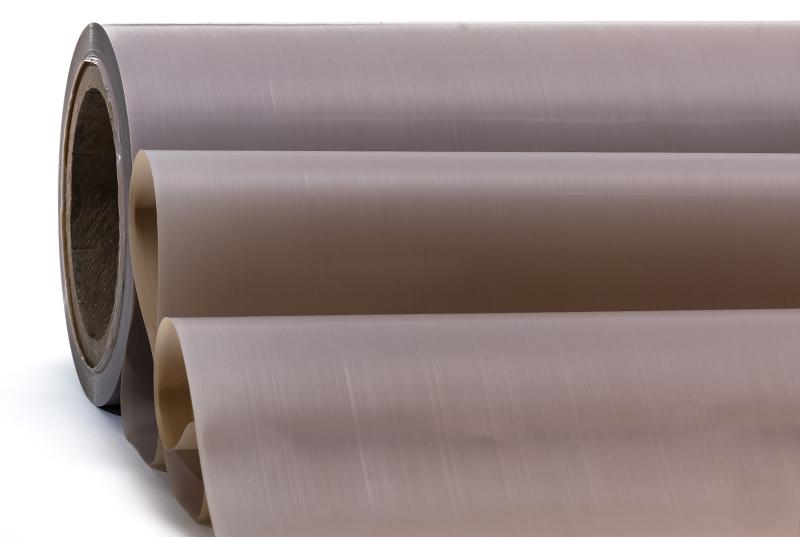
Our skived virgin PTFE films deliver exceptionally high fluoropolymer purity for minimal extractables and robust solvent resistance, helping protect drug stability more reliably than standard alternatives. Precision skiving, consistent thickness control, and excellent thermoformability enable defect‑free forming and ease of assembly.
Why should we use PTFE‑laminated septa instead of standard rubber septa?
Standard rubber can interact with pharmaceutical media, release extractables, or degrade with aggressive solvents. Laminating rubber with virgin PTFE creates an ultra‑clean, impermeable, and chemically inert barrier that protects sensitive formulations, supporting higher purity and more stable long‑term performance.
What specific performance benefits does PTFE bring to our septa system?
PTFE provides a non‑reactive barrier that prevents chemical interaction with the drug, maintains excellent pierceability, resists aggressive solvents and biologics, and significantly improves cleanliness and longevity, particularly valuable in high‑frequency vial access environments.
Will PTFE laminations affect pierceability for septa applications?
No. The PTFE‑to‑rubber multilayer is designed to retain pierceability while adding a clean, impermeable barrier. It supports consistent, reliable access and protects against interaction‑related contamination.
How does Saint‑Gobain ensure the cleanliness and purity of its PTFE‑laminated septa films?
Our skived virgin PTFE films offer very high fluoropolymer purity, ultra‑smooth surfaces, and extremely low particle generation. When laminated to the elastomer, the multilayer construction forms a highly reliable contamination barrier that meets stringent pharmaceutical and diagnostic requirements.
Why are Saint‑Gobain products considered the industry standard for these particular applications?
Exceptional polymer purity and surface quality yield minimal extractables and strong chemical resistance. Our best‑in‑class etching makes the film bondable for strong adhesion to rubber, while precision skiving ensures consistent thickness and defect‑free surfaces, resulting in robust, clean, and durable septa.
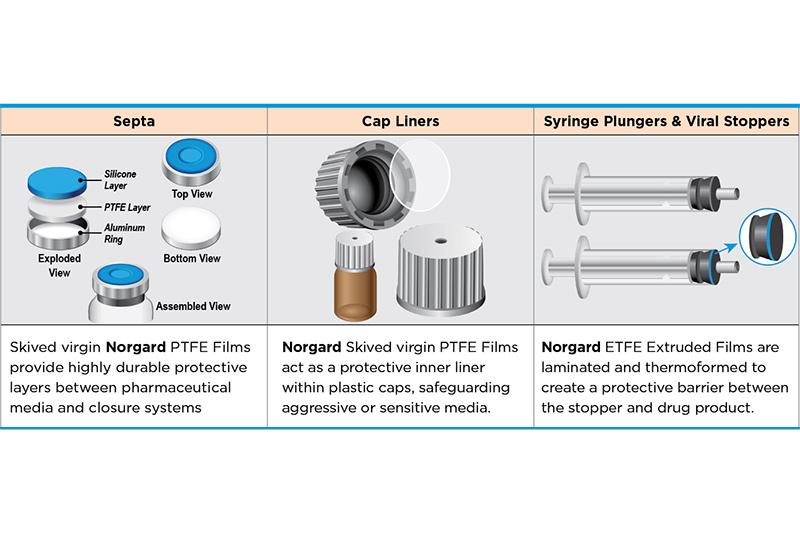
In critical drug delivery and container closure systems, the interface is everything. By introducing inert, ultra‑clean fluoropolymer barriers exactly where the drug meets the component, Norgard PTFE for cap liners and septa and Norgard ETFE for syringe plungers, manufacturers can reduce extractables and particulates, maintain seal integrity, and support long‑term stability for sensitive formulations.
These films are engineered to perform through sterilization, high‑speed automation, and extended storage while aligning with global regulatory expectations and quality requirements.
And when PFAS‑free* materials are needed, the Tape Solutions team is ready with the know-how to offer co‑development support to help meet both technical and sustainability goals.
The result is a cleaner, safer, and more reliable path from fill-finish to patient, backed by a partner with the materials expertise and manufacturing depth to deliver at scale.
Connect with our team to learn more!
Our PFAS-free* designation means we do not intentionally add PFAS to our formulations during the manufacturing of the product. However, due to certain factors, trace amounts may be present as unintended impurities in the raw materials that we receive from our suppliers. The asterisk (*) reflects our commitment to transparency and scientific integrity, rather than making absolute claims that cannot be guaranteed or verified.