
PTFE vs. UHMW: A Complete Guide to Material Performance, Wear Resistance, and Industrial Applications
The first quarter of any new year is a time for reflection and introspection — we often look back to move forward. We examine the past year's challenges, accomplishments, and journey, utilizing lessons learned to develop future-focused strategies.
In the manufacturing industry, careful analysis of market trends is key for managing resource allocation and adapting to changes in consumer preferences. When the major goal is to prevent failure in mission-critical systems, understanding customer requirements for material selection is vital for ensuring long-term efficiency, durability, and reliable performance.
Many markets such as automotive, aerospace, energy, and industrial applications require materials that can withstand some of the toughest conditions — including chemical resistance, impact resistance, abrasion resistance, heat resistance, and more.
One material that is often a go-to for many industries is polytetrafluoroethylene (PTFE). Its advanced properties — including high strength, excellent wear resistance, chemical inertness, dielectric stability, and exceptional temperature and heat resistance — continue to propel the PTFE market forward.
However, there are also many use cases where consumers seek alternatives. One such alternative is ultra-high molecular weight polyethylene (UHMW or UHMWPE). In many applications, UHMW offers comparable benefits such as excellent abrasion resistance, impact strength, and a low coefficient of friction, making it attractive where PTFE may not be necessary. UHMW sheet materials are particularly valued for their toughness and versatility across a wide range of industrial applications.
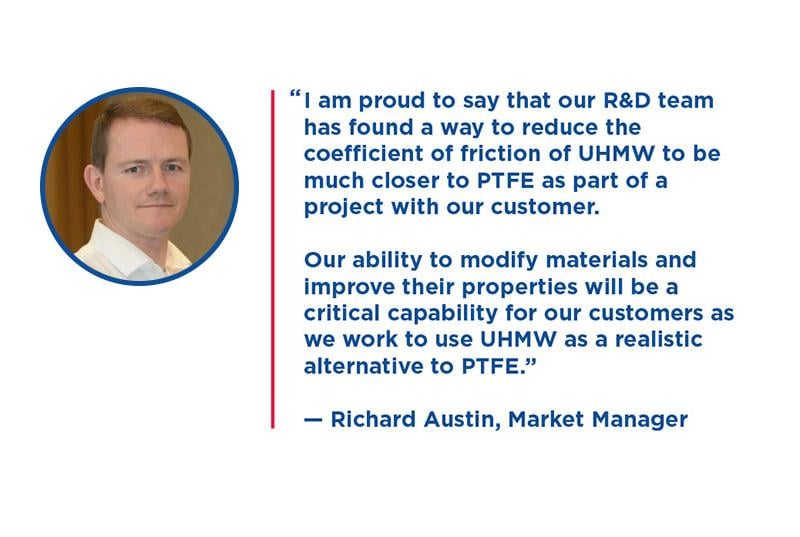
With growing interest in PTFE and alternatives, we connected with Richard Austin, Global Market Manager for Saint-Gobain® Tape Solutions, to review key differences between these materials. Our discussion helped us narrow in on use cases in the automotive market and better understand the pros and cons of each.
It is no doubt that PTFE reigns supreme in environments where temperature stability and chemical resistance are crucial. Due to its ability to operate in extreme environments as well as its resistance to acids and caustics, PTFE is a preferred material in applications like vessel linings, pump interiors, gaskets, seals, and as coatings for engine parts, gears, bearings, and so much more! For these reasons, it will undoubtedly remain a top choice in a multitude of different industries. From 2025–2032, it is projected that PTFE will grow at a CAGR (Compound Annual Growth Rate) of 5.1.
However, even with its high-performance advantages, PTFE might not always be the best option. Specific applications, especially those that involve continuous contact, friction, or wear, may yield better results from alternatives such as UHMW. UHMW is often sought out as a viable alternative because it can often outwear and outperform PTFE in tough mechanical applications. According to market predictions, UHMW will have a projected growth of 9.5 CAGR by 2029.
Some of this growth can be attributed to the environmental advantages of UHMW such as non-toxic properties, recyclability, and lower environmental impact during production.
Both PTFE and UHMW are highly specialized polymers that excel in distinct areas due to their unique properties. The choice between one or the other is often dependent on specific application requirements.
Let’s take a deeper dive.
Understanding PTFE
PTFE is best known for its superior performance in harsh chemical environments, making it a better option for applications that have exposure to chemicals, acids or solvents. PTFE is the material of choice in use-cases such as lining chemical tanks or pipes that handle corrosive acids because it can maintain its performance, even when continuously exposed to harsh chemicals.
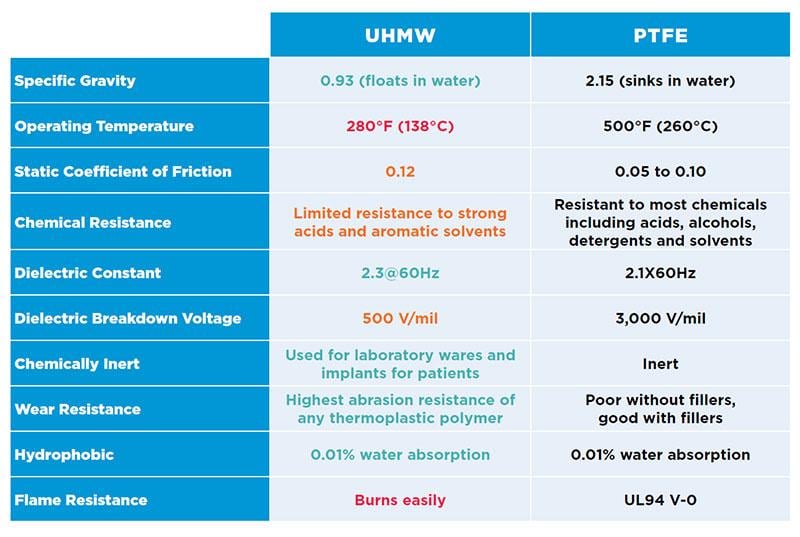
Often coupled with a silicone adhesive system, PTFE allows for greater thermal resistance and high-temperature performance. It has shown the ability to withstand temperatures of about 260°C (500°F), making it ideal for many industrial applications such as electrical, chemical or automotive, which may experience temperatures that exceed 80–100°C (176–212°F).
Due to its extremely low friction coefficient (non-stick property), PTFE is also a great choice for applications that require smooth motion such as within seals, bearings and gaskets. Its high tensile strength can also aid in improving industrial production efficiencies, especially in applications like wire and cable insulation as well as electrical insulation.
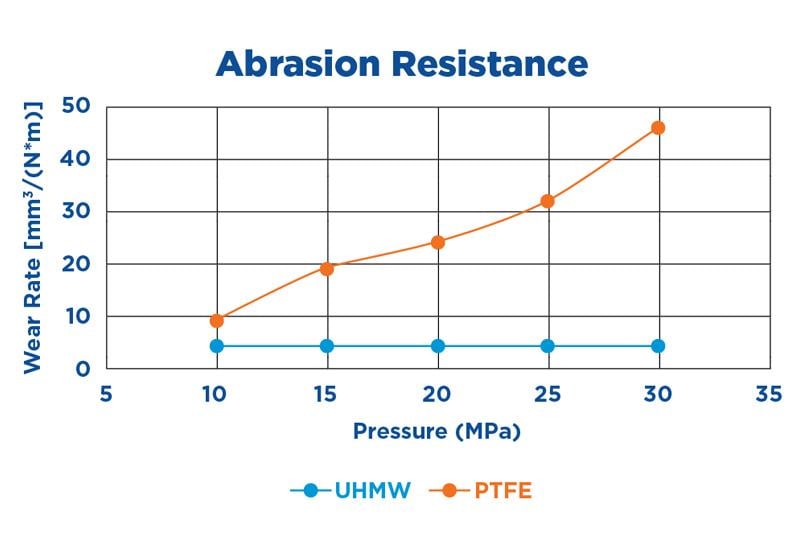
Where PTFE excels in chemical resistance and temperature tolerances, its performance, when it comes to wear resistance, can be surpassed by alternative materials such as UHMW.
Understanding UHMW
UHMW (Ultra High Molecular Weight Polyethylene), otherwise abbreviated as UHMWPE or UHMW-PE, is a more cost-effective solution in applications that require higher abrasion resistance, toughness, and impact strength. It is often combined with acrylic adhesive, which not only offers excellent aging properties, but also has lower CO2 emissions than silicone. Less prone to cracking or breaking under pressure, UHMW is ideal for environments that require mechanical strength and superior impact resistance. UHMW is an excellent candidate in applications exposed to friction and heavy loads. It can provide the required protection against wear and tear in material handling, conveyor systems, slide and glide applications, robotics materials handling in warehouses, and other similar types of use-cases.
Perhaps one of the bigger advantages is that UHMW is a much more cost-effective solution compared to PTFE. Additionally, UHMW can be made available with UV-cured adhesive, offering a solvent-free option to help reduce the environmental impact of the tape, while maintaining high performance.
For situations requiring both durability and performance under mechanical stress, UHMW is a great choice. It has superior abrasion resistance compared to PTFE and offers the best performance for applications exposed to constant friction such as in chute and guide rail coverings. It is a strong alternative to PTFE in low to moderate-temperature range applications, serving as a versatile solution for industries requiring reliable protection against wear, impact, and chemical exposure.
In the automotive industry, the quest for lightweight, cost-effective, solutions that can improve fuel efficiency, reduce emissions, and improve overall vehicle performance is ongoing.
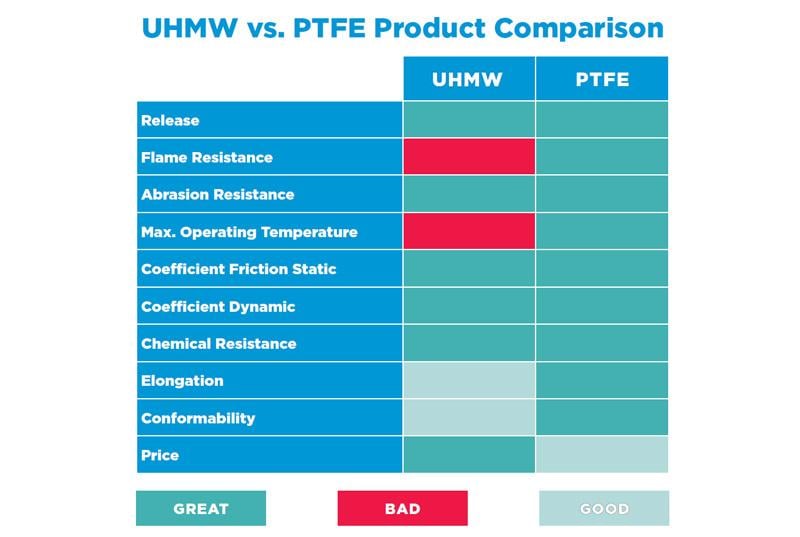
When comparing UHMW to PTFE, we’ve learned that UHMW has many advantages for automotive applications and that, in many cases, it can serve as a viable alternative to PTFE.
A major advantage lies in the price. This is a huge factor for automakers trying to keep vehicle costs low for consumers. Not only is UHMW significantly less expensive than PTFE, it offers comparable advantages in applications that require durability, making it ideal for bearing surfaces where moving parts need to slide smoothly against each other. A low coefficient of friction allows for smooth, quieter movement without the need for additional oils or lubricants.
UHMW is also particularly advantageous for automotive components that experience wear such as liners, guides and bushings. UHMW boasts superior abrasion resistance and endurance. Parts that are protected by it are less prone to wear and tear, reducing the need for frequent replacements.
In applications where every extra gram of weight impacts fuel efficiency and fuel dynamics, UHMW is also a better choice because it has lower density and lower weight than PTFE. Additionally, UHMW has lower CO2 emissions during production and better recyclability than PTFE, making it a strong candidate for helping automakers reduce their environmental impact.
Auto manufacturers are also frequently drawn to the UHMW black version which is UV resistant and aids in safeguarding against static discharge, dust attraction, and can maintain form despite ongoing exposure to sunlight. UHMW products have very low rates of moisture absorption which are ideal for general-purpose applications and protection of components that have exposure to wet or moist environments.
Despite its many advantages, PTFE can still outshine UHMW in high-performance applications requiring chemical resistance and high-temperature stability such as in and around the engine and in seals and bearing in e-motors and drive trains. With excellent electrical insulating properties, PTFE can withstand the higher operating voltages and set of non-negotiable criteria of modern-day e-motors including the ability to withstand demanding environmental conditions, and superior chemical and electrical resistance. Materials such as skived PTFE films provide reliable insulation and can serve as go-to solutions for next-generation e-motors.
While PTFE remains essential for high-temperature applications, UHMW is a strong candidate for many other automotive applications where cost savings, weight reduction, abrasion resistance, and lower CO2 emissions are key considerations.
Evaluating market trends, understanding emerging technologies, tracking customer preferences, and anticipating shifts in demand are key activities for many industries across the globe. Keeping a finger on the pulse aids in product development decisions, helps provide insights into the performance of raw materials, and can play an important role in optimizing supply chains and improving efficiencies. And, at Tape Solutions, monitoring understanding, and staying ahead of market trends is in our DNA.
Our teams take pride in being knowledgeable, fast, and responsive partners for many industries, where quick turnaround and a customized approach are critical.
Whether it’s for UHMW or PTFE products, our in-house capabilities are endless. We are willing to produce quick prototypes, offer die-cutting or co-develop and customize solutions to aid our customers in meeting demanding timelines and the most challenging application requirements. We can customize adhesive types, roll lengths, and widths to ensure customers receive rapid prototypes and can scale up quickly. Our products can be produced with or without liners and can be customized to meet specific color requirements.
Whether it's for automotive, robotics, or industrial applications, connect with our team to help you make the best material selection and ensure your application, process, and output are as seamless and efficient as possible. Our goal is to provide quality solutions for proven performance today and long-standing reliability well into the future.