
EV Innovations & Performance: Why Material Component Choices Matter
The EV market is advancing rapidly, but this does not come without challenges.
Customers are seeking better, more durable and more cost-effective solutions to align with the evolving EV landscape. Automakers worldwide are up for this challenge, continuing to explore new and innovative solutions to make the future of mobility all electric.
We sat down with Richmond Powers, EV Specialist, to talk more about what the Saint-Gobain® Tape Solutions teams are doing to help customers get to the next level in terms of EV innovation and stay at the top of mind in today’s competitive environment.
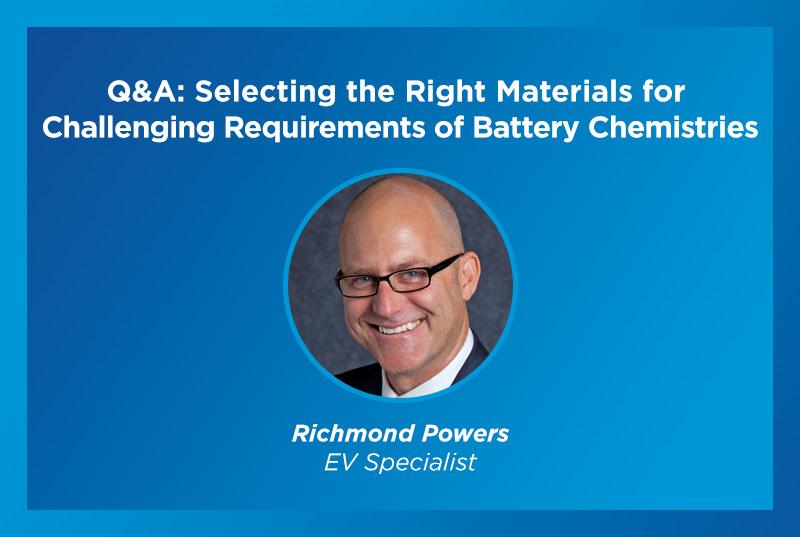
Performance, durability, safety and increased driving range of EVs (electric vehicles) are influenced by the battery chemistry itself, but material component choices in and around the battery cannot be ignored. Could you speak more about this topic?
Not all batteries are the same. We are seeing different battery chemistries being used, depending on EV price, performance requirements and driving range requirements. Most EVs have either lithium-ion NMC (Nickel, Manganese, Cobalt) or lithium-ferrous LFP (Lithium, Iron, Phosphate) chemistries.
NMC batteries have higher performance, higher energy densities, better charging performance and better acceleration than LFP batteries. While NMC lithium-ion battery performance is considered higher, there is also a higher risk for thermal events, which needs to be accounted for in the design stage of the battery pack.
In contrast, LFP batteries are generally safer, have lower costs, run cooler (less chance for thermal runaway), but also have lower performance and lower energy density. However, this is an active space where designers see significant improvements.
What we are seeing right now is that these safer technologies are at odds with energy density technologies and it's our role, together with customers, to help bridge the gap between safety and performance by helping with product innovation and material selection.
What products does Saint-Gobain offer customers whose primary concern is Lithium Battery Thermal Runaway?
What we’ve seen with NMC battery chemistry is that thermal runaway propagation occurs at extremely elevated temperatures that overcome many common material solutions. We’ve specially designed our Norseal® TRP product line to help mitigate these risks. Our TRP1000 is a silicone foam with added mica surface layers that can resist 1000°C. Its technology effectively combines the properties of a compression pad with thermal runaway protection. This means that TRP1000 can deliver great performance during the life of the battery but has the additional benefit for thermal mitigation which rarely happens.
In our TRP product family line, we are constantly looking for new, innovative ways to better target more of these higher-performance, demanding technologies. We're working on new product developments and enhancements to create products that help provide a fire barrier, provide compression and are designed to help withstand high temperatures and provide added thermal runaway protection.
You mentioned compression set value. Why does this matter?
Our battery compression pads adjust to the swelling that occurs in pouch and prismatic cells throughout the battery lifespan. The foam needs to provide an optimal pressure to the cells and provide cushioning support during the charge/discharge cycle.
“Compression set” determines how well a particular material can recover back to its original shape and dimension after being compressed. The advantage of a low compression set is that the material can recover from force and impact, returning to and retaining its original shape over time. If there is poor recovery, air gaps occur which create pressure problems for the cell. Therefore, a springlike characteristic is required to deflect and return energy and diffuse it across a range of compression amounts. This is called compression force deflection (CFD). When exposed to extreme pressure or compression loads, our recommended foam cushioning materials show high resistance and typically maintain effectiveness even beyond the lifespan of the battery pack.
At Saint-Gobain Tape Solutions, our goal is to look ahead. We aim to have close collaboration and partnership with customers to understand their needs and help remove any material shortcomings. We do this by utilizing a variety of test methodologies that help demonstrate how a material will perform based on the required application.
— Richmond Powers
Could you share how Saint-Gobain Tape Solutions can help customers support diverse battery configurations and even foresee potential performance challenges that may occur in the future?
While we focus on meeting OEM (original equipment manufacturers) standards and ASTM (American Society for Testing and Materials) testing standards, sometimes customers require accelerated tests and answers to more complex questions that may not be covered by these common industry test methods.
Our teams are challenged with questions such as what happens when the foam reaches, say, 10,000 compressions? What is the maximum temperature performance of a particular material? What will a foam material do at 1% compression, at 2% or at 500°C and so on and so forth. You get the idea.
To answer these types of questions, our team relies on innovative modeling software, which surpasses standard test methodologies. It allows us to input a wide variety of data, depending on the answers our customers seek, and test it. This helps foresee potential issues/challenges that might not have been accounted for. It allows us to gather great information regarding trends, requirements and capabilities across different applications. It is a value-add for customers interested in co-developing products/solutions. It also provides baseline and next-level information for our R&D teams to continue exploring, testing and innovating.
No matter where you are located or what your newest challenge is, our teams, backed by global resources and capabilities, are ready to partner up and meet the ever-evolving needs of today, tomorrow and beyond. With advanced testing and simulation capabilities, we work, together with our customers, to think ahead and actively pursue innovation and novel solutions with performance and safety top of mind.