

Green Transformers: Advancing Sustainable Power Distribution
The electrical industry is one of the many industries that is playing its part in developing sustainable energy practices. When it comes to the transmission and distribution of electricity and modernization of the power grid, green transformers are effective modern-day solutions. In addition to improving energy efficiency and lowering CO2 emissions, green transformers have improved fire safety, enhanced life cycle and require lower maintenance.
It should come as no surprise that the demand for green power transformers is growing. The market size is projected to increase over 6.5% from 2023–2032. The expansion of renewable energy projects and the increasing need for the reduction of energy losses during power transmission and distribution support this growth.
To ensure both longevity and performance of these green transformers, design engineers need to select materials that can withstand the most challenging applications, have high thermal and mechanical resistance as well as high chemical compatibility.
Safer Energy Distribution and Environmental Superiority
The base-materials within green transformers are derived from bio-based ester oils, which have much better fire retardance. Unlike mineral oil alternatives, ester oils boast a higher fire point (over 300° Celsius vs. 170° Celsius for mineral oil). These fire safety benefits allow for green transformers to run at higher temperatures, which also allows for increased power distribution. Green transformers are specially designed for more energy efficient operations to allow for less power loss. Additionally, there is no need to expand the weight and size of the transformer unit. Ester oil transformers can be smaller and provide the same power output as mineral oil transformers, saving space.
Findings show that ester fluids are better performing and environmentally superior alternatives to mineral oils. Ester fluids are non-toxic and biodegradable. If there is ever an oil spill, these oils will break down quickly and will not pose an environmental risk. This makes spill mitigation, clean-up and recycling procedures easier and less costly.
Using bio-based materials also helps ensure a longer equipment lifecycle. Compared to mineral oils, ester oil is more resistant to oxidation and oxidative generation. Ester oils also have a high water saturation limit. They can dry out moisture content from cellulose paper at a rate 10 times faster than mineral oils, protecting from transformer failure by protecting the cellulose insulation. Esters tolerate more moisture without degrading dielectric properties.
With limited pollution risk, smaller size and greater efficiency, lower maintenance costs, optimized lifecycle and greater safety due to less flammability, green transformers are a solid, more sustainable, alternative to traditional transformers.
Common challenges and how to mitigate them to optimize performance
Saint-Gobain® Tape Solutions has a wide portfolio of adhesive tapes that have proven chemical stability, long-term thermal capability and superior adhesion. Acrylic adhesives have variations within the adhesive formulations which help design engineers achieve better chemical compatibility with transformer oils.
One thing to keep in mind when selecting products for green transformers, specifically, is that ester oils are more aggressive against plastic materials that are exposed to them, making plastics more likely to degrade. When plastic materials degrade, they can contaminate the oil and reduce the electrical insulation capability of the oil. If the electrical insulation capability is degraded enough, the transformer will fail.
Have you ever heard a transformer on a telephone pole blow? It sounds like a loud gunshot or firecracker explosion, and this is the sound of a transformer reaching its failure point.
Filament reinforced tapes with paper backing vs. polyester
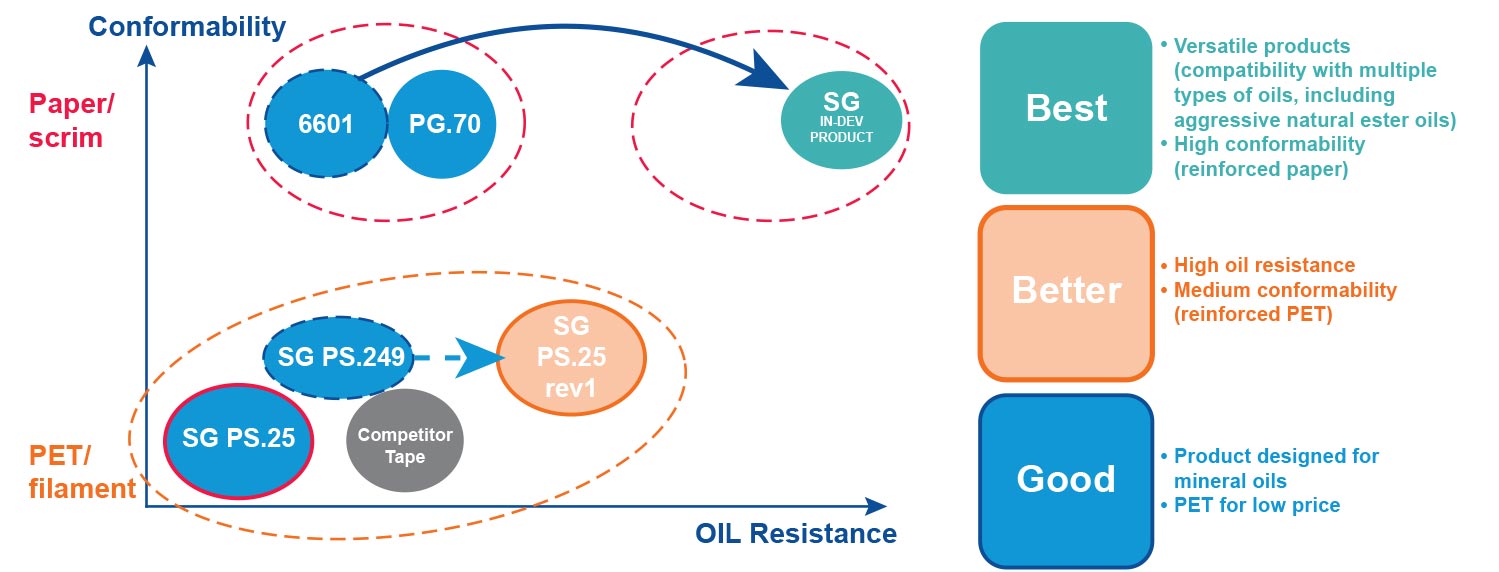
Because ester oils and synthetic oils are more aggressive to plastics than traditional mineral oils, products that are comprised of filament reinforced paper perform better in comparison to products comprised of filament reinforced polyester. Filament reinforced tapes with paper backings including products such as PG.70, 6601 & our newly formulated, in-development, product. These products are the preferred choice when avoiding the possibility of air bubbles in insulation oils is necessary.
Generally, if there is an air bubble in a transformer, it creates corona discharge which can lead to premature failure. Tapes with paper backing allow the oil to completely penetrate and eliminate the chances of air bubbles from forming. While products such as PS.25 and PS.249, which have plastic film (polyester), have generally good performance, they also have a higher likelihood of air bubbles becoming trapped between the tape and electrical wires in green transformer applications. They are better used in traditional mineral transformers, rather than in green transformers where the aggressivity of the oil is higher.
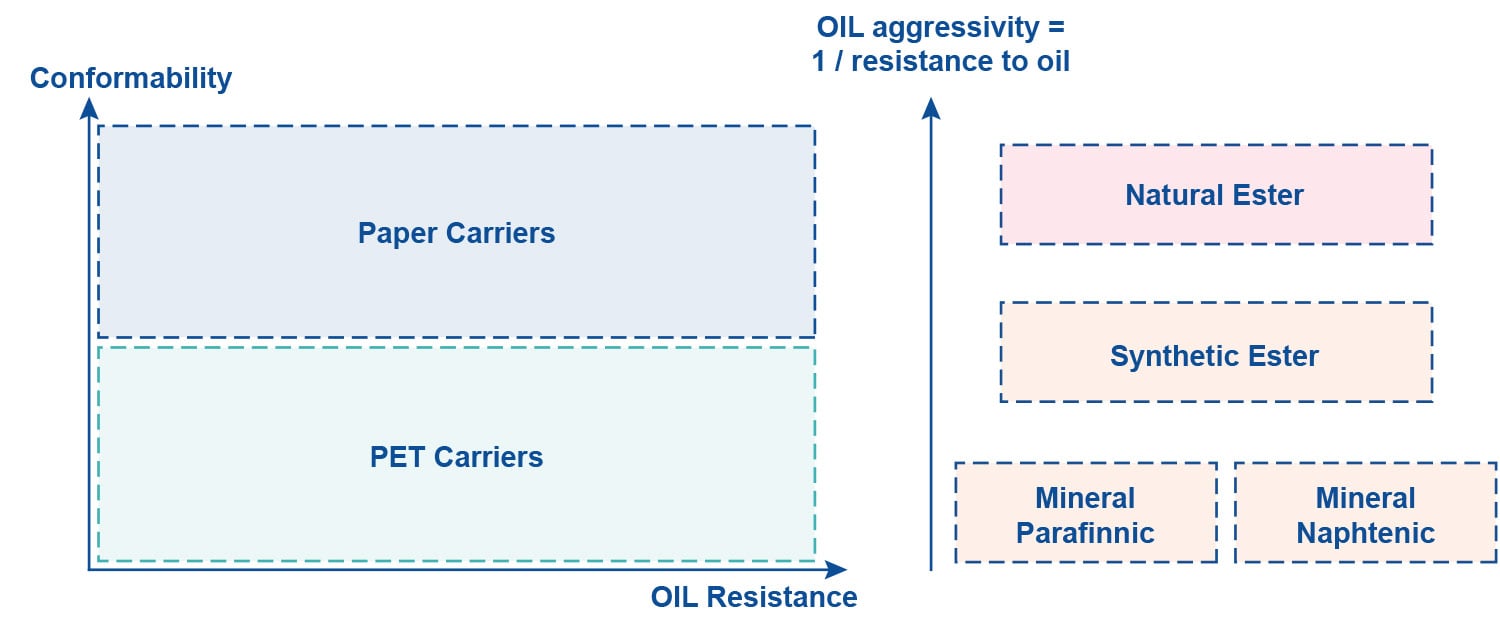
Other considerations when selecting the best product for green transformer applications have to do with oil compatibility and resistance. Customers seek products that will not dissolve in synthetic and natural ester oils because this leads to contamination and premature failure of the oil filled transformers. Products that have better oil compatibility with natural esters can add years of life. However, the challenge we see is that sometimes the polyester filament tape products are superior in terms of oil resistance while the paper filament tape products are more conformable and better for prevention of issues such as corona discharge. As a result, our teams developed a new product which will be coming soon to stand up to these challenges.
Product spotlight: new in-development product variation of CHR® 6601
Our new, in-development, product, is specially designed for heavy duty air and oil filled transformer applications, reinforcements as well insulation. This product is made up of a glass fiber reinforced paper backing with acrylic pressure sensitive adhesive. Its superior tensile strength, adhesion and dielectric values make this the premier product for heavy banding and holding applications found in large scale coil winding processes such as transformers, generators and motors.
Acrylic adhesive tape compatibility in ester fluids: a clear winner
There are a variety of tests that can be performed to determine compatibility of adhesive tapes in oil. At Saint-Gobain Tape Solutions, our teams studied the behavior and compatibility of various acrylic adhesive tapes after immersion in ester oils such as Cargill FR3, Natural Ester A, Synthetic Ester A and Natural Ester B.
Two common tests include the swelling test and the peel adhesion test. Below is a synopsis of each test and the results:
- Swelling Test: The purpose of this test is to analyze the adhesive behavior after it is soaked in the above listed ester oils. In this test tapes are cut into strips of 25mm or 10 mm in width and dipped into a jar filled with oil, allowing each tested adhesive tape to be completely saturated with each oil type. The jars are closed to prevent the entry of new oxygen. These tapes are then put in an oven for 24 hours at 100°C to undergo aging. Specimens are extracted afterwards for visual inspection, and consistency testing.
The results of this test demonstrated that Cargill FR3 and other natural ester oils were much less aggressive to the different adhesives in comparison to synthetic oils. However, this newest in-development product, demonstrated great resistance in all fluids without showing visible damage or swell.
- Peel Adhesion: This is a quantitative 180ᵒ peel adhesion test of the tape from an aluminium substrate before and after oil exposure. The preparation and aging of the samples are the same as for the swelling test, however, the adhesive tape strips are applied to a metallic surface before immersion in the oils. The tapes are then peeled at constant speed and the resulting force is measured with a dynamometer.
In this test, the performance of CHR 6602 demonstrated superiority. It demonstrated increased performance which was likely because efficient heat transmission of the fluids did not affect the adhesive chemistry.
Understanding interaction of tapes drives to enhance longevity
Understanding the interaction of adhesive tapes with oil is vital when designing and manufacturing green transformers. Adhesive tapes must demonstrate strong adhesive interactions with bio-based ester oils as well as high tensile strength and absorption capabilities to ensure optimal electrical performance, ensure energy conservation and minimize risk of transformer failure. With advancements in technologies and growing effort to find safer and more sustainable solutions, bio-based transformers may be a key for limiting pollution, minimizing fire risk, and creating safer options that support the needs of the future. Enhanced performance, less maintenance and greater longevity of green transformers make them a financially viable and environmentally responsible solution for the transmission and distribution of electricity.


