
What are the 3 Main Components of a Foam Bonding Tape
There are numerous advantages to utilization of bonding tapes over mechanical fasteners or liquid adhesives. Compared to fasteners, they are easier to apply, eliminate the need to drill holes and require less labor and cost. And, compared to liquid adhesives, application is cleaner, there is no need for mixing or additional cleanup and they provide little waste to dispose of, all while having a generally longer shelf life.
We’ve talked with Evan Kenyon, Product Manager and Chris Dickens, Global Market Manager, Mobility, to explore the three principle components of a bonding tape: liner, foam core and adhesive.
Let’s explore each component and its benefits more closely.
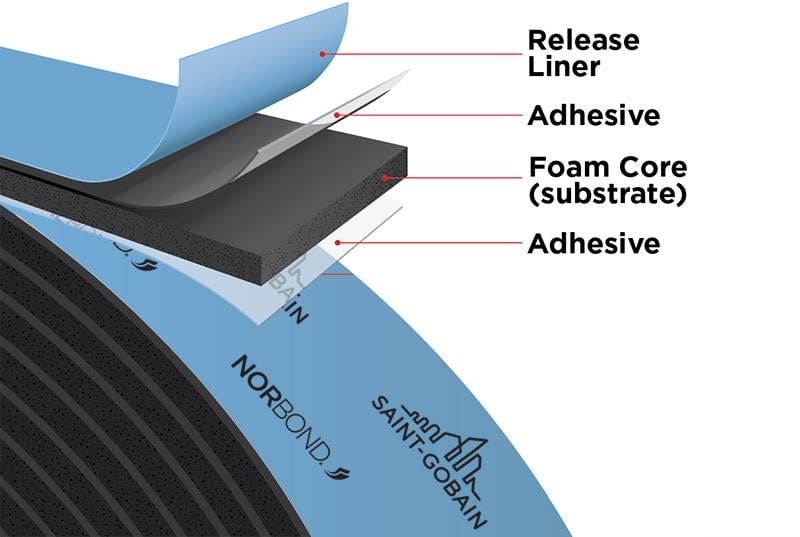
Liners are typically comprised of paper, polyester, polyethylene or polypropylene. The choice of liner type is dependent on factors such as the type of adhesive, required application and manufacturing process. Liners are the protective layer that covers the adhesive side of the bonding tape. They can be thought of as the tape’s armor, protecting it from dust, dirt, moisture or other contaminants.
Liners are specially engineered for easy release from adhesive formulations. This allows for more convenient handling of the tape by workers, allowing them to align and position the tape accurately before having to peel off the liner and reveal the adhesive side and allow for the bond to be formed.
Liners such as those comprised of polyethylene and polypropylene can come in low to medium densities. These density variations can be beneficial to specific application needs. For example, liners with low density are favored for applications wherein a part needs to be bent around a corner due to the fact that lower density also means more flexibility and greater release.
When referencing a bonding tape, rather than talking about a specific adhesive type, we generally talk about its base foam core material — for example acrylic, polyethylene or polyurethane. The choice of material is dependent on the surfaces being joined, the needed bonding strength, or the environmental conditions the bond would need to withstand. In general, the foam core can be thought of as the backbone of the bonding tape as it provides structural support. The foam core allows tapes to absorb shocks, vibrations and thermal expansion, contributing to the overall longevity of the bonded assembly. This is an important quality in automotive, aerospace and electronic industries where materials are often exposed to stresses and strains over time.
When we talk about adhesion, we are talking about the ability to bond to or stick to a substrate. On a bonding tape, the adhesive is comprised of unique properties that allow it to join with other materials. The specific application requirements generally determine the type of adhesive that is used, such as acrylic, rubber or silicone as each has their own specific properties. Acrylic adhesives, for example, are known for their high-performance characteristics such as temperature stability and excellent UV resistance, making them suitable for both indoor and outdoor applications. A main advantage of adhesive bonding is its ability to evenly distribute stress across the entire bond area. This minimizes the risk of creating localized stress points, which often can happen when traditional mechanical fasteners are used. The result: improved aesthetics and a cleaner appearance.
Bonding tapes are efficient and reliable solutions that stand up to the challenges that traditional methods like screws, bolts and rivets cannot. They are a versatile alternative for offering a strong, durable and aesthetically pleasing way to join materials, eliminating issues such as labor-intensive installation or corrosion. The liner, foam core and adhesive are three key components that work in harmony to enhance the structural integrity, efficiency and aesthetics of the bonding tape.